Key takeaways
- No. Fatty liver cannot pass from person to person. Hepatitis C genotype 3 can put fat in the liver, but only the virus spreads.
- Hepatitis means liver inflammation, while fatty liver is usually a metabolic condition; steatohepatitis or MASH means fat has caused inflammation, not a virus.
- MASLD affected 31.3% of US adults in national scans from January 2017 to March 2020, including 37.1% of adults aged 45 and older.
- A hepatitis virus and fatty liver can occur in the same liver, but only the virus can spread to another person.
Fatty liver disease, in which extra fat collects inside liver cells as weight, blood sugar or drinking rises, is not contagious. No germ causes the fat to collect, so contact with another person cannot pass it on.
Most fatty liver is a metabolic condition, driven by how the body stores fat and handles blood sugar. The fat builds up inside the liver over months and years and often stays there, which places fatty liver among non-communicable conditions rather than infections.
Some of the worry may come from hepatitis, a word that also appears in the name of fatty liver’s inflamed stage.
Why fatty liver is confused with hepatitis
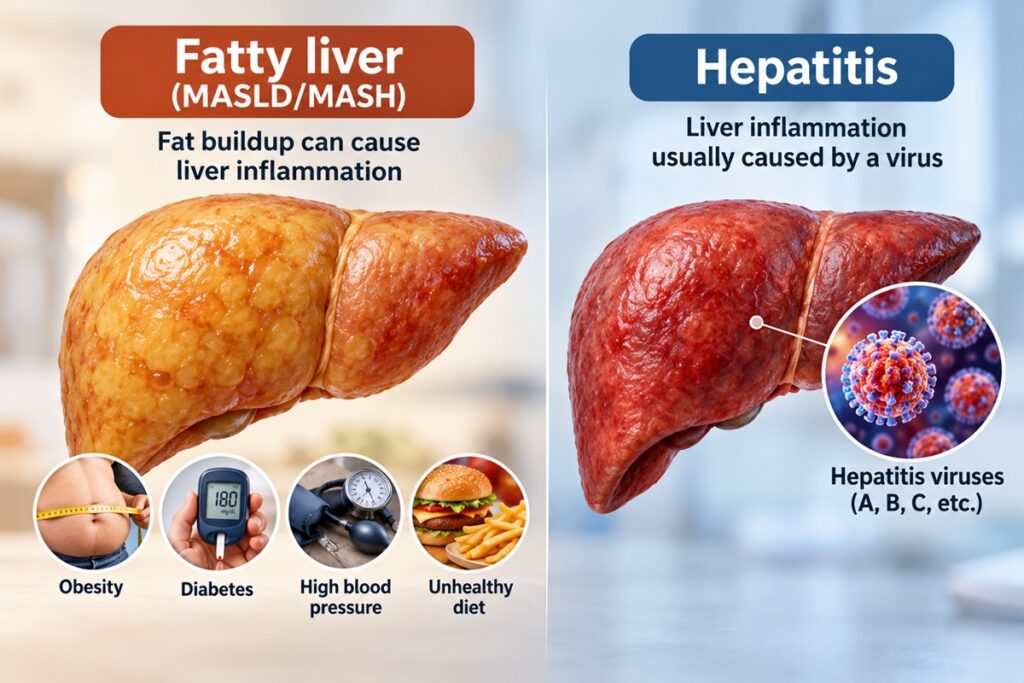
Calling a liver problem hepatitis says only that the liver is inflamed, not what inflamed it. The Centers for Disease Control and Prevention (CDC) names viruses as a frequent cause and lists heavy alcohol use, toxins, some medicines and certain medical conditions as others.
When fat inflames the liver, the stage is called steatohepatitis (inflammation caused by fat), and no virus is involved. A 2023 international consensus replaced the name non-alcoholic fatty liver disease with metabolic dysfunction-associated steatotic liver disease, shortened to MASLD, and named its inflamed stage MASH (metabolic dysfunction-associated steatohepatitis).
Fatty liver caused mainly by heavy drinking, grouped as alcohol-related liver disease, does not spread either.
Fatty liver is common among US adults. A 2024 analysis of national survey scans measured liver fat in adults aged 18 and older from January 2017 to March 2020 and found MASLD in 31.3%. The share was 24.4% in adults under 45 and 37.1% in those aged 45 and older.
How GLP-1 medicines affect fatty liver
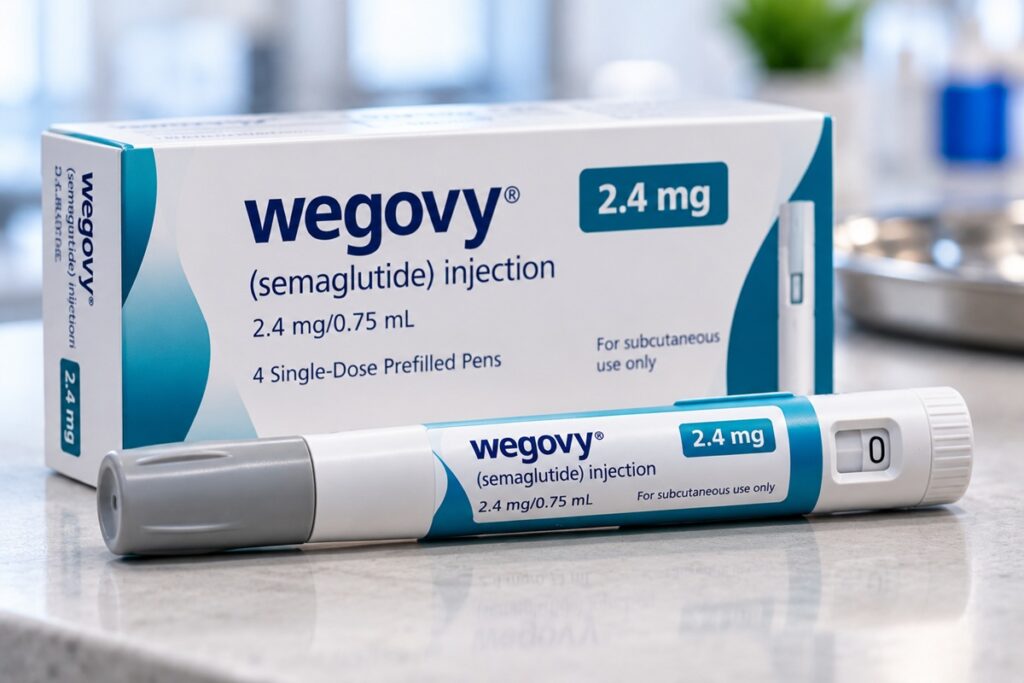
Fat builds up in the liver when people gain weight and their bodies stop responding well to insulin, a problem called insulin resistance. GLP-1 medicines lower weight and blood sugar, so trials have tested whether they also reduce liver fat.
Pooling nine trials, a 2025 analysis found liver fat on MRI scans 4.5 percentage points lower than in comparison groups. A 2021 trial in 67 adults found semaglutide lowered liver fat over 72 weeks but did not significantly change liver stiffness, a scan measure of scarring.
In a 2020 trial in India of 64 adults with type 2 diabetes, dulaglutide cut liver fat 3.5 percentage points more than usual care.
How much of the drop in liver fat comes from weight loss alone is not known. No medicine is approved for the early stage of fatty liver, when fat has built up without inflammation or scarring.
The Wegovy prescribing information limits its August 2025 US accelerated approval to adults with MASH and moderate to advanced scarring without cirrhosis. A longer trial due to finish in 2029 must show whether Wegovy prevents cirrhosis, liver failure, transplants and deaths.
Which types of hepatitis spread from person to person
Five viruses named hepatitis A to E infect the liver, and each one reaches it by its own route. That makes viral hepatitis one of the infectious diseases, unlike fatty liver.
Here is how each one spreads and whether it can last for years:
| Virus | How it spreads | Can it last for years | Vaccine in the United States |
|---|---|---|---|
| Hepatitis A | Swallowed virus from close contact or contaminated food or drink | No, people usually recover fully | Yes |
| Hepatitis B | Blood, semen and other body fluids | Yes, more often after infection in infancy | Yes |
| Hepatitis C | Blood | Yes, most infections persist unless treated | No, cure with 8 to 12 weeks of pills |
| Hepatitis D | Blood and body fluids, only with hepatitis B | Yes, more likely to last when added to existing hepatitis B infection | Hepatitis B vaccine gives protection |
| Hepatitis E | Swallowed virus from stool; most US cases follow travel, and some follow raw or undercooked pork, venison, wild boar or shellfish | Rarely, in people with weak immunity | None in the US |
Hepatitis B spreads when blood, semen or other body fluids from an infected person enter someone else’s body. CDC states that it does not spread through kissing, hugging, sharing utensils, coughing, sneezing, breastfeeding, food or water. Almost all infected adults recover fully, while most infected infants keep the virus.
Hepatitis C spreads when blood from an infected person, even a microscopic amount, enters another person’s body. CDC reports no evidence that it spreads through shared utensils, hugging, kissing, holding hands, coughing, sneezing, food or water.
Most people infected keep the virus unless treated, and 8 to 12 weeks of pills cure more than 95% of those treated. A 2025 estimate by CDC and university researchers put the number of US adults with current hepatitis C in 2017 to 2020 at about 2.5 million. A second model that added people who inject drugs raised the figure to about 4 million.
Fatty liver and viral hepatitis in the same person
Fatty liver and a hepatitis virus can be present in the same liver, and only the virus can pass to another person. A 2006 pooled analysis of 3,068 patients with biopsy-confirmed chronic hepatitis C, from 10 centers in Italy, Switzerland, France, Australia and the US, found liver fat in 50.9%.
Liver fat was more common with hepatitis C genotype 3, more scarring, diabetes, alcohol use, higher body weight and older age.
In genotype 3, one strain of hepatitis C, the virus itself puts fat into liver cells. The evidence comes from two small biopsy studies published in 2000 and 2002, before today’s pill cures. The first, of 101 selected patients, found more fat with genotype 3 and linked the fat to the amount of virus only in that strain.
In the second, biopsies before and after treatment in 62 patients showed fat falling in genotype 3 once the virus was cleared, with no change in weight or alcohol use. The virus in those patients could pass to someone else through blood, but the fat could not.
Hepatitis B shows a different pattern. In people with this virus, liver fat is linked with male sex, older age and metabolic factors. A 2021 pooled analysis of 54 studies covering 28,648 adults with long-term hepatitis B found liver fat in 32.8%.
Liver fat was linked with male sex, diabetes and other metabolic factors, and not clearly with scarring.
Why fatty liver is common in families and households
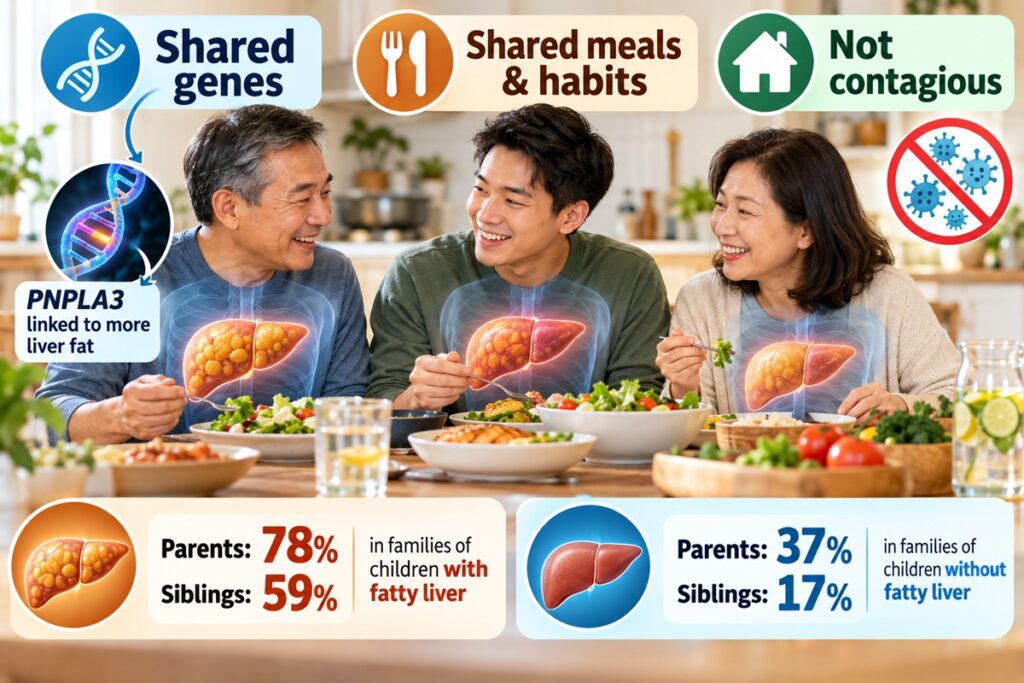
Fatty liver clusters in families because relatives share genes, meals and daily habits, not because it passes between them. A 2009 family study in San Diego used MRI scans to measure liver fat in parents and siblings of overweight children, some with biopsy-proven fatty liver and some without.
Fatty liver was found in 78% of parents and 59% of siblings of the children who had it. In families of the children who did not, the shares were 37% of parents and 17% of siblings.
A twin study in southern California, which scanned 60 pairs of twins between 2012 and 2015, found liver fat closely matched in identical twins but not in nonidentical twins. About half of the variation in liver fat between people in the study was linked to genes. The risk of serious scarring also runs in families.
A small 2017 US study of close relatives of people with cirrhosis caused by fatty liver used MRI-based scans to look for advanced scarring. It found scarring at that level in 17.9% of 39 relatives, compared with 1.4% of 138 people from the community.
One inherited gene variant, PNPLA3, is linked with more fat stored in the liver. A 2008 study in Dallas, which included adults of several ancestries, linked the variant to more liver fat and found it most common in Hispanic participants.
Hispanic adults also had the highest share of MASLD in the national scans from 2017 to 2020, at 38.3%.
Studies of couples are few. A 2018 to 2020 survey of 58,122 married couples aged 65 and older in Shenzhen, China, found fatty liver more often in people whose spouse had it.
Fatty liver is especially common in people with type 2 diabetes, and both conditions are linked to excess weight and insulin resistance. A national scan survey of 825 US adults with type 2 diabetes in 2017 to 2018 found liver fat in 73.8% and readings of advanced scarring in 15.4%.
Two relatives who share daily routines can gain excess weight and develop insulin resistance at the same time. A parent and an adult child who is in their late 30s may eat the same evening meals, spend most of their free time sitting and carry similar extra weight.
If scans later found fat in both livers, each liver would have stored its own fat through those shared habits and genes. Neither person would have passed anything to the other.
How fatty liver changes over the years
Fatty liver lasts for years and can worsen or improve as weight changes. It is managed over time, through weight loss that lasts and, for the inflamed stage with scarring, approved medicines.
Under CDC’s definition of chronic diseases, a condition counts as chronic when it persists for at least 12 months and calls for continuing medical care, restricts everyday activities, or both. The CDC page does not list fatty liver, but the course described below fits that definition.
Liver scarring advances in some people over the years. A 2025 analysis of national scans from 2017 to 2023 found readings in the advanced-scarring range in 8.1% of US adults with MASLD. Those readings came from liver stiffness scans, not biopsies.
In people with fatty liver without advanced scarring, US liver guidance from 2023 names heart and blood vessel disease and cancers outside the liver as the most common causes of death.
Once scarring is advanced, liver disease becomes the leading cause. How far fatty liver itself adds to heart risk is unclear. A 2014 meta-analysis of 33 studies also found about twice the odds of chronic kidney disease in people with fatty liver.
Weight loss can reverse part of the damage. A 2015 study in Havana, Cuba, followed 293 adults with biopsy-proven MASH through a year of lifestyle change and repeated the biopsy in 261. Inflammation cleared in 58% of those who lost at least 5% of their weight.
Among those who lost 10% or more, 90% no longer had inflammation and scarring lessened in 45%. The study ran at one center, and the group that lost the most weight was small.
The 2023 US liver guidance, from the American Association for the Study of Liver Diseases (AASLD), also sets out how much weight loss matters and how rarely it lasts. Losing 3% to 5% of body weight reduces liver fat, the guidance says.
Weight loss of more than 10% is generally needed to improve inflammation and scarring. The guidance also notes that 10% or fewer of patients reach effective weight loss with structured help at one year, and fewer than half of those keep the weight off for five years.
Medicines approved in the US treat only the inflamed stage with scarring, and each is used alongside diet and exercise.
Rezdiffra’s prescribing information limits its 2024 approval to adults with MASH and moderate to advanced scarring without cirrhosis, the same group covered by Wegovy’s 2025 approval. Neither medicine is approved for fatty liver at earlier stages.
Fatty liver is often first found when blood tests or abdominal scans done for another reason show liver fat or raised liver enzymes.
Note: The content on this page is for informational purposes only. It should not be construed as medical advice.
Sources
- Centers for Disease Control and Prevention: Viral hepatitis basics, Hepatitis A basics, Hepatitis B basics, Hepatitis B clinical overview, Hepatitis C basics, Hepatitis D basics, Hepatitis E basics, 2025; About chronic diseases, 2026
- US liver scan surveys: Lee et al., 2024; Kim et al., 2025; Ciardullo et al., 2021
- Names, guidance and kidney disease: Musso et al., 2014; Rinella et al., nomenclature, 2023; AASLD practice guidance, 2023
- GLP-1 trials: Kuchay et al., D-LIFT, 2020; Flint et al., 2021; Mantovani et al., 2025
- US Food and Drug Administration / DailyMed: Wegovy label, Rezdiffra label, 2026; Wegovy approval letter, 2025
- Hepatitis and liver fat: Rubbia-Brandt et al., 2000; Kumar et al., 2002; Leandro et al., 2006; Zheng et al., 2021; Hall et al., 2025
- Families and couples: Romeo et al., 2008; Schwimmer et al., 2009; Loomba et al., 2015; Caussy et al., 2017; Yuan et al., 2023
- Weight loss and repeat biopsies: Vilar-Gomez et al., 2015