Figures published c. 2005 by the World Bank. The Millennium Development Goals program concluded in 2015; this site is preserved as a historical record.
Latin America and the Caribbean
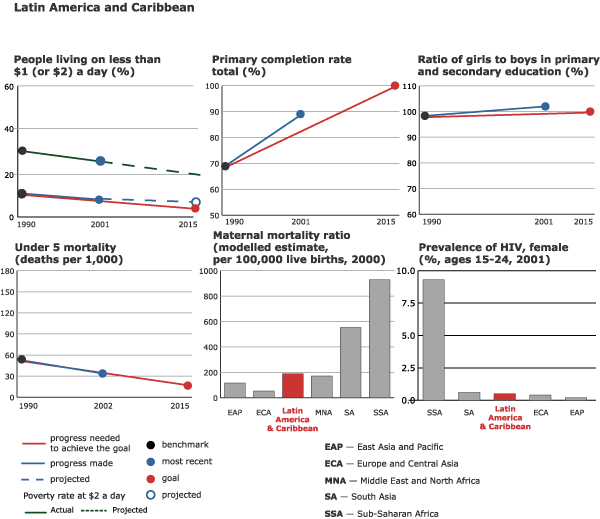
(LAC) region has the highest gross national income (GNI) per capita of all developing country regions. LAC is lagging behind on achieving the poverty goal, but is generally on track to meet the human development MDGs, particularly the child mortality, access to safe water, education, and gender equity in education goals. It has the highest life expectancy at birth, 71 years, is the only developing region where girls have a higher literacy rate than boys, and the only one on track to meet the the child mortality and drinking water MDGs. Yet there remain significant challenges in the broader MDGs agenda. There are still significant disparities in labor market opportunities and women’s empowerment. Child malnutrition remains a problem in the low-income countries and in poorer regions of some middle-income countries. The region's Heads of State have already endorsed elements of an MDG+ agenda in the 2001 Summit of the Americas in Quebec with a more demanding education goal for 2010, incorporating issues of education quality and 75 percent secondary school coverage for youth. The population living under less than $1 a day in the region would fall from 50 million in 2001 to 46 million by 2015, if it can maintain a per capita growth rate of 2.6 percent. But GDP per capita grew by only 1.5 percent a year during the 1990s due in significant part to a succession of external shocks, natural disasters, and domestic crisis since the mid-1990s. This disappointing growth performance and the fact that it is the most unequal region in the world are behind the limited progress in poverty reduction. Inequalities are high both across and within countries. The region includes four very poor HIPC countries (Bolivia, Haiti, Honduras and Nicaragua), and averages for country indicators in middle income countries mask wide disparities in social conditions by income, ethnicity, gender and geographic location. There are reasons for cautious optimism about the region's prospects for achieving the poverty MDG. The restoration of macroeconomic stability throughout much of the region lays the foundation for sustained growth and for reducing vulnerability to the kind of shocks that have seriously eroded poverty reduction gains. LAC continues to attract more private capital, $72 billion in 2001, than any other developing country region (although it mantains low overall rates of savings, 19 per cent of GDP). The region also has the lowest military spending among developing regions (1.3 percent of GDP). Many countries are starting to find ways to tackle inequality, the region's Achilles heel. Finally, the region's notable progress to date on the human development front should contribute to higher productivity and an acceleration of growth and poverty reduction.