Key takeaways
- Heart failure usually develops after coronary artery disease or high blood pressure damages the heart or makes it work harder.
- Worldwide in 2021, ischemic heart disease accounted for 34.5% of heart failure, and hypertensive heart disease accounted for 22.5%.
- Heart failure means the heart cannot pump enough blood or can do so only at abnormally high internal pressure; it is still beating.
- Most cases build over years, while a heart attack, acute inflammation, or a lung clot can cause sudden strain within hours.
Heart failure is a syndrome in which the heart either cannot pump enough blood for the needs of the body or manages only at abnormally high internal pressure. The heart is still beating, but it is not functioning at its best.
The Global Burden of Disease study, a worldwide modeling program, put the number of people living with heart failure at 55.5 million in 2021. That’s up from 25.4 million in 1990, according to a 2025 analysis of GBD 2021.
In the same estimates, ischemic heart disease (reduced blood supply to heart muscle) accounted for 34.5% of heart failure. Hypertensive heart disease (heart disease linked to long-standing high blood pressure) accounted for 22.5%.
In most cases, heart failure develops after another condition, such as coronary artery disease or high blood pressure, damages the heart or makes it work harder. The heart may become too weak to pump blood effectively or have trouble relaxing and filling with blood. Pressure can build up, causing fluid to collect in the lungs, legs, or other parts of the body. Common symptoms include shortness of breath, fatigue, and swelling.
Types and causes of heart failure
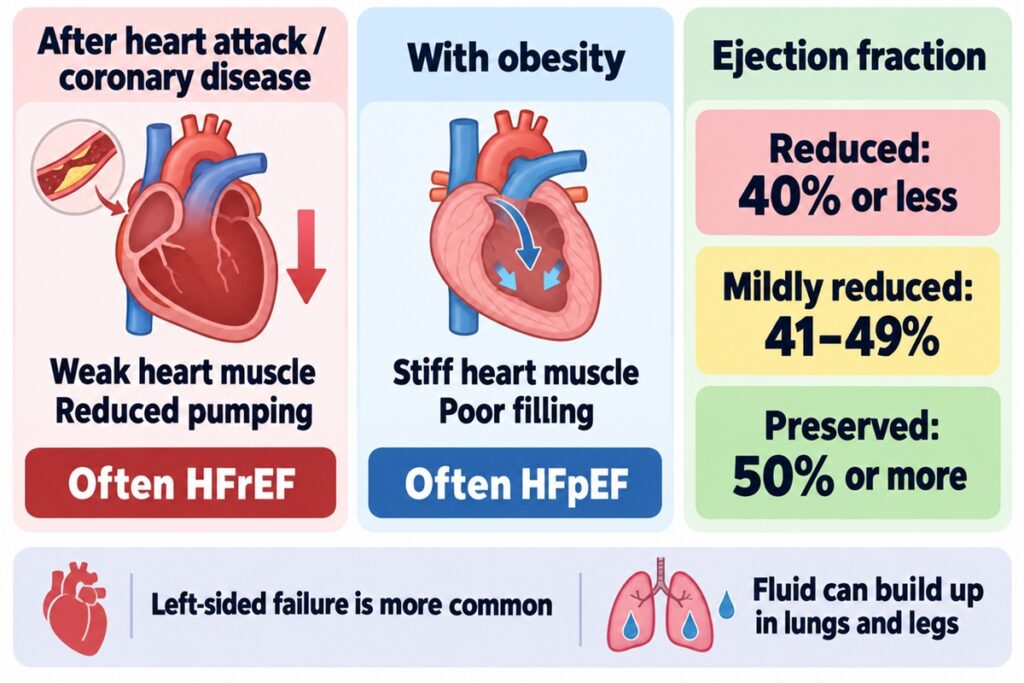
Heart failure following a heart attack or coronary disease typically involves a weakened heart muscle with reduced pumping ability. Obesity is strongly linked to heart failure with preserved ejection fraction, in which the heart pumps out a normal percentage of the blood it contains but may have trouble filling. However, coronary artery disease and obesity can contribute to either type of heart failure.
The 2021 universal definition of heart failure was agreed by heart failure societies in the United States, Europe, and Japan. It sorts cases by ejection fraction (the share of blood the left ventricle pushes out with each beat). Reduced ejection fraction is 40% or less, mildly reduced is 41% to 49%, and preserved is 50% or more.
In the Framingham Heart Study from 1981 to 2008, preserved ejection fraction, defined above 45%, made up 43% of new heart failure. The pooled 2021 cohort analysis found that 32% of cases under 55 and 43% of those 75 and over had preserved ejection fraction. Left-sided failure is more common than right-sided failure and is the main cause of right-sided failure through raised pressure in the lung circulation.
Heart failure, one of the long-term cardiovascular disease conditions, is also called congestive heart failure because fluid gathers in the lungs and legs.
Tirzepatide heart failure: what SUMMIT found
Tirzepatide is not approved to treat heart failure. Mounjaro is approved for blood-sugar control in adults and pediatric patients 10 years and older with type 2 diabetes. It is approved to reduce the risk of major cardiovascular events in adults with type 2 diabetes at high risk. Zepbound is approved for long-term weight reduction in adults with obesity or overweight plus a weight-related condition. It is approved for moderate to severe obstructive sleep apnea in adults with obesity. Neither is approved for heart failure.
In SUMMIT, 731 adults with obesity and heart failure with preserved ejection fraction of at least 50% were randomly assigned to receive up to 15 mg of tirzepatide or placebo weekly. Treatment lasted at least 52 weeks, and median follow-up was 104 weeks. Cardiovascular death or worsening heart failure occurred in 9.9% with tirzepatide and 15.3% with placebo.
The benefit was mainly from fewer worsening heart-failure events: 8.0% versus 14.2%. The trial did not demonstrate a reduction in cardiovascular deaths alone. Tirzepatide improved health-status scores after 52 weeks, but gastrointestinal side effects led more people to stop treatment.
Heart failure risk
In United States cohort studies, most people who developed heart failure already had another heart condition. The figures below measure the traits that raise the chance of that first damage.
| Factor | Measure | Figure | Study and period |
|---|---|---|---|
| Coronary heart disease | Attributable share | 61.6% | NHANES I, US, 1971 to 1992 |
| Smoking | Attributable share | 17.1% | NHANES I, US, 1971 to 1992 |
| High blood pressure | Came before heart failure | 91% of cases | Framingham, US, follow-up from 1970 |
| High blood pressure | Attributable share | 39% in men and 59% in women | Framingham, US, follow-up from 1970 |
| Obesity | Added risk per BMI unit | 5% in men and 7% in women | Framingham, US, published 2002 |
| Obesity at BMI 30 or more | Relative risk | About double | Framingham, US, published 2002 |
| Diabetes | Relative risk | 1.85 | NHANES I, US, 1971 to 1992 |
| Reaching age 40 | Lifetime risk | 21.0% in men, 20.3% in women (about 1 in 5) | Framingham, US, 1971 to 1996 |
| Known risk factors combined | Share of risk explained | 75% under 55, 53% at 75 and over | Pooled Framingham, PREVEND and MESA, published 2021 |
An attributable share is the proportion of cases that would not have occurred without the factor, if the factor is a cause. Because the rows come from different studies and measures, they cannot be added together.
In the He and colleagues 2001 NHANES I report, coronary heart disease had the largest attributable share of the factors in that US study. Hypertension came first in almost all cases in the Levy and colleagues 1996 Framingham report, with a larger attributable share in women than in men. Risk rose with each unit of body mass index in the Kenchaiah and colleagues 2002 Framingham report, and a body mass index of 30 or more carried about twice the risk.
In the Atherosclerosis Risk in Communities (ARIC) study in the United States from 1987 to 2005, having at least one of four risk factors above optimal accounted for 77.1% of heart-failure events. The four were blood pressure, cholesterol, diabetes, and smoking. Only 4.9% of participants had all four at optimal levels.
Lifetime risk stays high even when no heart attack comes first. In Framingham, lifetime risk without a prior heart attack was 1 in 9 for men and 1 in 6 for women, largely attributable to high blood pressure.
Age changes which factors weigh most. Smoking mattered far more in younger adults, with an attributable share of 32% under 55 compared to 1% at age 75 and over in the pooled 2021 analysis. Obesity, hypertension, and diabetes also carried larger attributable shares under 55 than at 75 and over.
Obstructive sleep apnea (repeated breathing pauses in sleep) made men with severe apnea 58% more likely to develop heart failure, with no link in women, in the Sleep Heart Health Study in the United States.
High blood pressure also raises the risk, and so does metabolic syndrome, which is a condition recognized as a cluster of large waist, raised blood pressure, raised blood sugar, and raised blood fats.
Conditions that damage or overwork the heart

A heart attack damages aa portion of the heart muscle. As the damaged area heals, scar tissue may form and reduce the heart’s pumping ability. Larger heart attacks generally cause more damage, although the effects depend on which part of the heart is affected. Long-standing high blood pressure thickens the wall. The thickened chamber is stiff at first and can weaken later.
Valve disease forces extra work with each beat. Endocarditis and rheumatic heart disease (valve damage following streptococcal infection) are among the causes of valve disease. Cardiomyopathy (disease of heart muscle) weakens contraction, and some forms run in families. Myocarditis (inflammation of heart muscle) follows viral infection, including COVID-19, and can leave lasting weakness. Heart defects present from birth make the healthy parts of the heart work harder for years.
Heavy alcohol use and cocaine damage heart muscle directly. Some chemotherapy and chest radiation injure the heart in the same way. Arrhythmia, such as atrial fibrillation, can contribute to heart failure. A persistently fast heart rate may weaken the heart muscle over time. Atrial fibrillation can also reduce the heart’s ability to fill with blood, especially when the heart rate is rapid. . In Framingham from 1981 to 2008, atrial fibrillation and smoking predicted the preserved type, while heart attack, coronary disease, and related vascular disease predicted the reduced type.
Lung disease strains the right side, including chronic obstructive pulmonary disease (COPD) and clots in the lungs. Chronic kidney disease adds extra fluid and raises pressure on the heart. Overactive and underactive thyroid, severe anemia, iron overload, HIV, and diabetes can also contribute.
Chagas disease, a parasitic infection common in parts of Latin America, damages heart muscle years after infection. Rheumatic heart disease and Chagas disease both begin as infections and end as damage to the heart itself.
Causes by age and region
In GBD 2021 estimates, ischemic heart disease accounted for the largest share of people with heart failure worldwide in 2021 and hypertensive heart disease came second, with cardiomyopathies well behind.
| Underlying cause | Share of people with heart failure worldwide, 2021 |
|---|---|
| Ischemic heart disease | 34.5% |
| Hypertensive heart disease | 22.5% |
| Other cardiomyopathies | 7.6% |
| COPD | 6.5% |
| Congenital heart anomalies | 5.7% |
| All other causes combined | 23.1% |
The Global Burden of Disease study models heart failure as a consequence of other diseases and assigns each case to one of 27 underlying causes, so shares are modelled estimates.
The mix of causes changed little from 1990 to 2021. High-income North America had the highest age-standardized rate of heart failure in 2021, 882 per 100,000.
The mix changes sharply with age. Congenital anomalies account for up to 64.4% of heart failure in children under 5. From 15 to 19, other cardiomyopathies and rheumatic heart disease account for 26.2% and 23.9% of heart failure in that age group. From 60, ischemic heart disease accounts for about 40% of heart failure in that age group.
Place changes the mix too. Ischemic heart disease accounts for more than 20% of heart failure in every region except sub-Saharan Africa and reaches 54% of heart failure in Eastern Europe. In sub-Saharan Africa, hypertensive heart disease accounts for about a quarter of heart failure, more than ischemic disease there. In East Asia, hypertensive heart disease accounts for 30.0% of heart failure.
Chagas disease accounted for 3.5% to 9.4% of heart failure in four Latin American regions in Global Burden of Disease 2017 estimates.
Sex also accounts for differences in rates of heart failure. Ischemic heart disease was the top cause in men and hypertensive heart disease in women in Global Burden of Disease 2019 estimates. So, the most common cause depends on where, at what age, and in which year it is measured. In GBD 2017, ischemic and hypertensive heart disease were effectively tied at 26.5% and 26.2%.
Short-term causes and flare-ups
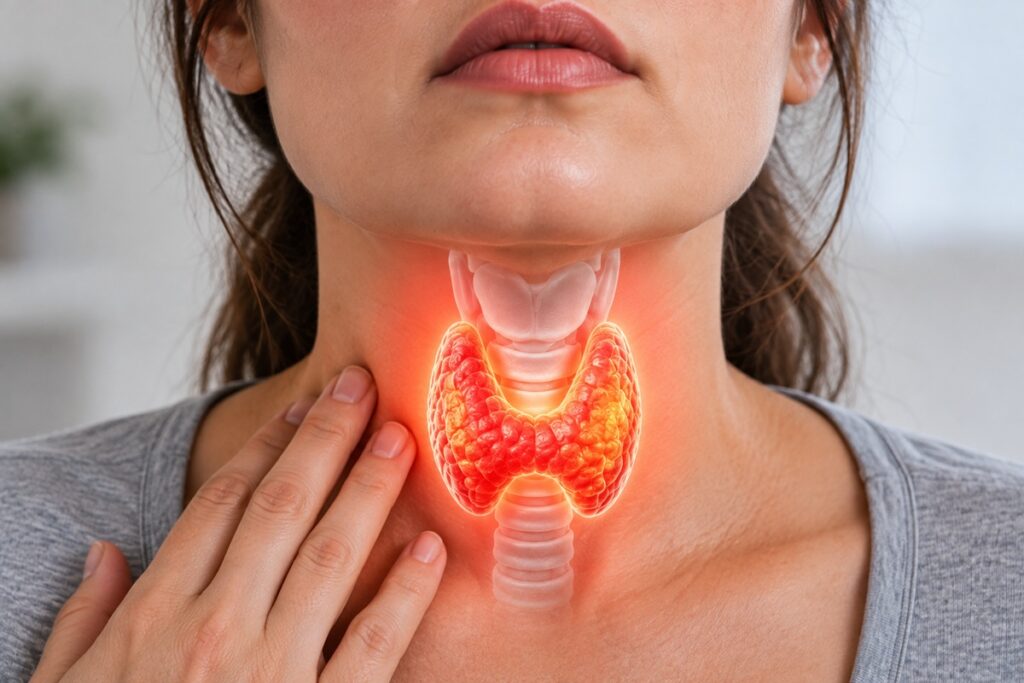
A heart with normal muscle can still fall behind when the body’s demand outruns what it can pump. Severe anemia, an overactive thyroid, or a very fast or irregular rhythm can do this until the underlying problem is treated.
A sudden start differs from the slow build of most cases. A heart attack, acute inflammation, or a clot in the lungs can damage the heart or add sudden strain within hours. Most heart failure instead builds over years of coronary disease, hypertension, diabetes, and obesity.
Events that tip a weakened heart into symptoms were measured in the OPTIMIZE-HF hospital registry, covering 48,612 people admitted to 259 US hospitals in 2003 to 2004. An identified trigger was present in 61.3% of admissions. The most frequent were pneumonia or another respiratory process at 15.3%, reduced blood flow to heart muscle at 14.7%, and arrhythmia at 13.5%.
Missed medicines, poor diet, uncontrolled blood pressure, and worsening kidney function were also recorded.
Death statistics and heart failure
When a death certificate lists another heart condition alongside heart failure, coding rules record that other condition, not heart failure, as the underlying cause of death. The World Health Organization (WHO) sets these coding rules in the International Classification of Diseases, 10th revision (ICD-10).
Its 2019 WHO ICD-10 Volume 2 instruction manual states the rule in one sentence: “Consider other heart conditions as the obvious cause of heart failure.” High blood pressure with heart failure is coded as hypertensive heart disease, I11.0. A certificate linking heart failure to diabetes is coded to diabetes in the same rules. In other words, the condition that caused heart failure also caused death.
The Global Burden of Disease study moves deaths recorded as heart failure back to the disease that caused the heart failure, often ischemic or hypertensive disease. These deaths then enter the wider count of noncommunicable diseases through the underlying cause of death (the disease that started the fatal chain).
The Ahern and colleagues 2011 analysis of global cardiovascular mortality data names heart failure as the most frequent code reassigned in this way, at 3.1% of coded deaths before correction. Across national death data, codes that must be reassigned fell from more than 43% of deaths under ICD-7 to 24% under ICD-10, in a 2010 analysis of national cause-of-death data. Among the living, the study still counts heart failure, which is where the 55.5 million figure for 2021 comes from.
United States figures show the gap between mention and cause. In 2023, heart failure was mentioned on 452,573 death certificates, out of 3,090,964 deaths in National Center for Health Statistics (NCHS) Data Brief 521, or 14.6%. The Centers for Disease Control and Prevention (CDC) page on heart failure describes that share as deaths heart failure was “responsible for,” but the figure counts mentions, not deaths caused.
The same CDC page puts people living with heart failure in the United States at nearly 6.7 million adults aged 20 and over, without survey years.
Earlier rounds gave different totals: 64.3 million in Global Burden of Disease 2017 estimates, 56.2 million in 2019 and 55.5 million in 2021.
Note: Content on this page is for educational purposes only and is not medical advice.
Sources
- Global Burden of Disease study analyses: Ran J et al., Global, regional, and national burden of heart failure and its underlying causes, 1990-2021: results from the global burden of disease study 2021, 2025; Wei S et al., Sex differences in the etiology and burden of heart failure across country income level: analysis of 204 countries and territories 1990-2019, 2023; Bragazzi NL et al., Burden of heart failure and underlying causes in 195 countries and territories from 1990 to 2017, 2021.
- Bozkurt B et al., Universal definition and classification of heart failure: a report of the Heart Failure Society of America, Heart Failure Association of the European Society of Cardiology, Japanese Heart Failure Society and Writing Committee of the Universal Definition of Heart Failure, 2021.
- Framingham Heart Study reports: Levy D et al., The progression from hypertension to congestive heart failure, 1996; Kenchaiah S et al., Obesity and the risk of heart failure, 2002; Lloyd-Jones DM et al., Lifetime risk for developing congestive heart failure: the Framingham Heart Study, 2002; Ho JE et al., Predictors of new-onset heart failure: differences in preserved versus reduced ejection fraction, 2013.
- He J et al., Risk factors for congestive heart failure in US men and women: NHANES I epidemiologic follow-up study, 2001.
- Folsom AR et al., Absolute and attributable risks of heart failure incidence in relation to optimal risk factors, 2009.
- Gottlieb DJ et al., Prospective study of obstructive sleep apnea and incident coronary heart disease and heart failure: the sleep heart health study, 2010.
- Tromp J et al., Age dependent associations of risk factors with heart failure: pooled population based cohort study, 2021.
- Kosiborod MN et al., STEP-HFpEF trials: Semaglutide in Patients with Heart Failure with Preserved Ejection Fraction and Obesity, 2023; Semaglutide in Patients with Obesity-Related Heart Failure and Type 2 Diabetes, 2024.
- Packer M et al., Tirzepatide for Heart Failure with Preserved Ejection Fraction and Obesity, 2025.
- Margulies KB et al., Effects of Liraglutide on Clinical Stability Among Patients With Advanced Heart Failure and Reduced Ejection Fraction: A Randomized Clinical Trial, 2016.
- Jorsal A et al., Effect of liraglutide, a glucagon-like peptide-1 analogue, on left ventricular function in stable chronic heart failure patients with and without diabetes (LIVE), 2017.
- US Food and Drug Administration / DailyMed, prescribing labels: Wegovy, Ozempic, Mounjaro, Zepbound, 2026.
- Fonarow GC et al., Factors identified as precipitating hospital admissions for heart failure and clinical outcomes: findings from OPTIMIZE-HF, 2008.
- World Health Organization, International Statistical Classification of Diseases and Related Health Problems, 10th Revision, Volume 2: Instruction manual, 2019.
- Institute for Health Metrics and Evaluation authors: Naghavi M et al., Algorithms for enhancing public health utility of national causes-of-death data, 2010; Ahern RM et al., Improving the public health utility of global cardiovascular mortality data: the rise of ischemic heart disease, 2011.
- US Centers for Disease Control and Prevention: About Heart Failure, 2024; National Center for Health Statistics, Mortality in the United States, 2023 (NCHS Data Brief 521), 2024.