Key takeaways
- A reading of 115/75 mm Hg is normal under US guidance: normal means below 120 systolic and below 80 diastolic.
- Hypertension starts at 130/80 mm Hg in US guidance, but at 140/90 mm Hg in WHO and European guidance.
- A US diagnosis requires an average of two or more careful readings on two or more occasions.
- A reading above 180 systolic or 120 diastolic needs prompt medical attention; organ damage signs make it a medical emergency.
High blood pressure, or hypertension, is a long-term rise in the force of blood on the artery walls that usually causes no symptoms but raises the risk of stroke, heart attack, and kidney disease.
The World Health Organization (WHO) put the number of adults aged 30 to 79 with hypertension at 1.4 billion in 2024, 33% of that age group, in its hypertension fact sheet.
A blood pressure reading gives two numbers in millimeters of mercury (mm Hg): systolic pressure, the force as the heart contracts, over diastolic pressure, the force as it rests between beats. Pressure rises with the volume of blood the heart pumps and with resistance in narrowed or stiff arteries.
Blood pressure ranges and the threshold for hypertension
US guidance draws the line at 130/80 mm Hg; WHO and European guidance draw it at 140/90 mm Hg.
| System | Hypertension from | Other lines | Readings required |
|---|---|---|---|
| US, 2017 categories kept in 2025 | 130 systolic or 80 diastolic | Normal below 120 and below 80; elevated 120 to 129 and below 80; stage 1 130 to 139 or 80 to 89; stage 2 from 140 or 90; severe above 180 and/or 120** | Average of two or more careful readings on two or more occasions |
| WHO, 2021 | 140 systolic and/or 90 diastolic | None given | Readings on two different days |
| Europe, 2024 | 140/90 in the clinic | Elevated 120/70 to below 140/90; home 135/85; 24-hour average 130/80 | Clinic, home, and 24-hour (ambulatory) readings |
All values in mm Hg. In the US system a reading takes the higher band when its two numbers fall in different bands.
The 2025 US guideline describes the link between pressure and cardiovascular risk as “continuous and graded.” Each threshold is an agreed cut-off on that steadily rising risk.
**Stage 2 hypertension begins at a systolic pressure of 140 mm Hg or a diastolic pressure of 90 mm Hg. A reading above 180 systolic or 120 diastolic requires prompt medical attention. When severely elevated blood pressure is accompanied by signs of organ damage, such as chest pain, severe shortness of breath, or new neurological symptoms, it is a medical emergency.
Worldwide prevalence of hypertension
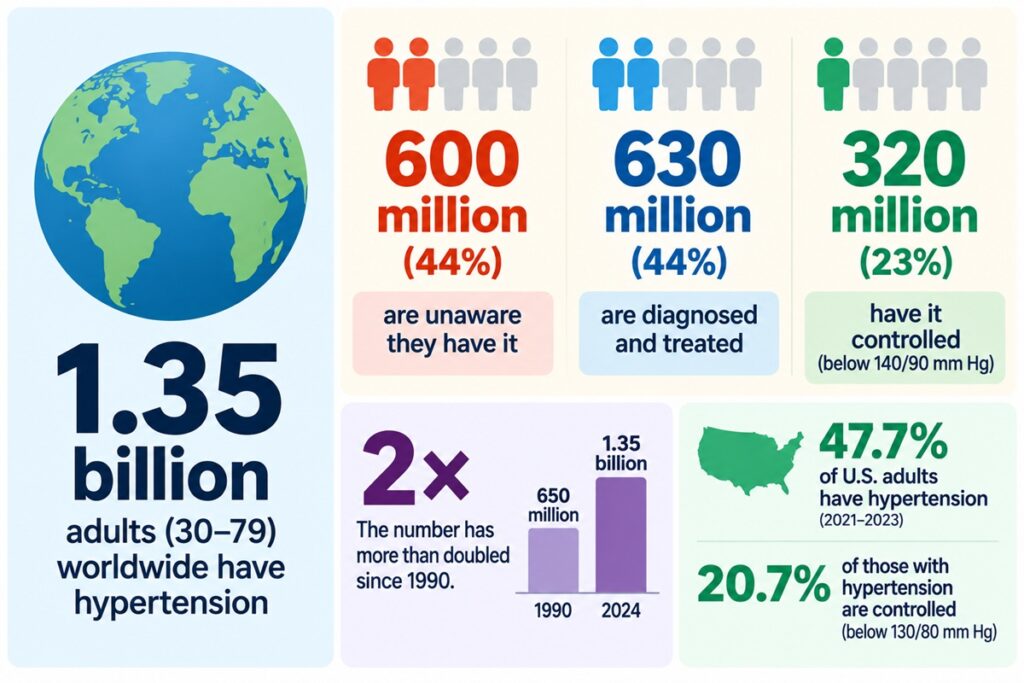
Global estimates for adults aged 30 to 79 with hypertension in 2024 identified 600 million (44%) of them as unaware they even had it, while a remaining 630 million (44%) were diagnosed and treated. Only 320 million (23%, just over 1 in 5) had it controlled below 140/90 mm Hg.
The number has more than doubled since 1990, from 650 million to over a billion, while the age-standardized share with hypertension moved only from 32% to 33%, mainly because there are more older adults.
In the US, a national examination survey for August 2021 to August 2023 found hypertension in 47.7% of adults at the 130/80 mm Hg threshold. Only 20.7% of those with hypertension were controlled below it, in the US survey report for 2021 to 2023.
Tirzepatide blood pressure and hypertension
Tirzepatide (Mounjaro, Zepbound) can lower blood pressure, although it is not approved specifically to treat hypertension. Mounjaro is approved for type 2 diabetes in adults and pediatric patients 10 and older.
Zepbound is approved for long-term weight management in certain adults and for moderate to severe obstructive sleep apnea in adults with obesity.
In a 24-hour blood pressure monitoring substudy of adults with a BMI of at least 27 without diabetes, tirzepatide lowered average systolic blood pressure more than placebo after 36 weeks. The placebo-adjusted reductions were 7.4 mm Hg with 5 mg, 10.6 mm Hg with 10 mg, and 8.0 mm Hg with 15 mg. Daytime and nighttime results were consistent.
The monitoring study included adults whose blood pressure was below 140/90 mm Hg at the start; some were taking stable blood pressure medicines. A mediation analysis indicated that about 70% of the change was explained by weight loss, so weight reduction accounts for much, but not all, of the effect. Tirzepatide is not a replacement for standard blood pressure treatment.
The Zepbound prescribing label reports supportive blood pressure results after 72 weeks in adults with obesity or overweight without type 2 diabetes. Compared with placebo, systolic pressure fell 5.6 mm Hg more with 5 mg, 6.7 mm Hg more with 10 mg, and 6.4 mm Hg more with 15 mg. The label also reports low blood pressure in 1% of people taking 5 or 10 mg and 2% taking 15 mg, compared with 0% with placebo. Ask your doctor how to monitor blood pressure, especially if you take blood pressure medicine or have dizziness.
Primary and secondary hypertension
About 5% to 10% of people with hypertension have an identifiable underlying cause, according to a 2014 review of secondary hypertension. The rest, roughly 9 out of 10, have primary hypertension, which builds slowly from many factors acting together.
European guidance puts the share with a secondary cause at about 10% and notes that systematic screening may find more. Inheritance, the ageing of blood vessels, the kidneys’ handling of salt and water, hormone signals, and daily habits all feed into primary hypertension.
While primary hypertension has no one, single cause, secondary hypertension is caused by a secondary underlying health condition:
- kidney disease, including narrowed kidney arteries
- primary aldosteronism (an adrenal gland making too much aldosterone), found in about 5% to 10% of stage 1 and 11% to 22% of stage 2 hypertension in the 2025 US guideline, depending on the test
- obstructive sleep apnea (repeated blocking of the airway during sleep), one of the most frequent secondary causes
- thyroid and other adrenal disorders
- some medicines, including anti-inflammatory pain relievers, decongestants, and hormonal contraceptives
- cocaine and amphetamines
White-coat hypertension, where readings are high in the clinic but normal at home, and masked hypertension, the reverse, are the reason for separate home and 24-hour thresholds.
Some types of hypertension reflect patterns or specific circumstances. Nocturnal hypertension is high at night. Isolated systolic hypertension becomes more likely as arteries stiffen with age. Isolated diastolic hypertension is more common in younger adults. Resistant hypertension stays high despite several medicines. ICD-11, the current edition of the International Classification of Diseases, files isolated systolic hypertension, code BA00.2, and isolated diastolic hypertension, code BA00.1, as subtypes of essential hypertension, another name for primary hypertension.
Weight, salt, alcohol, and other risk factors
In trials, one change at a time lowered blood pressure by a few mm Hg, and cutting salt or adding potassium lowered it more in people who already had hypertension. People with kidney disease, or who take certain medicines, should talk with a doctor before using potassium supplements or potassium-based salt substitutes.
| Factor | Measured change | Evidence |
|---|---|---|
| Weight | About 1 lower systolic and 0.9 lower diastolic per 2.2 pounds lost | 25 trials, 4,874 adults, 2003 meta-analysis |
| Salt | 4.2 lower systolic and 2.1 lower diastolic for 4.4 g less salt a day; 5.4 and 2.8 in people with hypertension | 34 trials, 3,230 adults, 2013 review |
| Potassium | 3.5 lower systolic and 2.0 lower diastolic with higher intake, in people with hypertension only | Trials, 2013 review |
| Alcohol | No clear fall at two or fewer drinks a day; 5.5 and 4.0 lower when people drinking six or more a day halved intake | 36 trials, 2,865 adults, 2017 review |
Changes in mm Hg, systolic then diastolic. Values are trial averages, not individual responses.
Mean adult sodium intake worldwide was estimated at 4,310 mg a day in 2019. That is more than double WHO’s recommended population limit of under 2,000 mg, or 5 g of salt, in the 2023 global sodium intake report. The same report ties excess sodium to about 1.89 million deaths each year. In the 2013 potassium review, higher intake was also associated with a 24% lower risk of stroke in cohort studies.
In the US survey, the share with hypertension rose with age, affecting 23.4% of adults aged 18–39, 52.5% at 40–59, and 71.6% at 60 and over. It affected 50.8% of men and 44.6% of women. Worldwide in 2024, the age-standardized share with hypertension was 34% of men and 31% of women aged 30–79.
Family history and physical inactivity also raise the risk. Tobacco pushes pressure up for a while after each use. Diabetes and kidney disease both raise blood pressure and are made worse by it. Long-term stress, pregnancy, and air pollution may also increase blood pressure.
WHO’s fact sheet names air pollution as the most significant environmental factor. Blood pressure is also part of metabolic syndrome: a reading of 130/85 mm Hg or above is one of the five measurements used to define it.
Why US and global figures differ
The US headline figure and the global headline figure measure different things, in different age groups, in different ways.
| Feature | US survey, 2021 to 2023 | Global estimate, 2024 |
|---|---|---|
| Threshold for hypertension | 130/80 mm Hg or on medication | 140/90 mm Hg or on medication |
| Ages | 18 and over | 30 to 79 |
| Age adjustment | 47.7% unadjusted; 44.5% age-adjusted to the US 2000 population | 33% age-standardized to a world standard population |
| People on medication | Counted as hypertensive | Counted as hypertensive |
| Controlled, among people with hypertension | Below 130/80 mm Hg: 20.7% | Below 140/90 mm Hg on treatment: 23% |
Because both counts include people on medication, treatment cannot account for the difference, and the published data do not show how much each difference contributes.
The US survey averages up to three readings at a single examination visit. In that survey, 59.2% of adults with hypertension knew of the condition and 51.2% took medication for it.
A clinical diagnosis under both WHO’s definition and the 2025 US definition needs readings on separate occasions, and how much that changes the counts is not known. In England, a clinic reading of 140/90 mm Hg counts only once home readings or a daytime 24-hour monitor also average 135/85 mm Hg or more, under England’s national guidance, updated in 2026.
The global estimates are modeled from 1,201 population studies covering 104 million people, in a pooled analysis of worldwide trends. For 2019 that analysis found 59% of women and 49% of men with hypertension had been diagnosed, while 23% of women and 18% of men had it controlled.
Deaths are also counted in two ways. Deaths recorded with hypertension as the underlying cause are coded I10 to I15 in ICD-10 and BA00 to BA04 in ICD-11. The 2025 global hypertension report attributes 11 million deaths in 2021, 16% of all deaths, to systolic pressure above about 110 to 115 mm Hg, spread across strokes, heart attacks, kidney failure, and other causes. The first is a count of death certificates; the second is a modeled estimate. The two cannot be added together.
Targets for 2025 and 2030
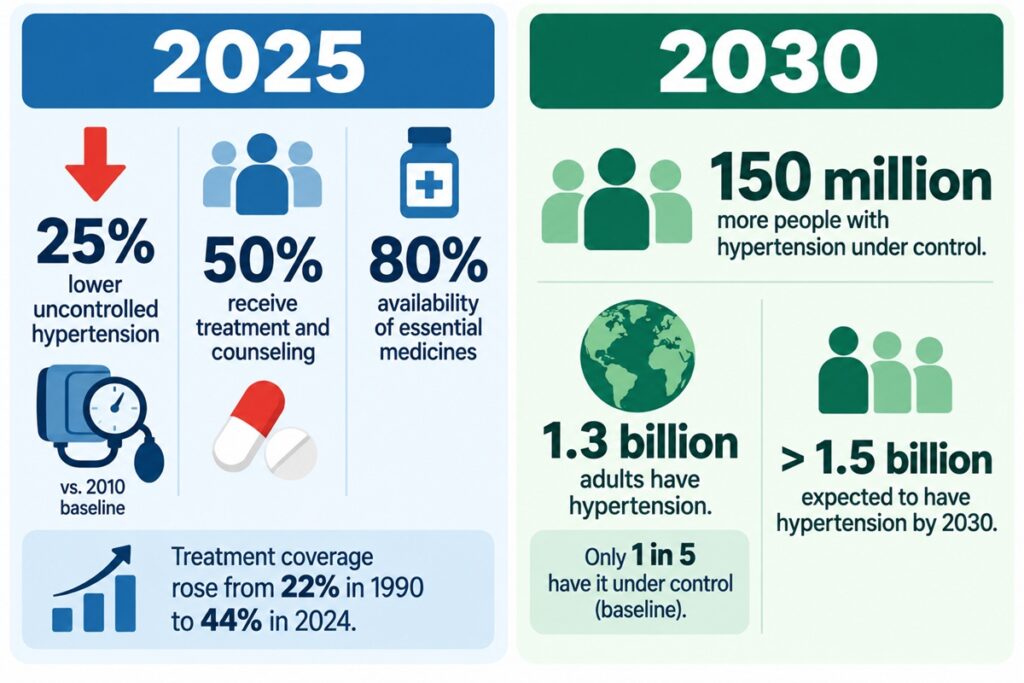
In 2013 the World Health Assembly adopted a voluntary target of “a 25% relative reduction in the prevalence of raised blood pressure,” measured from a 2010 baseline to 2025. Later documents use the term uncontrolled hypertension for the same measure.
Companion targets aimed for 50% of eligible people to receive drug therapy and counseling to prevent heart attacks and strokes, and for 80% availability of basic technologies and essential medicines, by 2025.
Treatment coverage among people with hypertension rose from 22% in 1990 to 44% in 2024. WHO estimates that two-thirds of people with the condition are in low- and middle-income countries and gives no year for that share. In the 2024 estimates only four countries had more than half of people with hypertension under control: Canada, Costa Rica, Iceland, and the Republic of Korea. In 99 countries control was below 20%.
The December 2025 political declaration on noncommunicable diseases in United Nations (UN) resolution 80/117 set a 2030 goal to help 150 million more people get their hypertension under control. It states its own baseline as “1.3 billion adults living with hypertension and only one in five have it under control.”
With the global total projected to pass 1.5 billion by 2030, the goal counts extra people brought under control rather than a fall in the share with hypertension. No Sustainable Development Goal indicator measures blood pressure. Deaths recorded with hypertension as the underlying cause fall inside the heart and vessel group counted by indicator 3.4.1, which covers deaths from four disease groups among people aged 30 to 70.
What long-term high blood pressure does to the body
The risk of death from stroke and heart disease climbs steadily with pressure. The steady climb showed no threshold down to at least 115/75 mm Hg in a 2002 pooled analysis of 61 cohort studies covering one million adults. At ages 40–69, each 20 mm Hg of higher systolic pressure went with more than twice the stroke death rate. Trials of lowering pressure show the reverse.
In a 2016 meta-analysis of 123 trials with 613,815 participants, each 10 mm Hg reduction in systolic pressure lowered the risk of stroke by about 27% and heart failure by 28%. It lowered major cardiovascular events by 20%, coronary heart disease by 17%, and death from any cause by 13%. The effect on kidney failure was not significant.
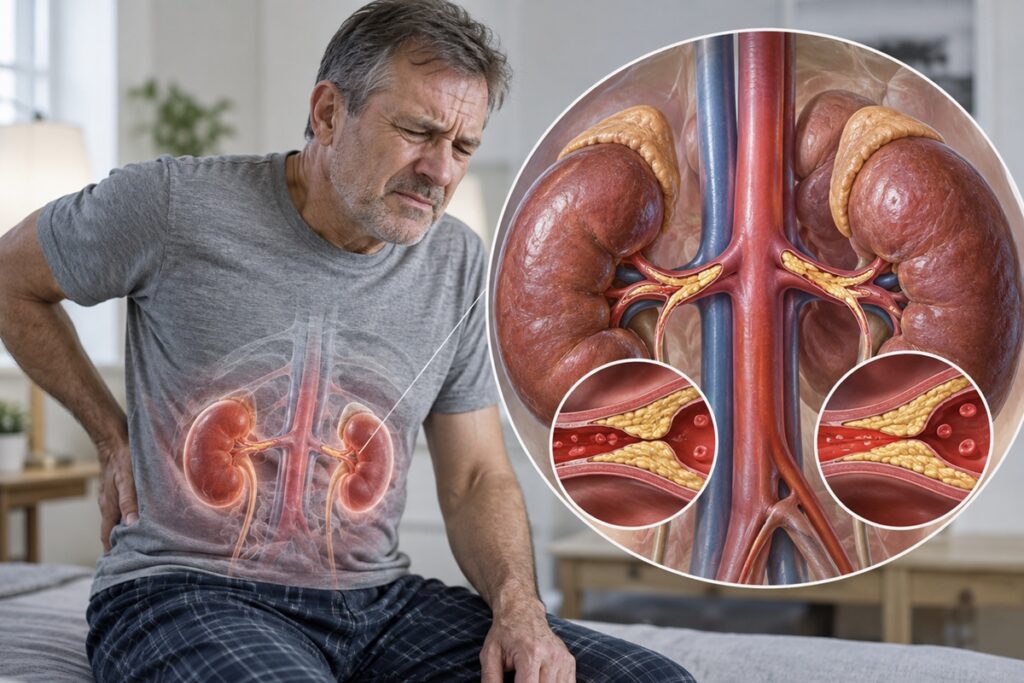
Over time, the extra force damages artery walls, which gather plaque and narrow, and the narrowing pushes pressure higher still. The heart pumps against more resistance, and the wall of its main pumping chamber thickens (left ventricular hypertrophy), which can progress to heart failure. ICD-10 has a single code, I11.0, for hypertensive heart disease with heart failure.
Other consequences include stroke, heart attack, kidney damage, damage to the retina at the back of the eye, aneurysm, and dementia. The 2025 global report names uncontrolled hypertension as a leading risk factor for dementia as well as heart attack, stroke, and chronic kidney disease. It attributes 53% of cardiovascular deaths, 58% of stroke deaths, and 31% of chronic kidney disease deaths in 2021 to high systolic pressure. In a 2023 global ranking of risk factors, high systolic pressure came first, accounting for 8.4% of all healthy years of life lost to illness and early death.
Note: This article is for educational purposes only and is not medical advice.
Sources
- World Health Organization (WHO): hypertension fact sheet and global hypertension report, 2025; sodium intake report, 2023; hypertension treatment guideline, 2021.
- Blood pressure guidelines: 2025 US guideline (AHA/ACC), 2025; 2024 European guideline (ESC), 2024; NICE NG136, 2026.
- Population data: US Data Brief 511 (NCHS), 2024; GBD 2023, 2025; NCD-RisC pooled analysis, 2021.
- Risk and outcome studies: Ettehad et al., 2016; Rimoldi et al., 2014; Lewington et al., 2002.
- Lifestyle trials: Roerecke et al., 2017; He et al. and Aburto et al., 2013; Neter et al., 2003.
- GLP-1 medicine trials: Cochrane review, Spary-Kainz et al., 2026; pooled analysis, Kennedy et al. and SURMOUNT-1 24-hour substudy, 2024.
- US Food and Drug Administration: Wegovy prescribing label and Zepbound prescribing label, 2026.
- Classifications and declarations: ICD-11, 2026; UN resolution 80/117, 2025; SDG indicator 3.4.1 metadata, 2024; ICD-10, 2019.