Key takeaways
- Noncommunicable diseases (NCDs) do not pass from person to person and tend to be long-lasting, with genetic, physiological, environmental, and behavioral causes.
- The four main types counted by SDG indicator 3.4.1 are cardiovascular disease, cancer, chronic respiratory disease, and diabetes.
- SDG target 3.4 seeks to reduce premature NCD mortality by one third by 2030; “premature” means death between exact ages 30 and 70.
- NCDs killed at least 43 million people in 2021, or 75% of non-pandemic-related deaths globally; 18 million deaths occurred before age 70.
A noncommunicable disease is a disease that does not pass from person to person. The World Health Organization describes noncommunicable diseases, or NCDs, as conditions that tend to be of long duration and result from a combination of genetic, physiological, environmental, and behavioral factors.
Heart disease, stroke, cancer, diabetes, and chronic lung disease are some familiar examples, but the category is much wider than that.
NCDs account for most of the world’s deaths. WHO reports NCDs killed at least 43 million people in 2021, equivalent to 75% of non-pandemic-related deaths globally. Eighteen million of those deaths came before the age of 70.
The United Nations Sustainable Development Goals track NCDs through target 3.4 and indicator 3.4.1, covered below. Articles on individual conditions link from the numbered list below.
Note: This page describes population-level indicators and health policy. It is educational reference material, not medical advice. We are not affiliated with the United Nations or the World Health Organization.
What is a noncommunicable disease?
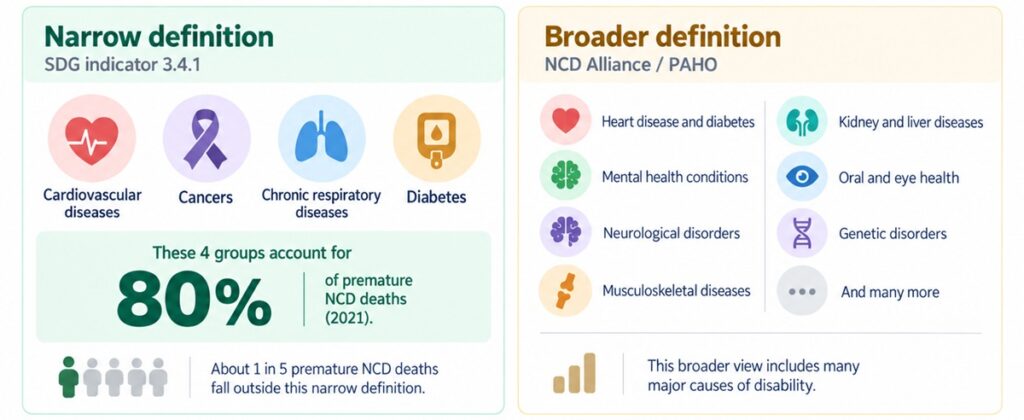
There are two popular definitions of noncommunicable disease.
SDG indicator 3.4.1 identifies four types of noncommunicable disease: cardiovascular diseases, cancers, chronic respiratory diseases, and diabetes. WHO calls these “the main types of NCDs” and reports that they account for 80% of all premature NCD deaths (2021 reference year). About a fifth of premature NCD deaths falls outside the narrow definition. Conditions outside indicator 3.4.1 include mental health, neurological, and kidney conditions.
The NCD Alliance describes NCDs as ranging “from heart disease and diabetes to mental health, neurological, musculoskeletal, kidney and liver diseases, oral and eye health, genetic disorders, and many more.” The Pan American Health Organization (PAHO) explains that these conditions “are not mainly caused by an acute infection, result in long-term health consequences, and often create a need for long-term treatment and care.”
In some cases, the line between communicable and noncommunicable is blurred. For example, cervical and liver cancers follow viral infection, as our page on communicable and noncommunicable disease shows.
How many people have a noncommunicable disease?
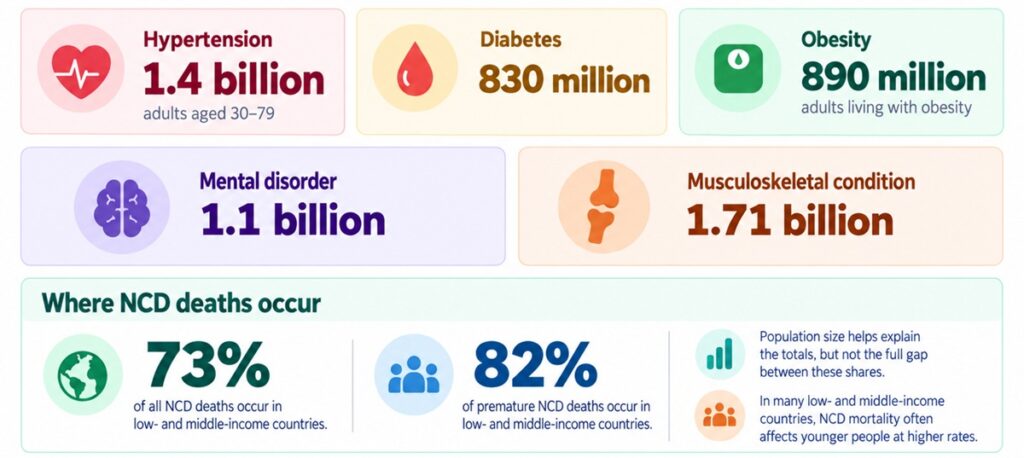
WHO’s fact sheets count 1.4 billion adults aged 30 to 79 with hypertension, 830 million people with diabetes, 890 million adults living with obesity, 1.1 billion people with a mental disorder, and 1.71 billion with a musculoskeletal condition. For where that hypertension count begins, see blood pressure ranges and the threshold for hypertension.
The groups overlap, so the figures cannot be combined to form an accurate picture of disease per capita, but each is a large share of the world’s adults on its own.
Low- and middle-income countries account for 73% of all NCD deaths and 82% of premature NCD deaths. Population size accounts for the totals but leaves the gap between the two shares unexplained. NCD mortality in these countries often affects younger people at higher rates.
How does tirzepatide work?
Tirzepatide (Mounjaro, Zepbound) is a GIP and GLP-1 receptor agonist that increases insulin secretion and reduces glucagon in a glucose-dependent manner. It lowers fasting and after-meal blood sugar, and it reduces food intake and body weight.
Mounjaro is indicated with diet and exercise for blood sugar control in adults and pediatric patients 10 years and older with type 2 diabetes. It is also indicated to reduce the risk of major adverse cardiovascular events in high-risk adults with the disease.
Zepbound is indicated with a reduced-calorie diet and increased physical activity to reduce excess body weight and maintain weight reduction long term in adults with obesity or overweight with at least one weight-related comorbid condition. It is also indicated for moderate to severe obstructive sleep apnea in adults with obesity.
In September 2025, WHO added tirzepatide and three GLP-1 medicines to the Model List of Essential Medicines. They are for adults with type 2 diabetes who have established cardiovascular disease or chronic kidney disease and obesity with a BMI of 30 or above. High prices limit access. Making these treatments available in primary care, especially in underserved areas, is key to expanding access. In the United States, high brand prices lead some patients to compounded tirzepatide, which is not FDA-approved and is sold through online compounding providers.
List of noncommunicable diseases
The first seven groups below share risk factors and often occur in the same person. Figures are from WHO fact sheets unless another otherwise quoted.
1. Cardiovascular disease

Cardiovascular disease covers the heart and blood vessels: coronary heart disease (heart attacks), cerebrovascular disease (stroke), heart failure, rheumatic and congenital heart disease, and peripheral arterial disease. We cover the conditions that lead to heart failure separately.
High blood pressure belongs here as a condition and as a leading cause of heart attack, stroke, and heart failure. CVD killed an estimated 19.8 million people in 2022, 32% of all deaths, 85% of them from heart attack and stroke.
2. Metabolic syndrome
Metabolic syndrome is a cluster of measurements: a large waist plus at least two of raised triglycerides, low HDL cholesterol, blood pressure of 130/85 mmHg or above, and fasting glucose of 100 mg/dL or above, under the International Diabetes Federation definition.
The IDF estimates around one adult in four meets it. It marks the stage where heart disease, type 2 diabetes and fatty liver disease are still risk rather than diagnosis.
3. Type 2 diabetes

In type 2 diabetes the body stops using insulin properly and blood glucose rises. It accounts for more than 95% of the 830 million people with diabetes in 2022, four times the 1990 figure, and more than half of them were taking no medication.
Diabetes directly caused 1.6 million deaths in 2021 plus 530,000 kidney disease deaths. WHO names overweight, insufficient exercise and genetics as contributing factors.
4. Type 1 diabetes
Type 1 diabetes is a different disease with a shared name. The immune system destroys the cells that make insulin, so the person needs insulin daily from diagnosis. Diet and body weight do not cause it.
The IDF Diabetes Atlas estimates 9.5 million people were living with it in 2025, with 174,000 premature deaths in the year, 17% of them because the disease was not diagnosed in time. Type 1 and type 2 are counted together under the SDG indicator.
5. Obesity
Obesity in adults is a body mass index of 30 or above; overweight begins at 25. WHO counted 2.5 billion overweight adults in 2022, of whom 890 million were living with obesity, 16% of the world’s adults. The obesity fact sheet calls it “a chronic, relapsing disease”; the NCD monitoring framework lists it as a metabolic risk factor.
Our double burden of malnutrition page explains why the population figures need a closer look before countries are compared.
6. Nonalcoholic fatty liver disease (NAFLD)
Nonalcoholic fatty liver disease is the build-up of fat in the liver in people who drink little or no alcohol. In 2023 an international consensus of liver societies renamed it metabolic dysfunction-associated steatotic liver disease, MASLD.
A 2023 systematic review in Hepatology covering 9.4 million people put global prevalence at 30% of adults. Most people with it have no symptoms, while a minority progress to cirrhosis and liver cancer. It tracks obesity and type 2 diabetes closely. Unlike viral hepatitis, fatty liver disease is not contagious.
7. Chronic kidney disease

Chronic kidney disease is the gradual loss of kidney function. The Global Burden of Disease study estimated 788 million adults had it in 2023, more than double the 1990 figure, and the ninth leading cause of death, at nearly 1.5 million. Chronic kidney disease is not contagious, but it often runs in families.
Diabetes and high blood pressure are its two main causes, and the GLP-1 listing names it as a qualifying condition. Kidney disease not attributed to diabetes falls outside SDG indicator 3.4.1.
8. Cancers
Cancer is the uncontrolled growth of abnormal cells. WHO reports close to 10 million cancer deaths in 2024, led by lung cancer at 1.86 million, then breast, colorectal and prostate cancer.
Nearly a quarter of cancer deaths are attributed to tobacco, alcohol, high body mass index, low fruit and vegetable intake and physical inactivity. Infections such as HPV and hepatitis B and C cause around 30% of cases in low- and lower-middle-income countries.
9. Chronic respiratory diseases (COPD and asthma)
Chronic obstructive pulmonary disease restricts airflow and includes emphysema and chronic bronchitis. It caused 3.4 million deaths in 2023, 6% of all deaths, and is the third leading cause of death worldwide. Tobacco accounts for over 70% of cases in high-income countries.
Nearly 90% of COPD deaths under 70 occur in low- and middle-income countries, where household air pollution is a major cause too. Asthma affected 363 million people in 2023 and killed 442,000, most in low- and lower-middle-income countries.
10. Mental health and neurological conditions

Mental disorders affect 1.1 billion people, nearly one in seven, with anxiety disorders (359 million) and depression (280 million) the most common.
Neurological conditions include dementia, epilepsy, Parkinson’s disease, and migraine. They sit inside target 3.4, whose second clause is “promote mental health and well-being”, and outside indicator 3.4.1.
11. Musculoskeletal conditions
Musculoskeletal conditions affect the muscles, bones, joints, and connective tissue. WHO estimates 1.71 billion people have one, led by low back pain (570 million) and osteoarthritis (528 million), then fractures, neck pain, rheumatoid arthritis, and osteoporosis.
They are rarely fatal and are the leading contributor to disability worldwide, which a mortality indicator cannot see.
The risk factors NCDs share
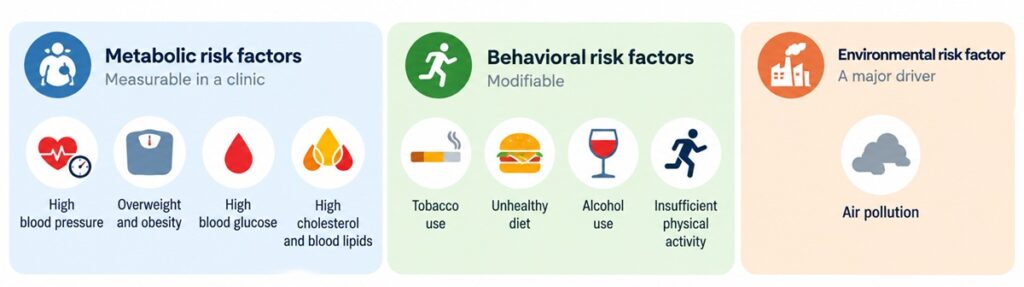
The conditions above are counted together because they share a small set of risk factors, not because they are biologically similar. WHO sorts those factors into three groups, and several of them are conditions on this list in their own right.
Metabolic risk factors are the ones a clinic can measure:
- High blood pressure is the leading metabolic risk factor globally, with 25% of all NCD deaths attributed to it. Of the 1.4 billion adults with hypertension in 2024, fewer than one in four had it under control.
- Overweight and obesity feed type 2 diabetes, cardiovascular disease, fatty liver disease, and several cancers.
- High blood glucose is what a clinic measures; insulin resistance is the mechanism behind it. It defines type 2 diabetes and raises cardiovascular and kidney risk on its own.
- High cholesterol and abnormal blood lipids, meaning raised LDL cholesterol and triglycerides with low HDL, drive the arterial disease behind heart attack and stroke.
Behavioral risk factors are the four WHO calls modifiable:
- Tobacco use, including second-hand smoke, is the leading cause of lung cancer and, in high-income countries, of COPD.
- Unhealthy diet means excess salt, sugar, and fats in WHO’s definition.
- Alcohol use, or in WHO’s wording “harmful use of alcohol,” causes cancer, cardiovascular disease, and liver disease.
- Insufficient physical activity.
WHO attaches a qualifier that is easy to skip: “The social, commercial, and physical environment are key drivers of these behaviours.”
Environmental risk is dominated by air pollution, which accounts for 6.7 million deaths globally, about 5.6 million of them from NCDs.
SDG target 3.4 and what premature means
Target 3.4 reads: “By 2030, reduce by one third premature mortality from noncommunicable diseases through prevention and treatment and promote mental health and well-being.”
The target has two clauses, so it carries two indicators, 3.4.1 and 3.4.2, both with WHO as custodian.
Premature has an exact meaning here: death between the exact ages of 30 and 70. A death at 71 from the same disease is not premature by this measure, and neither is a death at 29.
| Indicator | What it measures | Unit |
| 3.4.1 | Probability of dying between exact ages 30 and 70 from cardiovascular disease, cancer, diabetes, or chronic respiratory disease | Percent |
| 3.4.2 | Suicide deaths in a year divided by the population | Deaths per 100,000 |
Source: UN SDG indicator metadata for 3.4.1 and 3.4.2, last updated 20 December 2024.
How indicator 3.4.1 is calculated
The four main noncommunicable diseases the indicator counts
The indicator works from the underlying cause of death recorded against ranges of codes in the International Classification of Diseases, so a condition outside those ranges is outside the indicator.
| Disease group | ICD-10 codes | Examples | Deaths in 2021 |
| Cardiovascular disease | I00-I99 | Heart attack, stroke | At least 19 million |
| Cancers | C00-C97 | All malignant neoplasms | 10 million |
| Chronic respiratory disease | J30-J98 | COPD, asthma | 4 million |
| Diabetes | E10-E14 | Type 1 and type 2 | Over 2 million |
Note: Deaths from the WHO NCD fact sheet (reference year 2021), diabetes including the kidney disease deaths it caused. ICD ranges from the UN metadata for 3.4.1. Because only the underlying cause of death is used, a death in a person whose diabetes contributed may be recorded under cardiovascular disease.
From death counts to a probability
Despite the word “rate” in its official name, the quantity is a probability, expressed in percent.
WHO calculates it in four steps:
- Take deaths with an underlying cause in the four ICD ranges, from death registration where it is complete and modeled estimates elsewhere.
- Calculate a death rate for the four causes combined in each five-year age group from 30-34 to 65-69.
- Convert each rate into a probability of dying within that age group.
- Chain the eight probabilities together in a life table with all other causes of death removed and express the result as a percentage.
The 2021 global value of 17.8% means a 30-year-old facing 2021 mortality rates at every age would have a 17.8% chance of dying before 70 from one of the four groups, if nothing else could reach them first. It is not the share of deaths from NCDs.
| Year | Both sexes | Male | Female |
| 2000 | 22.5% | 26.8% | 18.3% |
| 2015 | 18.4% | 22.2% | 14.6% |
| 2021 | 17.8% | 20.7% | 14.9% |
Source: WHO Global Health Observatory, indicator NCDMORT3070, retrieved August 2026. The 2021 both-sexes value has an uncertainty interval of 13.5% to 22.9%.
What the indicator does not measure
It misses deaths outside the 30-to-70 band, where most cancer and cardiovascular deaths occur, the NCDs outside the four groups, and illness that does not kill. Sex is the only published disaggregation, and about 70 of WHO’s 194 Member States supply regular high-quality cause-of-death data; the rest is modeled.
Why NCDs were absent from the Millennium Development Goals
None of the eight Millennium Development Goals covered noncommunicable disease: not one goal, target, or indicator. The health goals ran to child mortality, maternal health and communicable disease. MDG 6, “Combat HIV/AIDS, malaria and other diseases,” had three targets, all on communicable disease, and its monitoring weight fell on the HIV/AIDS indicators and tuberculosis.
A country could report progress against every health goal while its NCD mortality rose. That is one of the largest differences between the MDGs and the SDGs.
NCD monitoring predates the SDGs. In 2013 the World Health Assembly passed resolution WHA66.10, endorsing WHO’s Global Action Plan for the Prevention and Control of NCDs 2013-2020 with nine voluntary global targets for 2025 and a monitoring framework of 25 indicators.
Its mortality target is a 25% cut in premature NCD mortality against a 2010 baseline, on the same 30-to-70 quantity later adopted as indicator 3.4.1, and target 7 is to “halt the rise in diabetes and obesity.”
FAQ
What is a noncommunicable disease?
A noncommunicable disease is one that does not pass from person to person. WHO describes NCDs as tending to be of long duration and resulting from genetic, physiological, environmental, and behavioral factors combined. The four main types are cardiovascular disease, cancer, chronic respiratory disease, and diabetes.
What are the four main noncommunicable diseases?
Cardiovascular disease, cancer, chronic respiratory disease, and diabetes are the four main noncommunicable diseases. These are the groups counted by SDG indicator 3.4.1, under ICD-10 ranges I00-I99, C00-C97, J30-J98 and E10-E14. WHO reports they accounted for 80% of premature NCD deaths in 2021.
What does premature mortality mean in SDG 3.4?
Premature mortality is death between the exact ages of 30 and 70. The phrase carries an operational definition here, not a general one. Indicator 3.4.1 counts deaths from the four disease groups inside that band only, so a death at 71 or at 29 from the same disease does not register.
Why do most NCD deaths happen in low- and middle-income countries?
WHO reports that low- and middle-income countries accounted for 73% of all NCD deaths and 82% of premature NCD deaths in 2021. Population size explains much of the total. It does not explain the gap between the two shares, which indicates NCD deaths there occur at younger ages.
Sources
- World Health Organization, Noncommunicable diseases fact sheet, 25 September 2025. Reference year 2021.
- United Nations Statistics Division, SDG indicator metadata for 3.4.1, last updated 20 December 2024.
- United Nations Statistics Division, SDG indicator metadata for 3.4.2, last updated 20 December 2024.
- World Health Organization, Global Health Observatory, indicator NCDMORT3070. Series 2000 to 2021, retrieved September 2026.
- World Health Assembly, resolution WHA66.10 (2013), including Appendix 2, the nine voluntary global targets.
- World Health Organization, NCD Global Monitoring Framework: Indicator Definitions and Specifications, 2014.
- United Nations, Millennium Development Goals.
- Institute for Health Metrics and Evaluation, Global Burden of Disease Study 2021 results, 2024.
- World Health Organization, news release on the 2025 Model List of Essential Medicines, 5 September 2025.
- Note: This page documents indicators published by the agencies named above. It does not produce or maintain the underlying statistics.