Key takeaways
- No. Kidney disease, including CKD, is not contagious or transferable and cannot be caught from another person.
- CDC estimates that 14% of US adults, about 37 million people, had CKD during 2021 to 2023.
- A kidney infection usually starts with a person’s own bowel bacteria moving from the bladder, so it is not caught from someone who has one.
- People with diabetes, high blood pressure, heart disease, or a family history of kidney failure should be checked for kidney disease.
Kidney disease is not contagious. Chronic kidney disease (CKD), in which damaged kidneys filter blood less well and usually lose more function over the years, cannot be caught from another person.
It is a non-communicable disease, and its two leading causes, diabetes and high blood pressure, develop inside the body. A few infections can injure the kidneys, but the kidney damage they leave does not pass from one person to another.
CDC survey estimates updated in March 2026 put the share of US adults with CKD at 14%, about 37 million people, in 2021 to 2023.
What causes chronic kidney disease
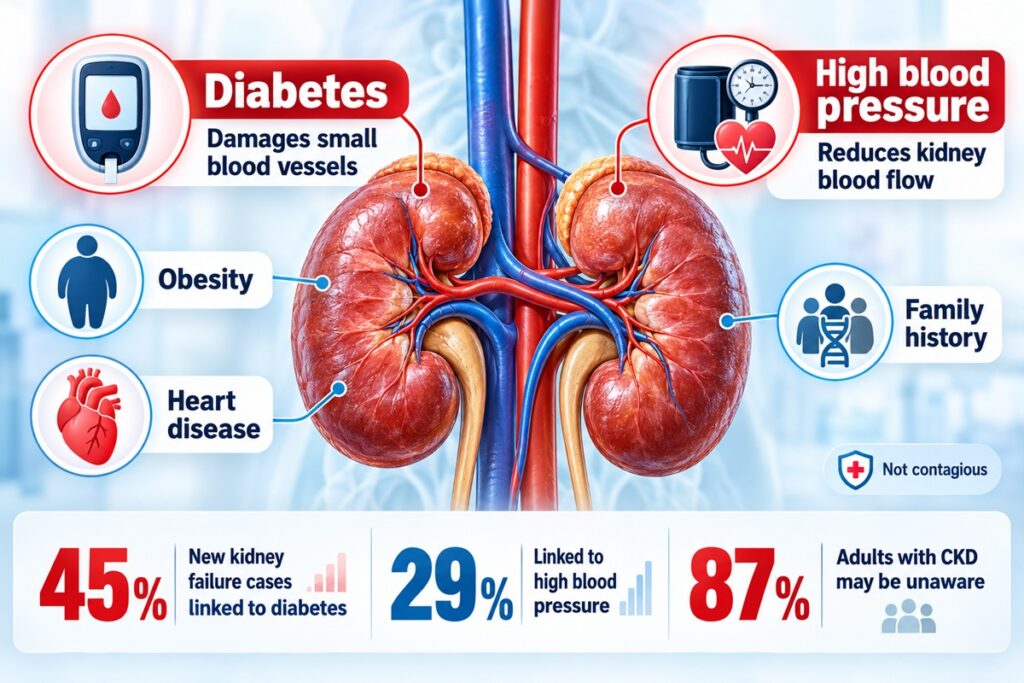
Most kidney damage builds slowly from conditions a person already has. High blood sugar from diabetes harms the small blood vessels and nephrons (the kidneys’ filtering units), so the kidneys filter less well.
High blood pressure narrows and weakens blood vessels over time, which reduces the flow of blood through the kidneys. Obesity and having a close relative with CKD also raise the risk, and so does heart disease.
None of these causes can be caught from another person either: diabetes, hypertension and heart disease do not pass between people.
The same CDC survey shows how often CKD comes with the two main causes. In 2021 to 2023, 38% of US adults with diabetes had CKD, as did 41% of those with type 2 diabetes and 21% of adults with high blood pressure.
About 87% of adults aged 20 or older with CKD did not know they had it. These survey estimates come from single tests, not a diagnosis confirmed over months.
Among people whose kidneys fail, two causes (diabetes and high blood pressure) account for about three in four new cases. The US Renal Data System, the national registry of kidney failure, counted 131,564 new cases of treated kidney failure in 2023. It attributed about 45% of new cases from 2018 to 2023 to diabetes and about 29% to high blood pressure.
Can GLP-1 medicines slow kidney disease?

Diabetes causes more kidney failure than any other condition. One GLP-1 medicine is now approved to slow kidney disease in type 2 diabetes. In January 2025 the FDA approved Ozempic injection (semaglutide) for use in adults with type 2 diabetes and CKD.
The approved use is to lower their risk of kidney failure, a lasting fall in kidney function and death from cardiovascular disease.
The approval is based on FLOW, a trial reported in 2024. It gave 3,533 adults with type 2 diabetes and CKD weekly 1 mg semaglutide injections or a placebo. The combined risk of kidney failure, a 50% fall in kidney function, or death from kidney or cardiovascular causes was 24% lower on semaglutide.
The trial stopped early after a planned interim analysis, with 331 first events on semaglutide against 410 on placebo over a median 3.4 years. Estimated glomerular filtration rate (eGFR), the usual measure of kidney filtering, fell 1.16 mL/min/1.73 m² a year more slowly than on placebo.
No GLP-1 medicine, and neither brand of tirzepatide, is approved for kidney outcomes in CKD without diabetes.
When an infection damages the kidneys
Several infections can harm the kidneys, but none of them turns kidney damage into something another person can catch. With some, the germ passes between people; with others, it comes from the person’s own body.
One of these is a kidney infection, which often starts in the bladder. Bacteria from the person’s own bowel, most often Escherichia coli, move up the urinary tract into one or both kidneys.
Less often, bacteria from elsewhere in the body get into the blood and infect the kidneys. Because the bacteria usually come from the person’s own bowel, a kidney infection is not caught from someone who has one.
The second is post-streptococcal glomerulonephritis (PSGN), an inflammation of the glomeruli, the kidneys’ tiny filters, which can follow strep throat, scarlet fever or impetigo. It comes from the immune system fighting group A strep bacteria, not from bacteria in the kidneys.
It appears about 10 days after strep throat or about three weeks after impetigo, and it is more common in children than in adults. CDC states that people cannot catch PSGN from someone else, although the strep bacteria can spread while a person still carries them.
The next three are viruses carried in blood. Human immunodeficiency virus (HIV), hepatitis B and hepatitis C are communicable diseases spread through blood and some other body fluids. Each can damage the glomeruli, letting protein leak into the urine.
A 2018 review of 40 studies tested whether hepatitis C is linked with later CKD. In the 15 studies that followed people over time, CKD developed at about one and a half times the rate in people with hepatitis C.
With HIV, the risk of kidney disease is higher when the virus is poorly controlled, especially alongside hepatitis C.
The last is sepsis, the body’s extreme reaction to an infection, which can cause sudden kidney failure. A 2005 study followed 29,269 critically ill patients in 54 hospitals across 23 countries to find what caused sudden kidney failure.
Sudden kidney failure occurred in 5.7% of them, and septic shock contributed to 47.5% of those cases. The infection behind sepsis may be one that spreads, but sepsis and the kidney failure that follows it do not.
Side by side, the six infections differ in how the germ travels and in what it does to the kidneys:
| Cause | How the germ spreads | What it can do to the kidneys |
|---|---|---|
| Kidney infection | The person’s own bowel bacteria move up from the bladder, less often through the blood | Infects one or both kidneys, and rarely causes serious problems |
| PSGN after strep throat or impetigo | Group A strep bacteria spread while a person carries them; PSGN itself does not | The immune response inflames the filters |
| Hepatitis B | Blood, semen and certain other body fluids, not hugging, kissing or shared food | Damages the filters, letting protein into the urine |
| Hepatitis C | Blood entering another person’s body, often through shared drug-injecting equipment, not hugging, kissing or shared food | Damages the filters, and is linked with a higher rate of later CKD |
| HIV | Blood, semen, vaginal fluids, rectal fluids and breast milk | Damages the filters, more often when the virus is poorly controlled |
| Sepsis | The infection behind it may spread, but sepsis itself does not | Can cause sudden kidney failure |
Why dialysis centers test patients for hepatitis B

The main infection risk in kidney disease is to the patient. People with CKD catch serious infections more easily, and dialysis centers guard against viruses carried in blood, not against kidney disease.
A 2006 review of US Medicare data compared hospital stays for pneumonia, sepsis and urinary infections in people with and without CKD. It found infection-related problems at three to four times the rate among people with CKD.
Dialysis adds a second risk. Patients are treated in shared rooms, on machines used for one patient after another. CDC recommendations from 2001 for people on long-term hemodialysis call for hepatitis B vaccination of patients and staff who lack immunity. They also call for testing every patient for hepatitis B and C.
Patients without immunity are retested for hepatitis B every month. Anyone carrying hepatitis B should be treated in a separate room, with machines and supplies kept for them alone. The virus survives for at least seven days on surfaces. People with hepatitis C do not have to be separated.
Lapses in these steps have let the virus spread. From April to August 1994, hepatitis B spread in five dialysis centers in California, Nebraska and Texas. Investigators traced it to infected patients who were not identified and separated, to staff and equipment shared between patients, and to patients who had not been vaccinated.
By 1999, new hepatitis B infections among US dialysis patients had fallen to 0.06% of patients. In most outbreaks a virus passed in traces of blood on equipment or hands; no patient caught another patient’s kidney disease.
Inherited kidney diseases and family risk
Kidney disease can run in families through inherited genes and through causes common among relatives, such as diabetes and high blood pressure, but not through infection. The most common inherited form is autosomal dominant polycystic kidney disease (ADPKD), in which fluid-filled cysts grow in the kidneys.
A 2017 US government summary puts it at about one in 400 to one in 1,000 people, usually found between ages 30 and 50. By age 70, more than half of those affected have kidney failure. Each child of a parent with ADPKD has a 50% chance of inheriting the altered gene.
A second inherited risk comes from two high-risk copies of the APOL1 gene, which a 2025 expert report estimated are carried by about 10% to 15% of African Americans. Most people with two copies do not develop kidney disease.
There is no established treatment for the risk, and the evidence is not strong enough to recommend population screening. Family history also matters once CKD has begun.
A 2026 study of 5,623 US adults with CKD tested whether having a parent, brother, sister or child treated for kidney failure predicted faster decline. It did, even after allowing for APOL1.
Testing is advised for anyone with a family history of kidney failure. A person whose parent receives dialysis would usually be offered a blood test to estimate eGFR and a urine test for albumin, a protein. If the parent’s kidney failure was caused by ADPKD, an ultrasound to look for cysts, and possibly genetic testing, would also be discussed.
Anyone with diabetes, high blood pressure or heart disease should also be checked for kidney disease.
Tests, stages and treatment for chronic kidney disease
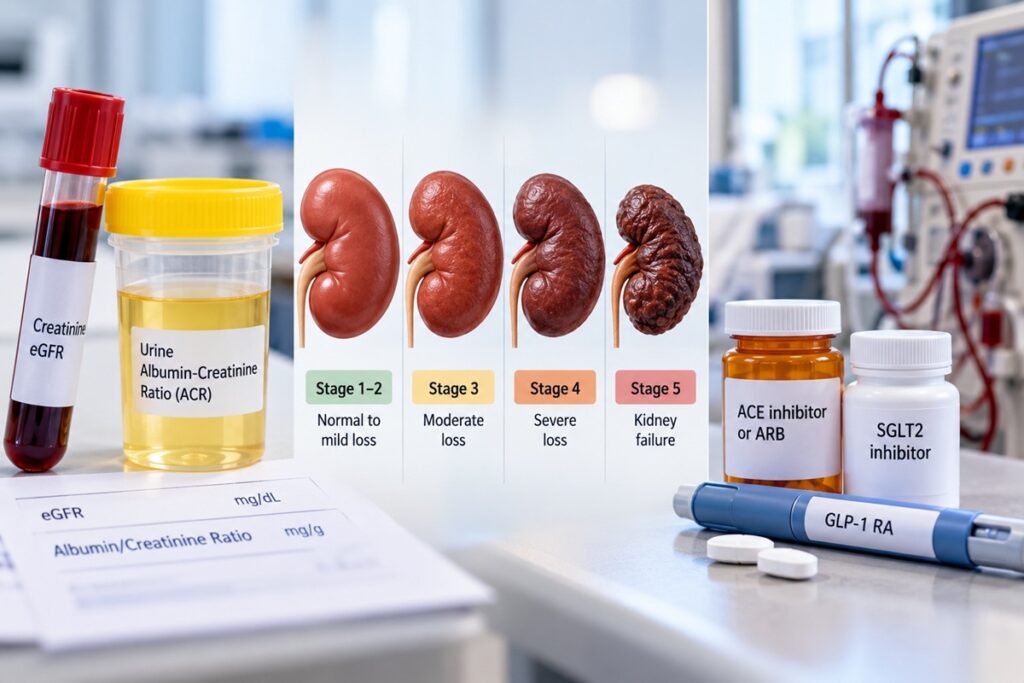
CKD is monitored with tests repeated over the years, and treatment aims to slow the loss of kidney function rather than bring it back. The 2024 international kidney guideline counts damage or reduced function as CKD only once it has lasted more than three months.
A single abnormal reading can come from a sudden, short-term injury instead.
Two tests are used. A blood creatinine test, reported in mg/dL, gives the estimate of eGFR, and a urine albumin-to-creatinine ratio, in mg/g, shows how much albumin is leaking into the urine.
The guideline sorts eGFR, in mL/min/1.73 m², into six ranges: 90 or above, 60 to 89, 45 to 59, 30 to 44, 15 to 29, and under 15. The lowest range marks kidney failure. The guideline also sorts urine albumin into three ranges: under 30, 30 to 300, and over 300 mg/g.
Yearly testing is advised for people with diabetes, and 41% of US adults with type 2 diabetes have CKD.
Treatment focuses on controlling blood pressure and blood sugar. For people with diabetes and raised urine albumin, the guideline recommends an angiotensin-converting enzyme (ACE) inhibitor or an angiotensin receptor blocker.
A second group of medicines, sodium-glucose cotransporter-2 (SGLT2) inhibitors, was tested in DAPA-CKD, a 2020 trial of dapagliflozin or placebo in 4,304 people with CKD.
Dapagliflozin lowered the combined risk of kidney failure, a 50% fall in eGFR, or death from kidney or cardiovascular causes by 39%. People with and without type 2 diabetes benefited to a similar degree.
Kidney function lost to long-standing CKD usually does not come back, so treatment is judged by a slower fall in eGFR. Sudden injury is different: in the 2005 intensive-care study, all but 13.8% of the survivors left the hospital without needing dialysis.
When the kidneys stop working altogether, dialysis or a transplant is needed to survive. The registry counted 831,192 people living with kidney failure in the United States at the end of 2023, with 558,095 on dialysis and 273,097 with a transplant.
Note: This article is for educational purposes and is not medical advice.
Sources
- CDC kidney pages: CKD in the United States, 2026; risk factors, 2024; about chronic kidney disease, 2024; kidney failure fact sheet, 2025
- CDC infection pages: PSGN, 2025; hepatitis B, 2025; hepatitis C, 2025; HIV, 2024; sepsis, 2026; dialysis recommendations, 2001; dialysis outbreaks, 1996
- NIDDK kidney pages: kidney infection, 2024; glomerular diseases, 2022; ADPKD, 2017; tests, 2016; what CKD is, 2025; high blood pressure and kidney disease, 2020
- US Renal Data System: 2025 annual data report, 2025
- Treatment evidence: FLOW, 2024; Ozempic injection label, 2026; Ozempic approval letter, 2025; DAPA-CKD, 2020; KDIGO CKD guideline, 2024
- GLP-1 labels: Wegovy, 2026; Victoza, 2025; Saxenda, 2026; Trulicity, 2026; Zepbound, 2026; Mounjaro, 2026; Rybelsus, 2026
- Inherited kidney disease: PKD genetics, 2014; APOL1 report, 2025; family history study, 2026; Mayo Clinic ADPKD, 2025
- Infection studies: infections in CKD, 2006; hepatitis C and CKD, 2018; sudden kidney failure in intensive care, 2005; BMC Infectious Diseases, 2017; PLOS ONE, 2012
- Cleveland Clinic pages: kidney infection, 2023; chronic kidney disease, 2023; urinary tract infections, 2023
- MedlinePlus: kidney failure, 2025
- World Health Organization: noncommunicable diseases, 2025
- National Kidney Foundation: kidney disease fact sheet, 2024