Key takeaways
- No. Hypothyroidism, including Hashimoto’s disease, is not contagious and cannot spread from one person to another, including through kissing.
- Hashimoto’s is an autoimmune disease: the immune system attacks the thyroid. It runs in families mainly through genes, not infection.
- United States: about one in 10 people aged 12 and older had hypothyroidism in 2009 to 2012; ages 30 to 49, about one in 15.
- Hypothyroidism is diagnosed with blood tests, not symptoms alone. The main tests measure TSH and free T4.
No, hypothyroidism is not contagious. It happens when the thyroid gland does not make enough thyroid hormone for the body’s needs. It does not pass from one person to another, so it is a noncommunicable condition.
About one in 10 people aged 12 and older in the United States had hypothyroidism in 2009 to 2012, according to a 2022 study of national survey data. At ages 30 to 49, the figure was about one in 15.
Hashimoto’s disease is the most common cause. It is an autoimmune disease, which means the immune system attacks the body’s own tissue, in this case the thyroid. Hashimoto’s disease runs in families, mainly through genes.
Why hypothyroidism cannot spread between people
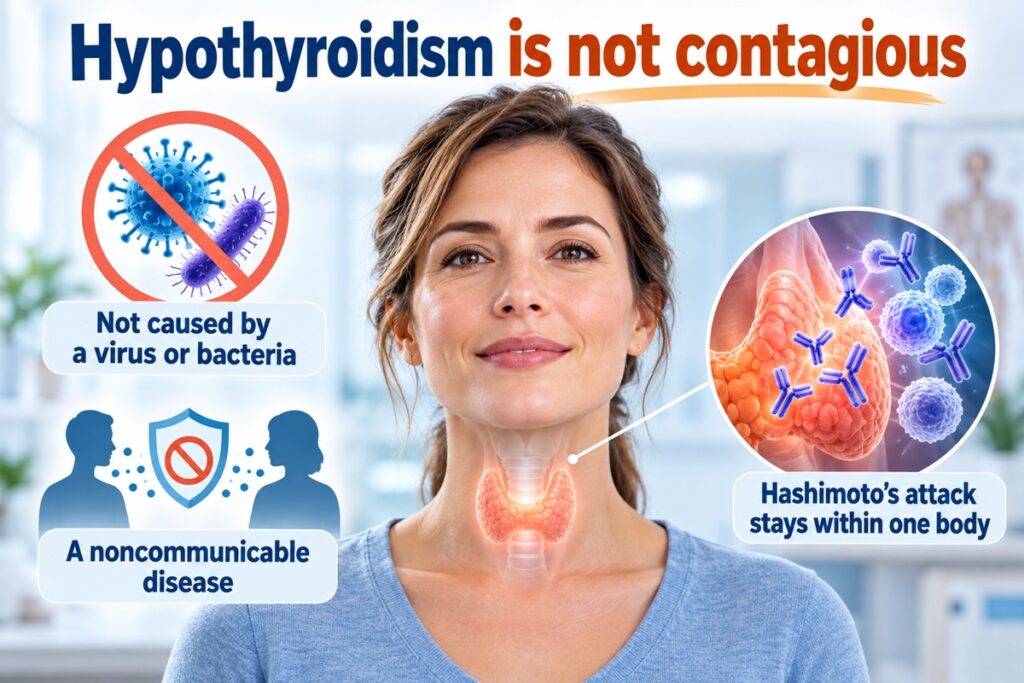
Hypothyroidism cannot spread between people because it is not caused by a germ passing from one person to another. The thyroid makes too little hormone because of damage or a problem inside one person’s body.
A contagious disease is caused by an infectious agent that spreads easily from person to person, according to CDC. A communicable disease is caused by a germ, such as a virus or bacterium, that can pass from one person to another. Hypothyroidism is neither, which makes it one of the noncommunicable diseases.
In Hashimoto’s disease, the immune system makes antibodies that attack the thyroid. White blood cells build up in the gland, and the gland becomes inflamed. This attack stays inside one body and cannot reach another person.
What causes hypothyroidism
Hypothyroidism has several causes. The National Institute of Diabetes and Digestive and Kidney Diseases (NIDDK) lists these causes.
- Hashimoto’s disease. The immune system attacks the thyroid. This is the most common cause.
- Thyroiditis. Inflammation makes stored hormone leak out of the thyroid. The thyroid may then become underactive, and over time this may become permanent.
- Congenital hypothyroidism. Some babies are born with a thyroid that has not developed fully or does not work well.
- Thyroid surgery. Removing the entire thyroid always results in hypothyroidism.
- Radiation treatment. Radioactive iodine gradually destroys thyroid cells.
- Certain medicines. The US label for amiodarone, a heart medicine, reports hypothyroidism in up to one in 10 patients. The lithium label says lithium can lead to hypothyroidism.
- Iodine or pituitary problems. Less often, hypothyroidism comes from too much or too little iodine, or from a disorder of the pituitary gland or hypothalamus. Iodine deficiency is extremely rare in the United States.
Why hypothyroidism runs in families
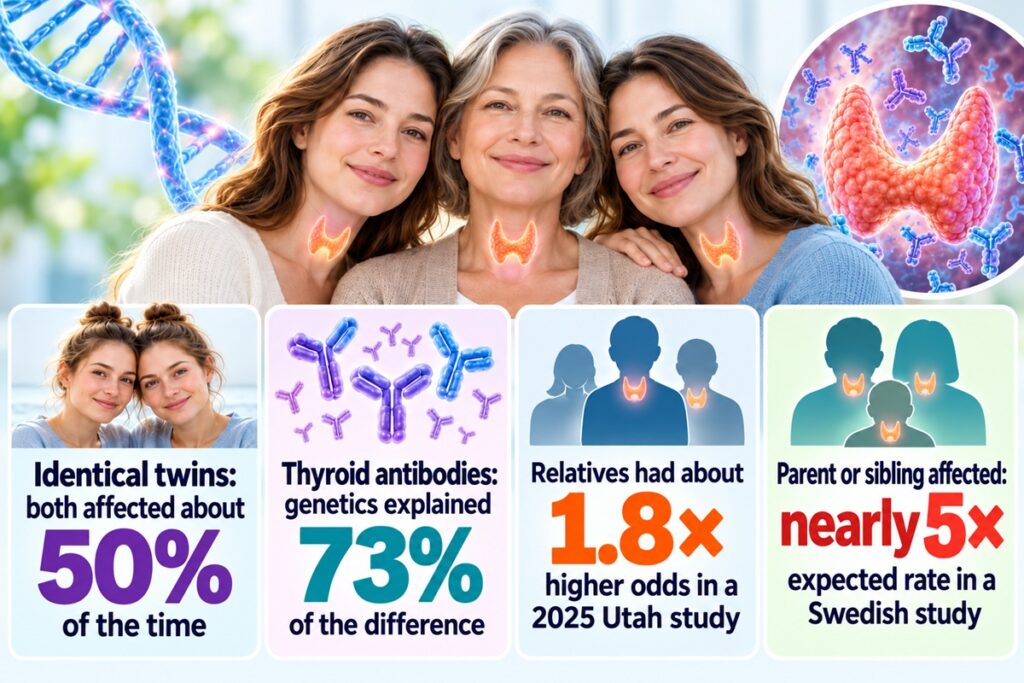
Hypothyroidism runs in families mainly because relatives share genes that make Hashimoto’s disease more likely.
Identical twins share all their genes, and non-identical twins share about half, so comparing the two shows how much genes matter. In a Danish study of 2,945 female twin pairs published in 2000, when one identical twin had autoimmune hypothyroidism, the other had it about half the time.
Among non-identical twins in that study, no pair had it together. The authors noted that identical twins did not always match, so surroundings also play a part.
A second Danish study of healthy twins, published in 2006, found that genes explained about three-quarters (73%) of the differences in who had thyroid antibodies. Thyroid antibodies are an early marker of the immune attack, so this figure describes antibody status, not hypothyroidism itself.
More recently, a 2025 Utah study used records from 1996 to 2021 to compare 92,405 adults with Hashimoto’s disease with 184,810 adults without it. Parents, siblings, and children of people with the disease had about 1.8 times the odds of having it too.
The Utah study found cases through diagnosis codes on at least two records in two separate years, so some cases may not have been autoimmune. Relatives of patients may also be tested more often, which can raise the observed risk.
A 2020 Swedish study of hospital records from 1964 to 2012 and outpatient records from 2001 to 2012 also found a family effect. People whose parent or sibling had Hashimoto’s disease developed it at nearly five times the expected rate. The Swedish and Utah figures use different measures, case definitions, and populations, so they cannot be compared directly or averaged.
Autoimmune conditions also cluster in the same person. Type 1 diabetes, one of the two main diabetes types, comes from an immune attack. A 2019 meta-analysis of 65 studies found hypothyroidism in about one in 10 people with type 1 diabetes.
For example, a 42-year-old whose parent has Hashimoto’s disease has higher odds than average of developing it. At ages 30 to 49, about one in 15 people in the United States has hypothyroidism. Odds about 1.8 times higher still leave most relatives of affected people without the disease.
Can a spouse or partner get hypothyroidism?
A spouse or partner cannot catch hypothyroidism from an affected partner. Hashimoto’s disease is somewhat more common in spouses of affected people. Spouses are not related by blood, so shared genes do not explain this.
- In Utah, husbands of affected wives had about 1.5 times the odds of Hashimoto’s disease.
- In Utah, wives of affected husbands had about 1.6 times the odds.
- In Sweden, spouses of affected people developed it at about twice the expected rate.
The Utah authors said the spouse finding suggests that shared surroundings play a part. Couples may also be alike before they meet, which the Utah authors named as another possible reason. Neither study can separate these two explanations, and neither shows that the disease passes between partners.
Can an infection cause hypothyroidism?
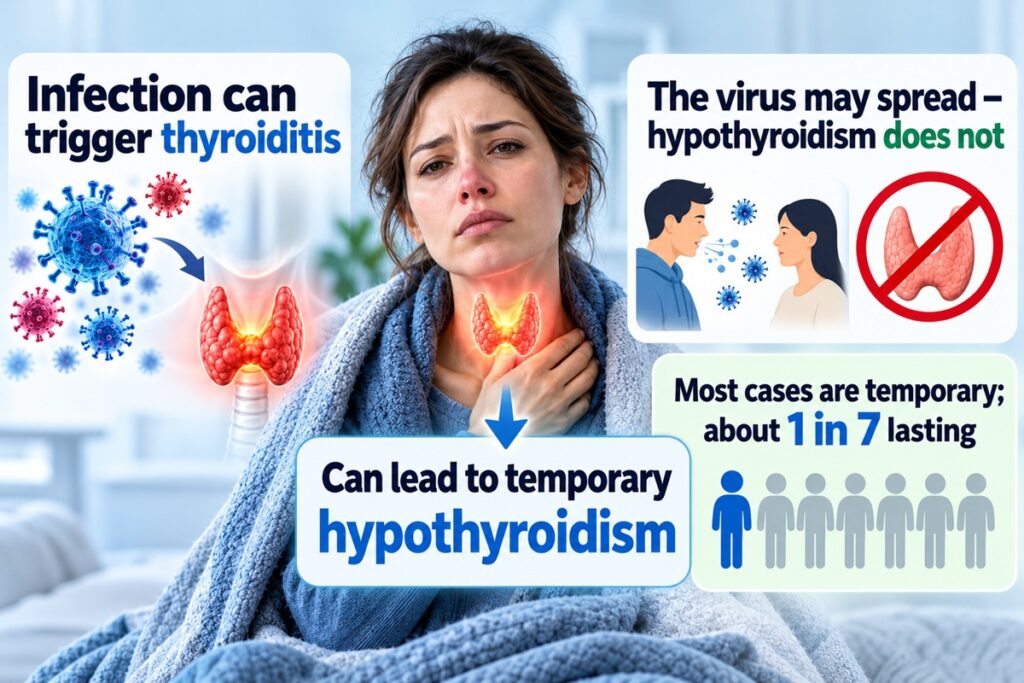
An infection can cause hypothyroidism in some cases, usually for a short time. The virus may spread between people, but the thyroid damage and any hypothyroidism that follows do not.
Subacute thyroiditis is a painful inflammation of the thyroid that can follow a viral illness. Viruses linked to it include influenza, Epstein-Barr virus, and the virus that causes COVID-19, according to a 2023 review. NIDDK also lists viruses such as hepatitis C among factors that may play a role in Hashimoto’s disease.
Subacute thyroiditis is rare and usually temporary. In Olmsted County, Minnesota, it occurred in about five in 100,000 people a year from 1960 to 1997, according to a 2003 Minnesota study. Temporary hypothyroidism was common early on.
By the latest follow-up in that study, about one in seven people had lasting hypothyroidism. Separately, the US label for Synthroid, a brand of levothyroxine, excludes hypothyroidism during the recovery phase of subacute thyroiditis from the medicine’s approved uses.
Someone with a painful thyroid after a viral illness may have low thyroid hormone for a time. Most people in the Minnesota study did not develop lasting hypothyroidism.
A long-term condition that slows metabolism
Hypothyroidism is usually a long-term condition that slows metabolism, the way the body uses energy. Thyroid hormones control that process, and without enough of them many body functions slow down.
Hypothyroidism develops slowly, and symptoms may go unnoticed for months or years. Common symptoms include:
- Fatigue
- Weight gain
- Trouble tolerating cold
- Joint and muscle pain
- Dry skin or dry, thinning hair
- Heavy or irregular periods or fertility problems
- Slowed heart rate
- Depression
Fatigue and weight gain are common and do not by themselves mean a person has a thyroid problem, according to NIDDK.
Hypothyroidism can contribute to high cholesterol. In a Colorado study of 25,862 people at a 1995 health fair, total and LDL (“bad”) cholesterol were higher on average in people with a TSH of 5.1 to 10 mIU/L than in people with normal thyroid function. High cholesterol is not something you catch from another person, and neither is hypothyroidism.
The Centers for Disease Control and Prevention (CDC) states that a total cholesterol above 200 mg/dL may be considered high.
Subclinical hypothyroidism is a mild form in which TSH, the signal that tells the thyroid to work, is raised but thyroid hormone is still normal. It is associated with metabolic syndrome, a group of health measures that together raise the risk of heart disease and type 2 diabetes. A 2021 meta-analysis of 18 articles (19 studies) with 79,727 people found about 1.3 times the odds of metabolic syndrome with subclinical hypothyroidism. The studies were observational, and most were done in Asia.
Heart risk is higher when TSH is well above the normal range. In a 2010 pooled analysis of 11 cohorts with 55,287 adults, the rate of coronary heart disease events was about 1.9 times higher at TSH of 10 to 19.9 mIU/L. That rate was measured in 25,977 adults from 7 of those cohorts. There was no clear rise at TSH of 4.5 to 6.9 mIU/L.
Hypothyroidism is linked to fatty liver disease. A 2018 meta-analysis of 15 studies found about 1.4 times the odds of fatty liver disease in people with hypothyroidism, based on its 12 cross-sectional studies. In the studies that followed people over time, subclinical hypothyroidism was not independently linked to new fatty liver disease. The studies were observational and cannot show cause.
Hypothyroidism is also more common as kidney function falls. In US adults surveyed from 1988 to 1994, about one in 20 people with normal kidney function had hypothyroidism. In the lowest kidney-function group, the figure was more than one in five. You cannot catch fatty liver disease or kidney disease from someone else.
How hypothyroidism is diagnosed and managed over time
Hypothyroidism is diagnosed with blood tests, not symptoms alone, and it is managed with thyroid hormone and regular testing.
The main blood tests measure TSH (thyroid-stimulating hormone) and free T4. TSH is the signal from the pituitary gland that tells the thyroid to make hormone. Free T4 is the main thyroid hormone available in the blood.
Thyroid tests are reported in mIU/L for TSH and ng/dL for free T4, not in mg/dL as cholesterol is. The table shows the typical ranges MedlinePlus gives.
| Test | What it measures | Typical range | Unit |
|---|---|---|---|
| TSH | Pituitary signal that tells the thyroid to make hormone | 0.4 to 4.8 | mIU/L |
| Free T4 | Thyroid hormone available in the blood | 0.8 to 1.9 | ng/dL |
| TPO antibodies | Antibodies against the thyroid, present in most people with Hashimoto’s disease | Varies by lab | Varies by lab |
Normal ranges vary by lab.
Treatment replaces the hormone the thyroid can no longer make. The usual medicine is levothyroxine, which is identical to a hormone a healthy thyroid makes. NIDDK describes this blood-test schedule for people who take it.
- About six to eight weeks after starting the medicine
- Again after each change in dose
- Six months later
- Once a year after that
The Synthroid prescribing label carries a boxed warning that thyroid hormones should not be used to treat obesity or for weight loss. In people with normal thyroid function, usual doses do not reduce weight. Larger doses may cause serious or even life-threatening toxicity.
Undertreated hypothyroidism is linked to more heart disease, obesity, and high blood pressure, according to a 2024 review.
GLP-1 medicines and the thyroid
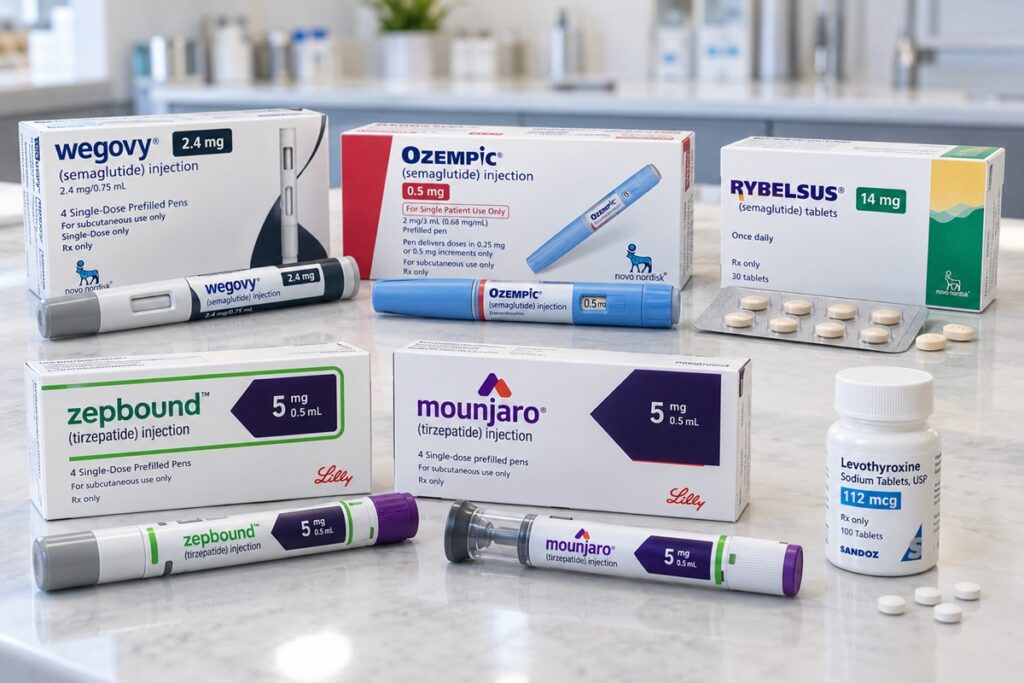
The thyroid warning on GLP-1 medicines concerns thyroid tumors, not hypothyroidism. The US labels for semaglutide (Wegovy, Ozempic, Rybelsus) and tirzepatide (Zepbound, Mounjaro) carry a boxed warning because both medicines caused thyroid C-cell tumors in rodents.
The labels state that it is unknown whether these medicines cause C-cell tumors in humans, including medullary thyroid carcinoma (MTC), a thyroid cancer. The five labels checked in September 2026 do not mention hypothyroidism.
In a single-dose study, semaglutide tablets raised the amount of levothyroxine in the blood by about one-third, according to the Wegovy prescribing label. The same label reports that semaglutide injection at 1 mg a week did not affect how oral medicines were absorbed.
The tirzepatide labels say the medicine may affect how oral medicines are absorbed. They do not name levothyroxine.
How common hypothyroidism is
Hypothyroidism affected about one in 10 people aged 12 and older in the United States in 2009 to 2012. Women were about twice as likely as men to have it. The adult figures come from published studies of NHANES, a national health survey run by CDC, not from a CDC report. The table shows US figures with their years and who was counted.
| Measure | Figure | Years | Who is counted | Source |
|---|---|---|---|---|
| Hypothyroidism | 4.6% | 1988 to 1994 | People aged 12 and older, NHANES III blood tests | Hollowell et al., 2002 |
| Clinical hypothyroidism | 0.3% | 1988 to 1994 | People aged 12 and older, NHANES III | Hollowell et al., 2002 |
| Subclinical hypothyroidism | 4.3% | 1988 to 1994 | People aged 12 and older, NHANES III | Hollowell et al., 2002 |
| Hypothyroidism | 9.6% | 2009 to 2012 | People aged 12 and older, not pregnant, NHANES blood tests or a thyroid prescription | Wyne et al., 2022 |
| Women | 12.9% | 2009 to 2012 | Women aged 12 and older, NHANES | Wyne et al., 2022 |
| Men | 6.1% | 2009 to 2012 | Men aged 12 and older, NHANES | Wyne et al., 2022 |
| Ages 30 to 49 | 6.5% | 2009 to 2012 | People aged 30 to 49, NHANES | Wyne et al., 2022 |
| Ages 50 to 79 | 15.3% | 2009 to 2012 | People aged 50 to 79, NHANES | Wyne et al., 2022 |
| Any thyroid disease on treatment | 5.05% | 2015 to 2018 | Adults, self-reported, NHANES, age-standardized | Zhang et al., 2023 |
| Congenital hypothyroidism | 1 in 2,000 to 4,000 | Reported 2018 | US live births | CDC MMWR, 2018 |
| Subacute thyroiditis | 4.9 per 100,000 a year | 1960 to 1997 | Residents of Olmsted County, Minnesota | Fatourechi et al., 2003 |
The 4.6% and 9.6% figures differ for three reasons.
- They cover different years.
- They define hypothyroidism with different blood tests.
- The 2022 study counts anyone taking thyroid medicine as having hypothyroidism.
AbbVie, which makes Synthroid, funded the 2022 study, and AbbVie staff co-authored it.
Screening for congenital hypothyroidism is part of the US recommended newborn screening panel, according to CDC.
How hypothyroidism is counted
Hypothyroidism is recorded under endocrine codes, not infection codes. The US version of the International Classification of Diseases (ICD-10-CM) uses these codes.
- E03.9, hypothyroidism, unspecified
- E06.3, autoimmune thyroiditis
- E03.3, postinfectious hypothyroidism
- E02, subclinical iodine-deficiency hypothyroidism
- E89.0, postprocedural hypothyroidism
Code E03.3 places hypothyroidism after an infection among the thyroid disorders. The Utah family study counted people by codes E06.3 and E03.9.
In the World Health Organization’s ICD-11, hypothyroidism is 5A00 and Hashimoto thyroiditis is 5A03.20. Both sit in the endocrine chapter, and infections sit in a separate chapter.
Nearly nine in 10 people worldwide used iodized salt in 2020, and 21 countries were still iodine deficient, according to a 2021 review. These figures count iodine deficiency, one cause of hypothyroidism, rather than hypothyroidism.
Sustainable Development Goal (SDG) indicator 3.4.1 counts deaths from cardiovascular disease, cancer, diabetes, and chronic respiratory disease. Thyroid disease is not among them, so hypothyroidism is not tracked under that indicator.
Frequently asked questions
Is Hashimoto’s disease contagious?
No, Hashimoto’s disease is not contagious. It is an autoimmune disease in which the immune system attacks the thyroid.
Can hypothyroidism go away?
Hypothyroidism can go away in some cases, such as after subacute thyroiditis or after pregnancy (postpartum thyroiditis). Hypothyroidism from Hashimoto’s disease, removal of the thyroid, or radioactive iodine is usually long-term.
This page summarizes research on hypothyroidism across groups of people. It is not advice about testing, treatment, or any medicine for an individual.
Sources
- Definitions and causes: NIDDK Hypothyroidism, 2021; NIDDK Hashimoto’s disease, 2021; MedlinePlus Hypothyroidism, 2026; Feldt-Rasmussen et al., Endocrine, 2024.
- Lab tests: MedlinePlus TSH test, 25 January 2026; MedlinePlus free T4 test, 25 January 2026.
- US figures: Hollowell et al., J Clin Endocrinol Metab, 2002; Wyne et al., J Endocr Soc, 2022; Zhang et al., Endocr Pract, 2023; CDC MMWR, congenital hypothyroidism, 2018.
- Family and spouse studies: Brix et al., J Clin Endocrinol Metab, 2000; Hansen et al., Eur J Endocrinol, 2006; Bujnis et al., J Clin Endocrinol Metab, 2025; Thomsen et al., J Transl Autoimmun, 2020; Nederstigt et al., Eur J Endocrinol, 2019.
- Infection and subacute thyroiditis: Fatourechi et al., J Clin Endocrinol Metab, 2003; Rafiei et al., Przegl Epidemiol, 2023.
- Cholesterol, heart, and related conditions: CDC About Cholesterol, accessed 25 September 2026; Canaris et al., Arch Intern Med, 2000; Ding et al., Endocr J, 2021; Rodondi et al., JAMA, 2010; Mantovani et al., Thyroid, 2018; Lo et al., Kidney Int, 2005.
- Thyroid medicines: Synthroid label, 29 February 2024; Pacerone (amiodarone) label, 16 July 2025; lithium carbonate label, 10 September 2026.
- GLP-1 medicines: Wegovy label, 30 June 2026; Ozempic injection label, 10 June 2026; Ozempic and Rybelsus tablets label, 19 August 2026; Zepbound label, 2 September 2026; Mounjaro label, 2 September 2026.
- Disease codes and global iodine: ICD-10-CM code set, searched through the NLM Clinical Tables service, 25 September 2026; WHO ICD-11 browser, 2025-01 release; Zimmermann and Andersson, Eur J Endocrinol, 2021.