Key takeaways
- Communicable diseases are infections that spread through air, food, water, contact, insect bites, or from mother to baby around birth.
- In 2021, infections and related maternal, newborn, and nutritional causes made up about 27% of the world’s 68 million deaths.
- Vaccination, safe water, and mosquito control each break a different link in how germs spread.
- Common examples include tuberculosis, malaria, HIV, measles, and hepatitis B. Lung infections were the deadliest after COVID-19 in 2021.
A communicable disease is an illness caused by a pathogen, or germ, such as a virus, bacterium, fungus, or parasite. These diseases can spread through the air, contaminated food or water, contact with infected people or animals, and insect bites. . The germ leaves a person, an animal, or the environment and reaches someone else through air, food, water, blood, an insect bite, or from mother to baby around birth.
In 2021, infections and the maternal, newborn, and nutritional causes grouped with them accounted for about 27% of the world’s 68 million deaths, up from 18% of all deaths in 2019. The World Health Organization (WHO) counts these causes together in its Global Health Estimates. A separate page explains how communicable and noncommunicable diseases differ.
How communicable diseases spread
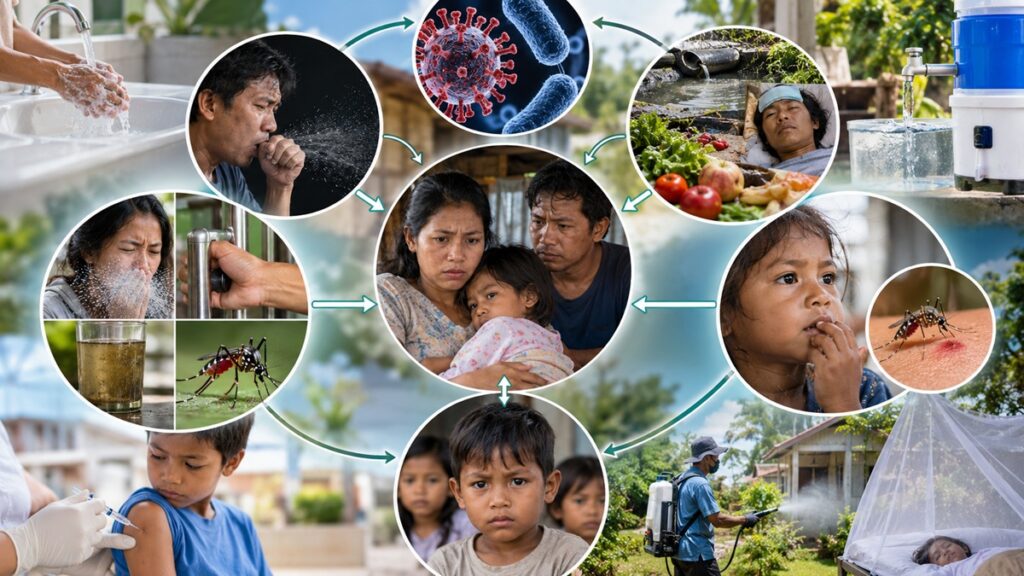
An infection spreads only when six things are present together:
- a germ, such as a virus, bacterium, fungus, or parasite
- a reservoir where the germ lives and multiplies, such as a person, an animal, water, soil, food, or a surface
- a way out, for example in feces, blood, or the droplets from a cough or sneeze
- a way of traveling, for example in air, droplets, food, water, on objects, or in insects
- a way in, for example through the mouth, broken skin, or an insect bite
- a person without immunity to that germ
Health workers call this sequence the chain of infection. Public health measures each target one part: vaccination makes the potential host immune, safe water blocks travel from feces to mouth, and mosquito control removes the living carrier that some germs need.
Most long-term conditions do not start with a germ, so they do not spread from person to person. Some still cluster in families. See whether diabetes, heart disease, kidney disease, or hypothyroidism is contagious.
An infectious disease such as cholera shows all six at work. The bacterium Vibrio cholerae leaves the body in feces, travels in contaminated water or food, and enters a new host through the mouth. Most people infected with the bacteria that cause cholera have no symptoms or only mild illness. However, they can still release (shed) the bacteria in their stool and contaminate food or water.
Types of transmission
Germs pass between hosts in seven main ways, with frequent overlap:
- direct contact with an infected person, such as shaking hands
- indirect contact, such as touching a contaminated doorknob
- droplet transmission directly when an infected person sneezes, coughs, talks, or breathes.
- inhaled airborne transmission of tiny, infected particles suspended in the air
- vector-borne transmission via living organisms
- vehicle-borne transmission by consuming contaminated water or food
- vertical transmission from mother to offspring
Close contact and droplets carry germs over short distances. Mpox spreads through close contact, contaminated materials, or infected animals, and can pass to a baby in pregnancy or around birth. Seasonal influenza spreads when infected people cough or sneeze.
Smaller particles carry some germs farther through the air. Measles is one of the most contagious infectious diseases. It spreads mainly through the air when an infected person breathes, coughs, or sneezes. The virus can remain infectious in the air for up to two hours after the infected person leaves an area. Tuberculosis mostly affects the lungs and spreads in tiny particles when infected people cough, sneeze, or spit.
Food and water carry germs shed in feces. Cholera and typhoid both spread through contaminated food or water, and the typhoid bacterium lives only in people. Hepatitis A spreads the same way or through close contact with an infected person. Polio passes mainly from person to person by the fecal-oral route, from feces to mouth, and sometimes through contaminated food or water.
Some germs pass through contact with body fluids in sex, blood, or injections. HIV (human immunodeficiency virus), for example, is carried in blood, breast milk, semen, and vaginal fluids. Hepatitis B also passes through blood or body fluids in sex or unsafe injections. Hepatitis C spreads through blood, mostly through unsafe injections, unscreened transfusions, and shared needles. More than 30 bacteria, viruses, and parasites can pass through sexual contact.
Insects carry some germs that do not pass directly between people. Malaria spreads mostly through the bites of some infected female mosquitoes of the Anopheles group, although blood transfusion and contaminated needles can also carry it. Dengue (also known as dengue fever) spreads through the bites of infected mosquitoes, and about half the world’s population now lives at risk of it.
Infection passed from mother to child can happen in pregnancy, at birth, or through breastfeeding. Hepatitis B passes most often at birth or in early childhood, HIV at any of these stages, and syphilis in pregnancy or at birth. An estimated 1.1 million pregnant women had syphilis in 2022.
Animals pass germs to people through bites, contact, food, water, or the environment. More than 200 zoonoses, infections that pass naturally from animals with backbones to people, are known. HIV began as one before the virus changed into a form that passes only between people. Rabies travels in saliva, usually through dog bites, and is almost always fatal once symptoms appear. Ebola reaches people through contact with the blood or body fluids of infected animals. It then passes between people through broken skin or the moist lining of the mouth, nose, and eyes, but only once symptoms have appeared.
Common communicable diseases worldwide

The table gives WHO’s latest global figures for 16 common communicable diseases.
| Disease | Cause | Main route | Latest global figure (cases, deaths or people living with infection) | Year |
|---|---|---|---|---|
| Tuberculosis | Bacterium | Air | 10.7 million fell ill, 1.23 million died | 2024 |
| HIV | Virus | Blood and sex, mother-to-child | 41.0 million living with HIV, 570,000 deaths, 1.2 million new infections | 2025 |
| Malaria | Parasite | Insect bite | 282 million cases, 610,000 deaths | 2024 |
| Hepatitis B | Virus | Mother-to-child, blood, and sex | 240 million long-lasting infections, 1.1 million deaths | 2024 |
| Hepatitis C | Virus | Blood | About 239,000 deaths | 2024 |
| Hepatitis A | Virus | Food and water | 35,569 deaths | 2023 |
| Measles | Virus | Air | 95,000 deaths | 2024 |
| Seasonal influenza | Virus | Droplets | Around 1 billion cases each year, 290,000 to 650,000 respiratory deaths each year | No year stated |
| COVID-19 | Virus | Air, contaminated surfaces | About 8.7 million direct deaths | 2021 |
| Cholera | Bacterium | Food and water | 1.3 to 4.0 million estimated cases each year, 535,321 reported cases and 4,007 reported deaths | Estimate with no year stated, reported figures for 2023 |
| Typhoid | Bacterium | Food and water | 9 million ill, 110,000 deaths | 2019 |
| Dengue | Virus | Insect bite | Over 14.6 million reported cases, more than 12,000 reported deaths | 2024 |
| Rabies | Virus | Animal bite | 59,000 estimated deaths each year | No year stated |
| Syphilis | Bacterium | Sex, mother-to-child | About 8 million adults aged 15 to 49 infected | 2022 |
| Pneumonia in children under 5 | Virus, bacterium, or fungus | Droplets and blood around birth | 740,180 deaths | 2019 |
| Diarrheal disease in children | Several germs | Food and water, poor hygiene | Around 443,832 deaths in children under 5 | No year stated |
The figures differ in year and method, so they should not be added together. Reported counts are far lower than estimates where tracking of cases is weak.
Pneumonia and diarrhea remain among the main causes of child mortality under five years of age. In 2019, pneumonia was the largest single infectious cause of death in children under five worldwide.
How deaths from infection have changed since 2000
Between 2000 and 2019, the share of all deaths caused by infections and the causes grouped with them fell steeply. COVID-19 raised it again in 2021, although the 2021 share without COVID-19 was lower than in 2019. As that share fell, noncommunicable diseases made up a larger part of all deaths.
| Year | All deaths | Communicable group (share of all deaths) | COVID-19 inside that group (share of all deaths) |
|---|---|---|---|
| 2000 | 51.34 million | 16.66 million (32.4%) | None |
| 2010 | 53.22 million | 13.04 million (24.5%) | None |
| 2019 | 56.75 million | 10.38 million (18.3%) | None |
| 2021 | 68.08 million | 18.64 million (27.4%) | 8.71 million (12.8%) |
Shares are calculated from Global Health Estimates country data for 183 countries, with maternal, newborn, and nutritional causes counted in the group. WHO’s leading causes page from Global Health Estimates ranks the individual causes for 2021.
Excluding COVID-19, the group accounted for 9.93 million deaths in 2021, 14.6% of all deaths. Lower respiratory infections (infections of the lungs and lower airways) were the deadliest communicable cause after COVID-19 in 2021, with 2.5 million deaths. Deaths from HIV and AIDS (acquired immunodeficiency syndrome) fell by 61% between 2000 and 2021, and deaths from diarrheal disease by 45%.
Two measures describe COVID-19 deaths. Direct deaths, estimated with COVID-19 as the underlying cause, were about 8.7 million in 2021. Excess mortality, deaths above the number expected from past trends, came to about 14.9 million over 2020 and 2021, including deaths caused indirectly by the pandemic. Middle-income countries accounted for 81% of that excess.
In 2024, WHO’s African Region had 95% of the world’s malaria cases and 95% of the world’s malaria deaths, and children under five made up about 75% of the malaria deaths there. About 64% of people living with HIV in the world at the end of 2025 lived in the same region.
Antimicrobial resistance, when germs stop responding to the drugs used against them, makes bacterial infections harder to treat. A 2024 analysis of bacterial resistance linked resistant infections to 4.71 million deaths in 2021—deaths that would not have happened without the infection. Of those, 1.14 million deaths would not have happened if the infection had responded to drugs.
Viral hepatitis caused 1.3 million deaths in 2022, 83% of them from hepatitis B and 17% from hepatitis C. That year it ranked level with tuberculosis as the second largest infectious cause of death.
How cases are recorded and reported
What counts as communicable depends on the classification. In the International Classification of Diseases, 10th revision (ICD-10), respiratory infections sit outside the chapter for infectious diseases, yet the Global Health Estimates count them as communicable.
| System | Chapter or group | Codes | Influenza and pneumonia |
|---|---|---|---|
| ICD-10 (International Classification of Diseases, 10th revision) | Certain infectious and parasitic diseases | A00 to B99 | Influenza J09 to J11 and pneumonia J12 to J18 sit in respiratory chapter X |
| ICD-11, January 2026 release | Certain infectious or parasitic diseases | 1A00 to 1H0Z | Influenza moved into the infectious chapter, pneumonia stays in the respiratory chapter |
| Global Health Estimates Group I | Communicable, maternal, newborn, and nutritional conditions | A00 to B99 plus G00 to G04, J00 to J22, U07 and others | Lower respiratory infections and COVID-19 counted inside the group |
ICD gives each diagnosis a code; Group I is used only for statistical estimates. Codes can be checked in the ICD-11 browser.
Reporting starts with national law, which lists notifiable diseases, those a doctor must report to health authorities. In England, a registered doctor must report a suspected case without waiting for laboratory confirmation. Under the England reporting guidance, urgent cases are reported by telephone within 24 hours and all cases within three days.
Between countries, reporting follows the International Health Regulations, which bind 196 States Parties, the countries that have accepted them. The Regulations require each of them to notify WHO within 24 hours of assessing any event that may be a public health emergency of international concern (PHEIC). WHO administers the rules but has no power to compel countries. Amendments adopted in 2024 took effect on 19 September 2025 and added a higher alert level above a PHEIC, the “pandemic emergency,” for spread that strains health systems and causes major disruption. Eleven States Parties rejected the amendments, and the previous version still applies to them.
On 17 May 2026, WHO’s Director-General determined that an epidemic of Ebola disease caused by the Bundibugyo virus, in the Democratic Republic of the Congo and Uganda, was a PHEIC. It did not meet the criteria for a “pandemic emergency,” as the PHEIC statement records. The international spread of polio also remains a PHEIC, and wild poliovirus, the naturally occurring form, was still reported in Pakistan in 2026.
The Pandemic Agreement is a separate treaty and is not yet in force. The World Health Assembly adopted it on 20 May 2025 in Assembly resolution WHA78.1. It cannot be signed until an annex on sharing pathogen samples and the benefits from them is agreed, and talks were still ongoing as of July 2026. It takes effect once 60 countries have ratified it.
Communicable diseases in the global goals (MDGs and SDGs)
The Millennium Development Goals (MDGs), which ran from 2000 to 2015, gave communicable disease a goal of its own. Goal 6 set three targets under the heading “Combat HIV/AIDS, malaria and other diseases”:
- 6.A: “Have halted by 2015 and begun to reverse the spread of HIV/AIDS”
- 6.B: “Achieve, by 2010, universal access to treatment for HIV/AIDS for all those who need it”
- 6.C: “Have halted by 2015 and begun to reverse the incidence of malaria and other major diseases”
New HIV infections, measured by the MDG HIV and AIDS indicators, fell by about 40% between 2000 and 2013, and malaria death rates fell 58% between 2000 and 2015.
When the Sustainable Development Goals (SDGs) replaced the MDGs for 2015 to 2030, they kept a communicable disease target under the health goal. Target 3.3 reads, “By 2030, end the epidemics of AIDS, tuberculosis, malaria and neglected tropical diseases and combat hepatitis, water-borne diseases and other communicable diseases.”
| Indicator | What it counts | Latest global figure |
|---|---|---|
| 3.3.1 HIV incidence (new infections per 1,000 uninfected people) | New infections | 1.3 million new infections in 2024 |
| 3.3.2 Tuberculosis incidence per 100,000 people | New and relapse cases (the disease returning) | 10.7 million fell ill in 2024 |
| 3.3.3 Malaria incidence per 1,000 people at risk | New cases among those at risk | 282 million cases in 2024, 64 per 1,000 at risk against 59 in 2015 |
| 3.3.4 Hepatitis B incidence per 100,000 people | Share of children under 5 with long-lasting infection | 0.6% of children under 5 in 2024, down from 0.8% in 2015 |
| 3.3.5 People requiring interventions against neglected tropical diseases (NTDs) | People needing preventive or individual care | 1.41 billion in 2024, down from 2.19 billion in 2010 |
HIV and tuberculosis are given as counts, not the rates their indicators name.
Indicator 3.3.4 is named for incidence, the number of new infections. Its official definition measures prevalence instead: the share of children under five living with long-lasting hepatitis B. The target mentions water-borne diseases, but no indicator counts them.
Reducing deaths from infection
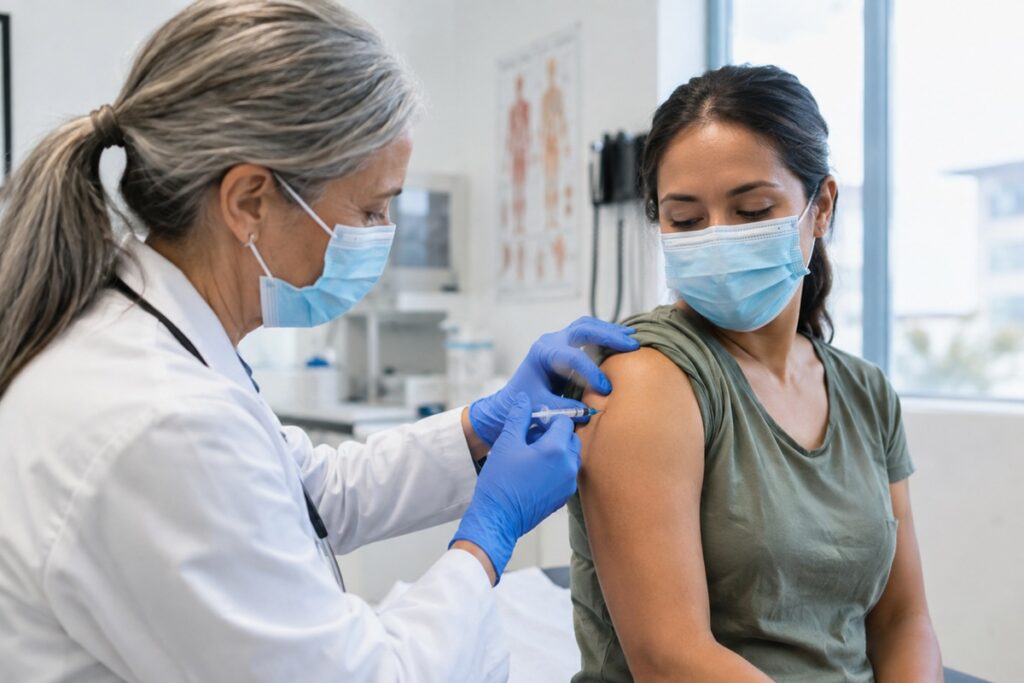
Eradication campaigns, vaccination, safe water, disease-control programs, and better access to medical care have prevented millions of infections and deaths. However, progress has been uneven. Some infectious diseases remain widespread, and new outbreaks, drug resistance, and gaps in vaccination continue to threaten public health . Smallpox is still the only human disease to have been eradicated. The last known case from regular local spread was in Somalia in 1977. Eradication was confirmed in December 1979, and the World Health Assembly declared it on 8 May 1980. Wild poliovirus cases dropped by more than 99% between 1988 and 2019, from about 350,000 in more than 125 countries where the virus was regularly present.
A 2024 modeling study covering 14 pathogens estimated that vaccination had averted 154 million deaths since 1974, 146 million of them in children under five. Vaccination accounted for 40% of the observed fall in infant mortality.
Unsafe drinking water, sanitation, and hygiene are estimated to cause about 1.4 million deaths a year, though the estimate gives no year. In 2024, about 2.1 billion people still lacked safely managed drinking water.
Since 2000, about 2.3 billion malaria cases and 14 million malaria deaths have been averted, and tuberculosis programs have saved about 83 million lives. Malaria parasites partly resistant to artemisinin, a key treatment, have now been confirmed or suspected in at least eight countries in Africa.
This page is general background on how communicable diseases spread and how they are counted. It gives no health guidance.
Sources
- WHO fact sheets: tuberculosis, HIV, hepatitis A, hepatitis B, hepatitis C and measles, 2026; influenza, COVID-19, sexually transmitted infections, malaria, dengue and Ebola, 2025; cholera, rabies, mpox, diarrhoeal disease and sanitation, 2024; typhoid, 2023; pneumonia in children, 2022; zoonoses, 2020; polio, 2019.
- Deaths since 2000: WHO Global Health Estimates, estimation methods, top 10 causes of death and viral hepatitis news release, and the Global Burden of Disease antimicrobial resistance study, 2024; WHO COVID-19 excess deaths news release, 2022.
- Classification: WHO ICD-11, 2026; ICD-10, 2019.
- Reporting and international rules: England notifiable diseases guidance, WHO Ebola PHEIC statement and Pandemic Agreement annex talks, 2026; International Health Regulations amendments in force and Pandemic Agreement, resolution WHA78.1, 2025; International Health Regulations, consolidated text, 2024.
- Goals and indicators: SDG Report 2026, Goal 3 and indicator metadata 3.3.2, 3.3.3, 3.3.4 and 3.3.5, 2026; SDG indicator framework, 2025; MDG Goal 6, 2015.
- What has reduced deaths: Global Polio Eradication Initiative update, 2026; World malaria report and WHO/UNICEF water and sanitation report, 2025; Shattock et al., vaccination modelling, 2024; WHO smallpox eradication releases, 2020 and 2019.
- Chain of infection: US Centers for Disease Control and Prevention, chain of infection components, 2022.