Key takeaways
- All type 2 diabetes medicines lower blood glucose. They differ in side effects, effect on weight, and heart or kidney benefits.
- Most carry little risk of low blood sugar on their own. Sulfonylureas and insulin raise that risk.
- Medicines add to diet and activity, not replace them. Guidelines disagree on which medicine to start first.
- Weight effects differ: tirzepatide (Mounjaro) causes very high weight loss, GLP-1 medicines intermediate to very high, metformin is neutral, and pioglitazone causes gain. Compare them
All medicines for type 2 diabetes lower blood glucose. Where the groups differ mainly concerns additional benefits and side effects.
Some may cause weight gain where others can result in weight loss. Most carry little risk of glucose falling too low on their own, while sulfonylureas and insulin raise that risk. Some products approved for type 2 diabetes have also shown heart or kidney benefits in large trials.
All US labels describe diabetes medications as a supplement to diet and activity, not a substitute. Guidelines still disagree on which drug to prescribe first and when to combine medicines. Where diet and activity go far enough, remission after stopping medication becomes possible for some people.
How diabetes medications lower blood glucose
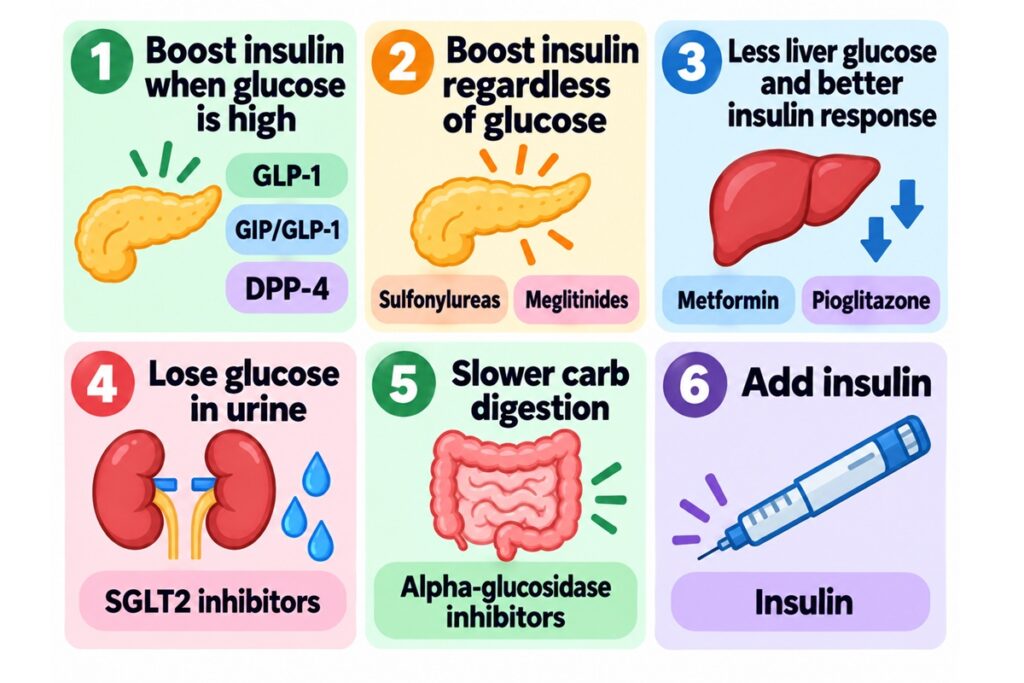
Most of these medicines lower blood glucose in one of six ways:
- More insulin release only when glucose is high, from three groups: GLP-1 receptor agonists, which copy the gut hormone glucagon-like peptide-1 (GLP-1); dual GIP and GLP-1 receptor agonists, which also copy a second gut hormone, glucose-dependent insulinotropic polypeptide (GIP); and DPP-4 inhibitors, which block dipeptidyl peptidase-4, the enzyme that breaks both hormones down
- More insulin release regardless of glucose, from sulfonylureas (medicines that push the pancreas to release insulin) and meglitinides
- Less glucose released by the liver and better response to insulin, from metformin and pioglitazone
- More glucose lost in urine, from SGLT2 inhibitors, which block sodium-glucose cotransporter 2, the kidney protein that returns glucose to the blood
- Slower carbohydrate digestion in the gut, from alpha-glucosidase inhibitors
- Insulin itself, replacing or adding to the hormone the pancreas makes
The number of medicine classes depends on the grouping scheme, so sources give different totals.
Prevalence and treatment
In 2022, 445 million adults aged 30 and over lived with diabetes, a major noncommunicable disease, without glucose-lowering treatment. That count was 3.5 times the number in 1990, with treatment coverage below 10% in some African countries. In the United States, about one in four adults with diagnosed diabetes reported using a non-insulin injectable, such as a GLP-1 medicine, in 2024.
The survey measure also counted people using injections to lose weight and did not count GLP-1 tablets. In a national sample analysis covering 2017 to 2020, 82.3% of adults with diagnosed type 2 diabetes met the 2022 consensus criteria for a GLP-1 receptor agonist or an SGLT2 inhibitor. Of that eligible group, 9.1% were taking either class.
GLP-1 and dual GIP/GLP-1 agonists
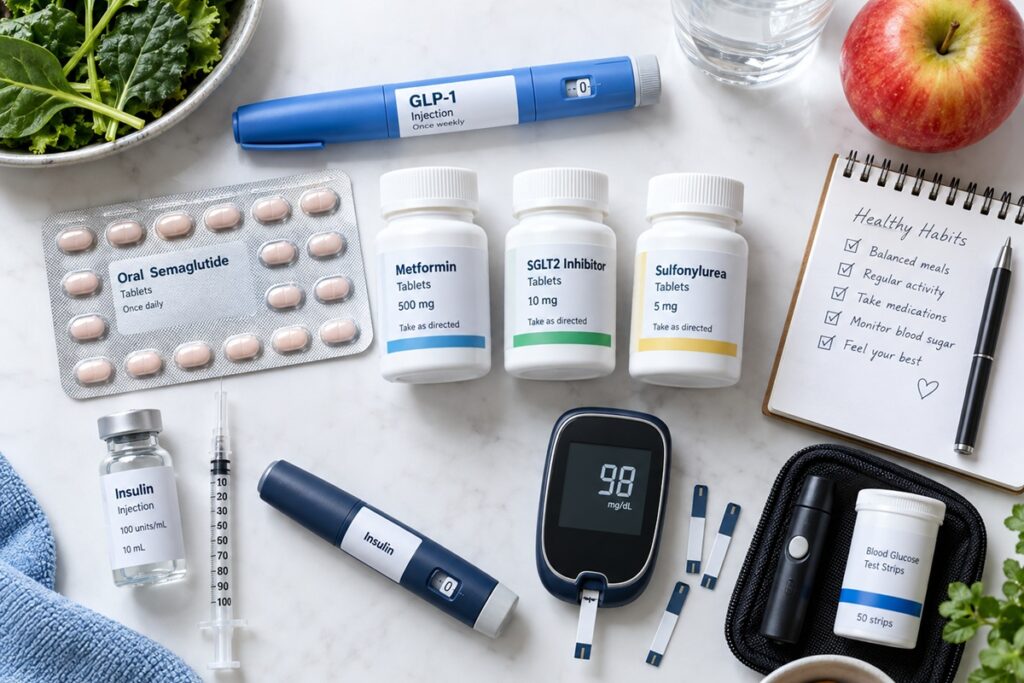
The dual agonist tirzepatide (Mounjaro, Zepbound) acts on two hormone receptors, GIP and GLP-1. Semaglutide acts on the GLP-1 receptor only. Both raise insulin release only when blood glucose is high.
Mounjaro is the brand approved for type 2 diabetes. Zepbound is the same medicine, approved for weight management in adults and for obstructive sleep apnea in adults with obesity.
GLP-1 receptor agonists and dual agonists are two of several groups of type 2 diabetes medicines, and they are often combined with other groups rather than used in their place.
The 2026 US guideline grades glucose lowering as high to very high for GLP-1 receptor agonists and insulin, high for metformin, and intermediate to high for SGLT2 inhibitors. Low-glucose risk rises when a sulfonylurea or insulin is added.
GLP-1 receptor agonists and tirzepatide lower glucose roughly as much as insulin does. They reduce weight where insulin increases it, and on their own they seldom cause hypoglycemia (abnormally low blood glucose, which may occur with or without symptoms).
Tirzepatide and most GLP-1 receptor agonists are given by injection. Nausea and vomiting are common when a dose is started or raised. Both groups cost more than metformin or human insulin.
Compared with placebo, the GLP-1s liraglutide, dulaglutide, and semaglutide, as both an injection and a tablet, reduced major heart events (heart attack, stroke, or death from heart disease), while lixisenatide and once-weekly exenatide did not. So the heart benefit belongs to those named medicines, not to every GLP-1 receptor agonist. The same guideline rates metformin’s heart effect as a potential benefit and insulin’s heart effect as neutral.
Oral semaglutide, sold as Rybelsus and Ozempic tablets, is the only GLP-1 receptor agonist tablet approved for type 2 diabetes. Wegovy tablets and Foundayo (orforglipron) are tablets approved for weight management.
The 2026 guideline from the American Diabetes Association (ADA) favors GLP-1-based treatment over insulin as the first injectable when glucose is not severely high. Where insulin is needed, the guideline recommends combining insulin with a GLP-1 receptor agonist, including the dual agonist tirzepatide.
The International Diabetes Federation’s 2025 recommendations keep metformin as the first single medicine, with GLP-1 receptor agonists usually added to it early. Neither body makes them the starting medicine for everyone.
Mounjaro for type 2 diabetes
Mounjaro (tirzepatide) is a once-weekly injection with two uses in type 2 diabetes on its US prescribing label:
- improving blood glucose control, alongside diet and exercise, in adults and children 10 and older
- lowering the risk of major heart events (death from heart disease, nonfatal heart attack, or nonfatal stroke) in adults who are at high risk of them
The FDA approved the glucose use for adults on 13 May 2022 and for children on 19 December 2025. It added the heart-event use on 27 August 2026, according to the FDA approval letter. That approval followed SURPASS-CVOT, in which tirzepatide was no worse than dulaglutide at preventing major heart events but was not shown to be better.
The Zepbound label does not list blood glucose control in type 2 diabetes as a use.
Mounjaro starts at 2.5 mg once a week. The dose can rise in 2.5 mg steps after at least four weeks on each dose, up to 15 mg a week for adults and 10 mg for children.
HbA1c (also called A1C) is a measure of average blood glucose over two to three months. In five trials in adults, SURPASS-1 to SURPASS-5, HbA1c fell by about 1.7 to 2.4 points on tirzepatide and weight fell by about 12 to 25 pounds, according to the Mounjaro label. The results varied by trial and dose.
SURMOUNT-2 was a 72-week Zepbound trial in adults with type 2 diabetes and overweight or obesity. People lost an average of 12.8% of body weight on 10 mg and 14.7% on 15 mg, against 3.2% on placebo.
Nausea, diarrhea, vomiting, and constipation are among the most common tirzepatide side effects. Most cases of nausea, vomiting, or diarrhea occur during dose increases. In the label’s placebo-controlled trials, nausea affected about one in eight to nearly one in five adults on tirzepatide, depending on the dose, against one in 25 on placebo.
Both Mounjaro and Zepbound carry a boxed warning about thyroid C-cell tumors observed in rats; whether this risk applies to humans is unknown. They are contraindicated in people with a personal or family history of medullary thyroid carcinoma or multiple endocrine neoplasia syndrome type 2 (MEN2), and in those with a previous serious allergic reaction to tirzepatide or the product’s ingredients.
Mounjaro vs Ozempic for diabetes
In SURPASS-2, tirzepatide lowered HbA1c and weight more than semaglutide 1 mg, the Ozempic dose the trial tested. The 40-week trial enrolled 1,879 adults who were already taking metformin. Participants knew which medicine they were taking, and Eli Lilly, the maker of tirzepatide, funded the trial.
HbA1c fell by 2.0 to 2.3 points on tirzepatide, depending on the dose, and by 1.9 points on semaglutide. Weight fell by about 17–25 lb on tirzepatide and about 13 lb on semaglutide, according to the SURPASS-2 trial report.
Ozempic’s label now allows up to 2 mg a week, so the trial does not show how tirzepatide compares with the highest Ozempic dose. SURPASS-2 did not compare heart or kidney outcomes.
Ozempic’s heart-event use covers adults with type 2 diabetes and established heart disease. Ozempic also has an approved kidney use in adults with type 2 diabetes and chronic kidney disease, and Mounjaro does not. Ozempic is for adults only, while Mounjaro is approved from age 10 for children with type 2 diabetes.
Mounjaro vs metformin
No published trial has compared tirzepatide with metformin head-to-head in type 2 diabetes. In most tirzepatide trials, people took it alongside metformin.
Comparisons of tirzepatide vs metformin rest on their labels and the 2026 US guideline:
- Metformin lowers the liver’s glucose output and improves the body’s response to insulin. Tirzepatide raises insulin release when glucose is high.
- Metformin is a tablet taken once or twice a day. Tirzepatide is an injection taken once a week.
- The 2026 US guideline grades glucose lowering as high for metformin and very high for tirzepatide. It rates metformin as weight neutral and tirzepatide’s weight loss as very high.
- The guideline lists neither medicine as causing low glucose on its own.
- Metformin’s boxed warning concerns lactic acidosis. Tirzepatide’s boxed warning concerns thyroid C-cell tumors in rats.
Metformin has historically been the first medicine for type 2 diabetes, and the International Diabetes Federation still puts it first. The 2026 US guideline names no single starting medicine.
Metformin is among the lowest-cost diabetes medicines and tirzepatide’s cost is among the highest, based on July 2025 prices in the 2026 US guideline.
How the main medicine classes compare
Of the groups in the table, only sulfonylureas and insulin carry a higher risk of low glucose on their own. Pioglitazone, sulfonylureas, and insulin can add weight.
The table compares the main classes for adults with type 2 diabetes. The effect and evidence entries are 2026 ADA grades unless a label is named, and dosing comes from US labels.
| Drug class | Example drugs | How often taken | A1C effect | Weight effect | Heart and kidney evidence |
|---|---|---|---|---|---|
| Metformin | Metformin, including extended-release (Glumetza) | Tablet, once or twice daily | High | Neutral, possible modest loss | Potential heart events benefit; heart failure and kidney neutral |
| SGLT2 inhibitors | Empagliflozin (Jardiance); dapagliflozin (Farxiga); canagliflozin (Invokana) | Tablet, once daily | Intermediate to high | Loss, intermediate | Heart events benefit (canagliflozin, empagliflozin); heart failure benefit (canagliflozin, dapagliflozin, empagliflozin, ertugliflozin); kidney benefit (canagliflozin, dapagliflozin, empagliflozin) |
| GLP-1 receptor agonists | Semaglutide (Ozempic, Rybelsus); dulaglutide (Trulicity); liraglutide (Victoza) | Weekly (Ozempic, Trulicity) or daily (Victoza) injection; daily tablet (Rybelsus) | High to very high | Loss, intermediate to very high | Heart events benefit (dulaglutide, liraglutide, semaglutide); heart failure and kidney benefit (semaglutide injection) |
| Dual GIP and GLP-1 receptor agonist | Tirzepatide (Mounjaro) | Weekly injection | Very high | Loss, very high | Mounjaro approved in 2026 to lower heart-event risk (label); ADA heart-event grade under investigation; reduces worsening heart failure in obese adults; potential kidney benefit (ADA) |
| DPP-4 inhibitors | Sitagliptin (Januvia); linagliptin; alogliptin; saxagliptin | Tablet, once daily (sitagliptin) | Intermediate | Neutral | Neutral; possible heart failure risk with saxagliptin and alogliptin |
| Pioglitazone | Pioglitazone (Actos) | Tablet, once daily | High | Gain | Potential heart events benefit; increased risk of heart failure; kidney neutral |
| Sulfonylureas, second generation | Glimepiride; glipizide; glyburide | Tablet, once daily (glimepiride, extended-release glipizide) | High | Gain | Neutral |
| Insulin, human and analogues | Insulin glargine (Lantus); insulin icodec (Awiqli) | Injection, once daily (glargine) or once weekly (Awiqli) | High to very high | Gain | Neutral |
The ADA grades are categories, not measured percentage points, and do not rank medicines. Risk of low glucose rises when a sulfonylurea, meglitinide, or insulin is added to any of them. The ADA standards were published before Mounjaro’s August 2026 heart-event approval. The tirzepatide heart failure grade comes from the SUMMIT trial in people with heart failure with preserved ejection fraction and obesity, and no US tirzepatide label lists heart failure.
Heart and kidney trials by medicine
Against placebo, fewer heart deaths, heart attacks, and strokes were recorded with empagliflozin, canagliflozin, liraglutide, dulaglutide, and both forms of semaglutide, and four trials slowed kidney decline. The remaining heart trials were neutral or showed only noninferiority (no worse than the comparator, within a set margin).
| Medicine | Trial, year | Compared with | Main result | United States indication that followed |
|---|---|---|---|---|
| Empagliflozin | EMPA-REG OUTCOME, 2015 | Placebo | Major events HR 0.86 | Heart death in type 2 diabetes with heart disease |
| Empagliflozin | EMPA-KIDNEY, 2023 | Placebo | Kidney progression HR 0.72 | Chronic kidney disease at risk of progression |
| Canagliflozin | CANVAS Program, 2017 | Placebo | Major events HR 0.86 | Major events in type 2 diabetes with heart disease |
| Canagliflozin | CREDENCE, 2019 | Placebo | Kidney composite HR 0.70 | Kidney outcomes in type 2 diabetes with albuminuria above 300 mg/day |
| Dapagliflozin | DECLARE-TIMI 58, 2019 | Placebo | Major events HR 0.93, not reduced | Hospitalization for heart failure in type 2 diabetes with heart disease or risk factors |
| Dapagliflozin | DAPA-CKD, 2020 | Placebo | Kidney composite HR 0.61 | Chronic kidney disease at risk of progression |
| Ertugliflozin | VERTIS CV, 2020 | Placebo | Major events HR 0.97, noninferior only | Glucose lowering only |
| Semaglutide injection | SUSTAIN-6, 2016 | Placebo | Major events HR 0.74 | Major events in type 2 diabetes with heart disease |
| Semaglutide injection | FLOW, 2024 | Placebo | Kidney composite HR 0.76 | Kidney decline and heart death in type 2 diabetes with kidney disease |
| Oral semaglutide | PIONEER 6, 2019 | Placebo | Major events HR 0.79, noninferior only | Glucose lowering at that time |
| Oral semaglutide | SOUL, 2025 | Placebo | Major events HR 0.86 | Major events in type 2 diabetes at high risk |
| Liraglutide | LEADER, 2016 | Placebo | Major events HR 0.87 | Major events in type 2 diabetes with heart disease |
| Dulaglutide | REWIND, 2019 | Placebo | Major events HR 0.88 | Major events in type 2 diabetes with heart disease or risk factors |
| Lixisenatide | ELIXA, 2015 | Placebo | Major events HR 1.02, no effect | None |
| Exenatide once weekly | EXSCEL, 2017 | Placebo | Major events HR 0.91, not superior | None; product since discontinued in the United States |
| Tirzepatide | SURPASS-CVOT, 2025 | Dulaglutide | Major events HR 0.92, noninferior, superiority not shown | Major events in type 2 diabetes at high risk |
| Sitagliptin, alogliptin, linagliptin, saxagliptin | TECOS, EXAMINE, CARMELINA, SAVOR-TIMI 53, 2013 to 2019 | Placebo | Neutral, HR 0.96 to 1.02 | Glucose lowering only |
| Pioglitazone | PROactive, 2005 | Placebo | Primary HR 0.90, not significant | Glucose lowering only |
| Insulin glargine | ORIGIN, 2012 | Standard care | Major events HR 1.02, neutral | Glucose lowering |
HR is the hazard ratio. A value below 1 means fewer events than the comparator over the trial period. Populations, comparators, and eras differ, so the numbers do not rank medicines against each other.
Jardiance and Farxiga are approved for heart failure and for kidney decline in adults with or without diabetes. Wegovy is approved for major cardiovascular events in adults with established heart disease plus obesity or overweight, also without a diabetes requirement.
Diabetes tablets: safety warnings and kidney-function limits
Metformin
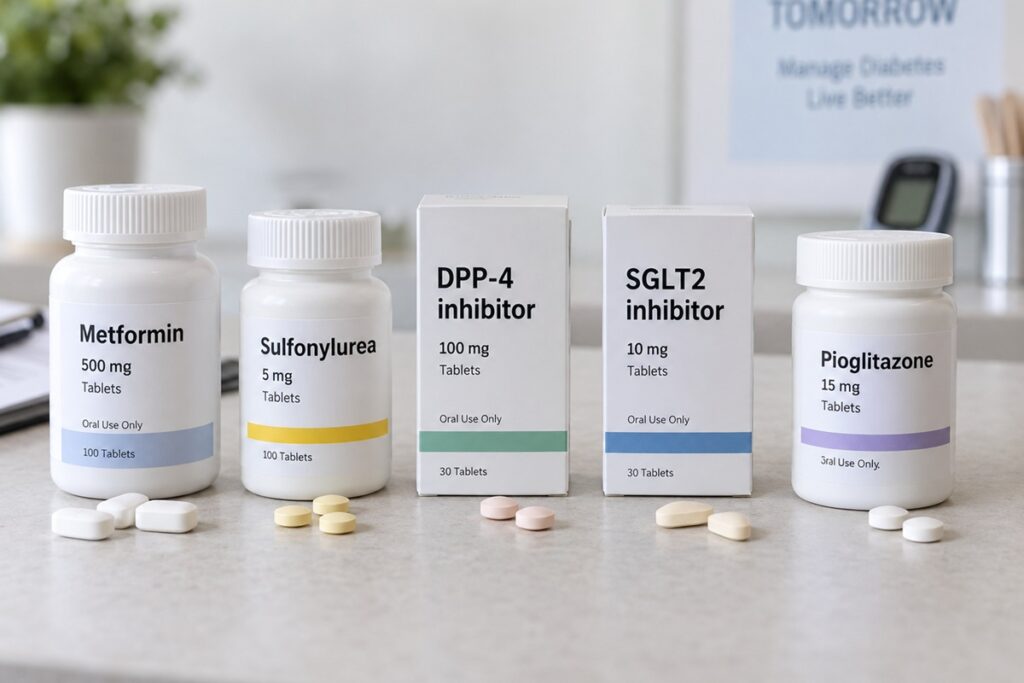
Metformin carries a boxed warning, which the FDA uses to highlight serious risks. The warning concerns lactic acidosis, a rare acid buildup. US labeling rules it out when kidney function, measured as eGFR (estimated glomerular filtration rate), is below 30 and advises against starting it between 30 and 45.
Long-term use can lower vitamin B12 levels. UKPDS 34 from 1998, part of the UK Prospective Diabetes Study, tested metformin against diet-based care in overweight people with newly diagnosed type 2 diabetes. It found fewer diabetes-related complications and deaths over about 11 years. The 2026 US guideline grades its heart effect as a potential benefit, not a proven one.
Sulfonylureas
These tablets make the pancreas release insulin whatever the glucose level, and low glucose and weight gain are their commonest side effects. CAROLINA in 2019 tested linagliptin against glimepiride in 6,033 people and found that 37.7% of participants on glimepiride had at least one low-glucose episode, compared with 10.6% on linagliptin.
Their US labels cover glucose lowering only. Gliclazide, the sulfonylurea on the World Health Organization (WHO) Essential Medicines List, has no US label; glipizide, glimepiride, and glyburide are the approved options in the United States.
DPP-4 inhibitors
These tablets prolong the action of GLP-1 and GIP and lower HbA1c modestly without weight gain. Heart trials for sitagliptin, alogliptin, linagliptin, and saxagliptin found neither benefit nor harm for major heart events.
Saxagliptin was linked to more hospital admissions for heart failure, with a hazard ratio of 1.27 in SAVOR-TIMI 53. The 2026 US guideline does not recommend adding a DPP-4 inhibitor to a GLP-1-based medicine because no extra glucose lowering follows.
SGLT2 inhibitors
These tablets raise urine glucose, and the extra sugar can make genital yeast infections and urinary infections more likely. Ketoacidosis (acid build-up when insulin is scarce), including cases with near-normal glucose, is a listed risk. Labels also warn about urinary tract infections, including serious infections, although randomized-trial analyses have not consistently found an increased overall UTI risk.
Their glucose-lowering effect fades when eGFR is below 45, but the 2026 US guideline supports starting or continuing them for heart and kidney benefit above 20. Canagliflozin once carried a boxed warning on leg and foot amputation, based on the CANVAS trial. The FDA removed that boxed warning in 2020 after reviewing more trial data, but amputation risk is still a concern, especially for people with poor circulation or a history of foot ulcers. The first generic dapagliflozin gained US approval in April 2026.
Pioglitazone
Pioglitazone improves insulin response but adds weight and fluid. US labeling carries a boxed warning that it can cause or worsen congestive heart failure. It is not recommended for people with symptomatic heart failure and must not be used in patients with severe heart failure classified as NYHA class III or IV. Other potential risks include bone fractures and a possible association with bladder cancer.
The 2026 US guideline grades the risk of heart failure as increased and advises against use in people with heart failure. Rosiglitazone’s US brand, Avandia, is discontinued.
Insulin, from daily injections to a weekly one
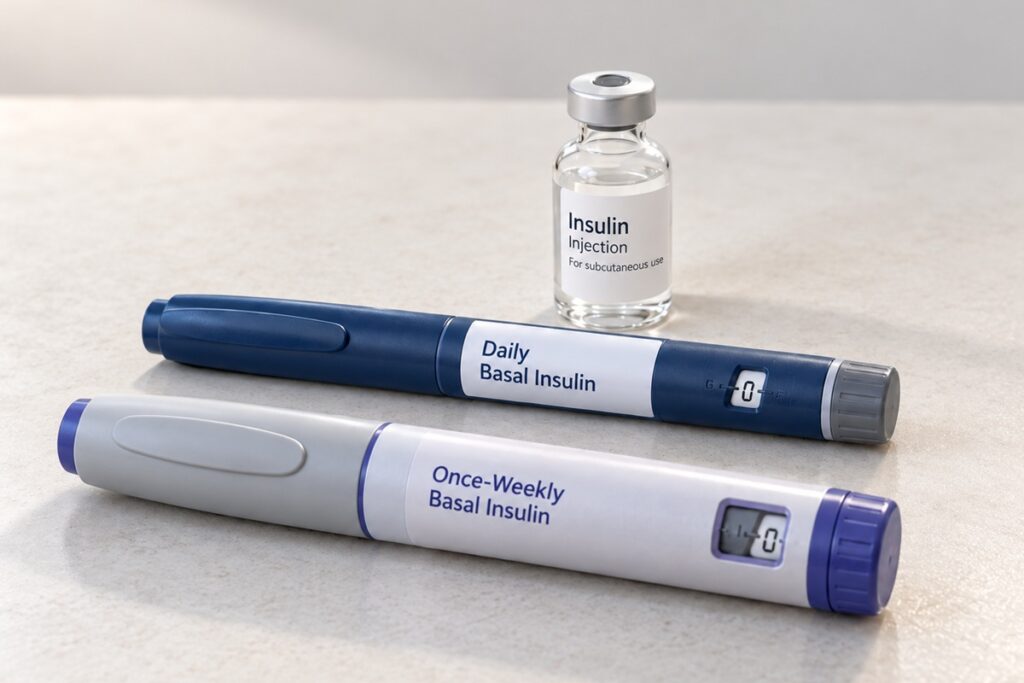
The 2026 US guideline suggests considering insulin where symptoms of high glucose are present or HbA1c is above 10% or glucose is at or above 300 mg/dL. Basal insulin (steady background insulin) alone is the most convenient start in that guideline, while other glucose-lowering medicines continue unless contraindicated or not tolerated.
The types include long-acting analogues such as glargine and degludec, human NPH (neutral protamine Hagedorn, an intermediate-acting insulin), rapid-acting analogues such as lispro and aspart, short-acting regular human insulin, and premixed and concentrated U-500 insulin.
The inhaled insulin Afrezza carries a boxed warning on bronchospasm in chronic lung disease, and the fixed-ratio pens Xultophy and Soliqua pair basal insulin with a GLP-1-based medicine. Awiqli, or insulin icodec, a once-weekly basal insulin that gained US approval on 26 March 2026, is approved for adults with type 2 diabetes. ONWARDS 1 followed 984 people with type 2 diabetes for 52 weeks; HbA1c fell 1.55 points on icodec against 1.35 on daily glargine.
Clinically significant or severe low-glucose events were 0.30 per person per year on icodec against 0.16 on glargine. In ORIGIN, glargine had no effect on heart events against standard care. Human insulin is in the 2026 US guideline’s lower-cost group, and the Essential Medicines List carries four insulin entries. Insulin is required from diagnosis in type 1 diabetes.
Less commonly used medicines
Meglitinides prompt a short burst of insulin around meals and are taken before eating. Alpha-glucosidase inhibitors delay carbohydrate digestion and often cause gas and diarrhea. Colesevelam, a cholesterol medicine that also lowers glucose slightly, by a route not well understood, causes constipation and can block absorption of other tablets.
Bromocriptine in quick-release form is taken once daily in the morning and often causes nausea. Pramlintide mimics amylin, a hormone released alongside insulin; it is used with mealtime insulin and carries a boxed warning for severe hypoglycemia. Bydureon BCise and albiglutide, sold as Tanzeum, are no longer marketed in the United States.
How guidelines choose and combine them
No guideline names one best medicine for all. Each weighs a person’s other conditions, the risk of low glucose, weight, and cost. The 2026 United States guideline suggests considering two medicines from the start to reach individual glucose goals sooner. For people with heart disease or a high risk of it, it favors medicines shown to reduce major heart events, whatever the HbA1c.
Where heart failure is present, it recommends an SGLT2 inhibitor for glucose control and fewer hospitalizations. For kidney disease, shown by an eGFR (a kidney-function measure) of 20 to 60 or by albuminuria, protein in the urine, it favors an SGLT2 inhibitor or GLP-1 receptor agonist with proven benefit. Where eGFR is below 30, it prefers a GLP-1 receptor agonist for glucose control because the risk of low glucose is lower. It also advises reassessing sulfonylureas, meglitinides, and insulin when any new glucose-lowering medicine starts.
The 2025 global guideline keeps metformin as the recommended first single medicine because of its global availability, efficacy, safety, low risk of low glucose, and cost-effectiveness. It finds emerging evidence for adding SGLT2 inhibitors or GLP-1 receptor agonists early, usually to metformin, but limited evidence exists for either as the first single treatment.
Starting two medicines together may keep glucose under control for longer than adding them one at a time. It notes that high cost and limited supply restrict incretin-based treatment (medicines that act like the gut hormones GLP-1 and GIP) where resources are low.
The 2020 primary-care module from WHO, HEARTS-D, names metformin as the recommended initial treatment, with gliclazide as an alternative where metformin cannot be used or tolerated. It does not recommend DPP-4 inhibitors, SGLT2 inhibitors, or thiazolidinediones for routine use because of cost.
That conflicts with the 2026 US lower-cost grouping, which includes thiazolidinediones and human insulin; the two documents cover different markets and years. In the United States, the first generic liraglutide was approved in December 2024. The 2025 Essential Medicines List includes metformin, gliclazide, empagliflozin, semaglutide, and four insulin types, with dulaglutide, liraglutide, and tirzepatide listed as alternatives to semaglutide. It omits DPP-4 inhibitors, pioglitazone, meglitinides and the rarely used tablets.
The information on this page is reference material, not medical advice.
Sources
- US prescribing labels (DailyMed): Mounjaro, Zepbound, Ozempic injection, oral semaglutide, Wegovy, Foundayo, Trulicity, Jardiance, Farxiga, Invokana, metformin, Glumetza, Awiqli, Afrezza, Cycloset, glimepiride, Glucotrol XL, 2026; Victoza, Actos, Januvia, Lantus, 2025; Welchol, 2024; Symlin, 2019.
- FDA approvals: Mounjaro approval history, Mounjaro heart-event approval letter, 2026; Mounjaro pediatric review, 2025; Zepbound sleep apnea approval, 2024; Zepbound approval, 2023.
- US Food and Drug Administration, first generics: dapagliflozin, 2026; liraglutide, 2024.
- Guidelines and medicine lists: ADA Standards, Section 9, 2026; IDF recommendations and WHO Essential Medicines update, 2025; WHO HEARTS-D, 2020.
- Treatment use: NCHS Data Brief 537, 2025; NCD Risk Factor Collaboration, 2024; Tang et al., 2023.
- SGLT2 inhibitor trials: EMPA-REG OUTCOME, 2015; CANVAS, 2017; DECLARE-TIMI 58, CREDENCE, 2019; DAPA-CKD, VERTIS CV, 2020; EMPA-KIDNEY, 2023.