Key takeaways
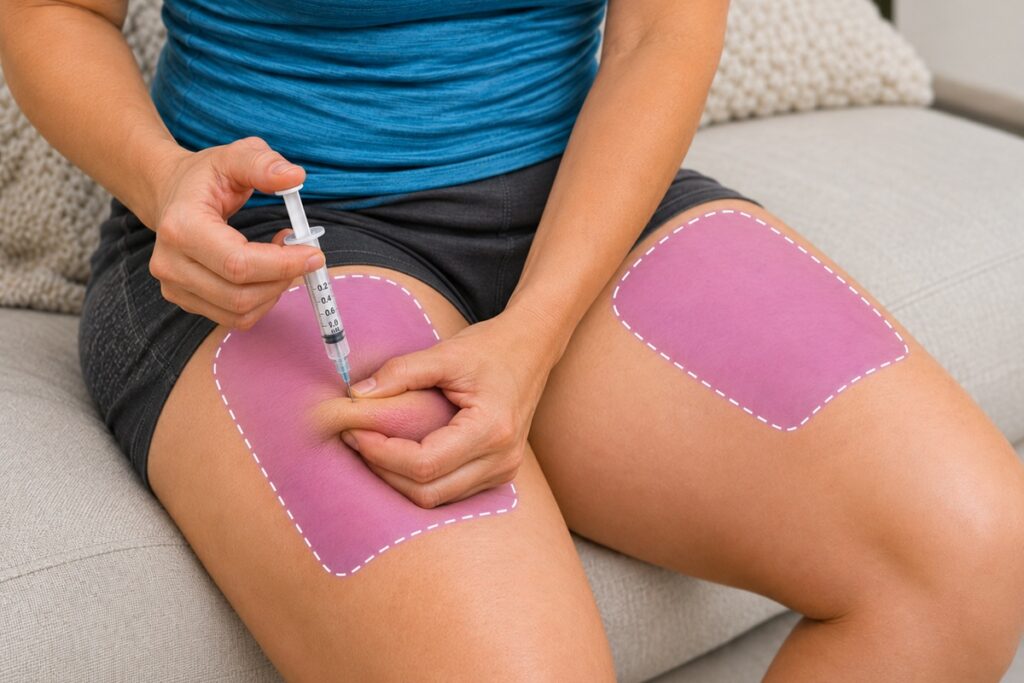
- Inject tirzepatide into the fatty tissue just beneath the skin, not into a muscle or vein. If you use a vial and syringe, your provider may instruct you to pinch a fold of skin to help ensure proper subcutaneous injection. Prefilled pens generally do not require skin pinching.
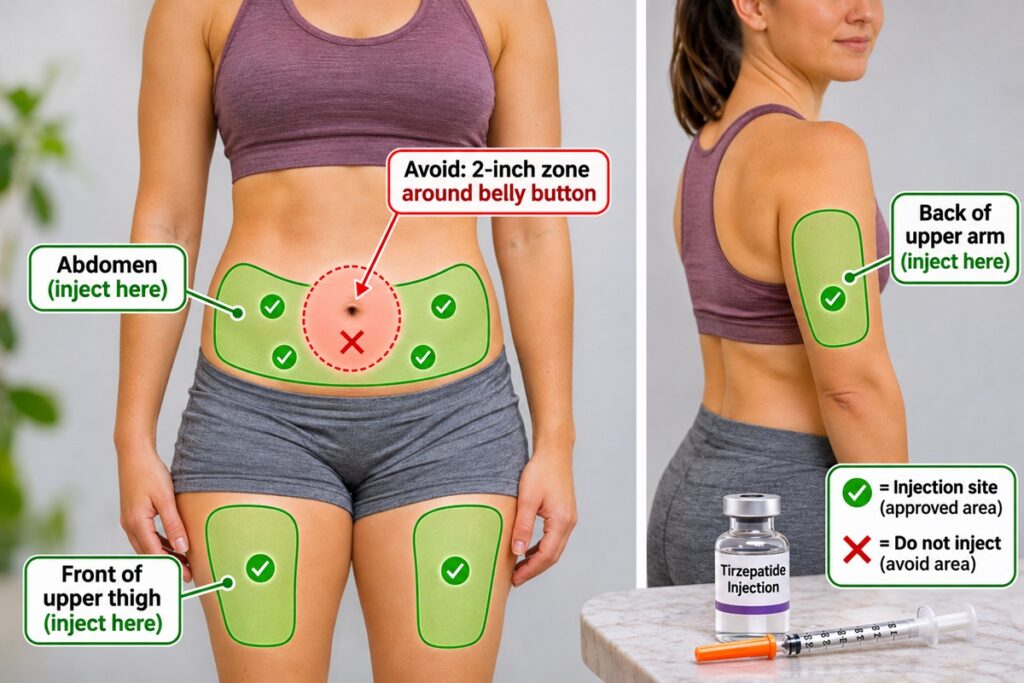
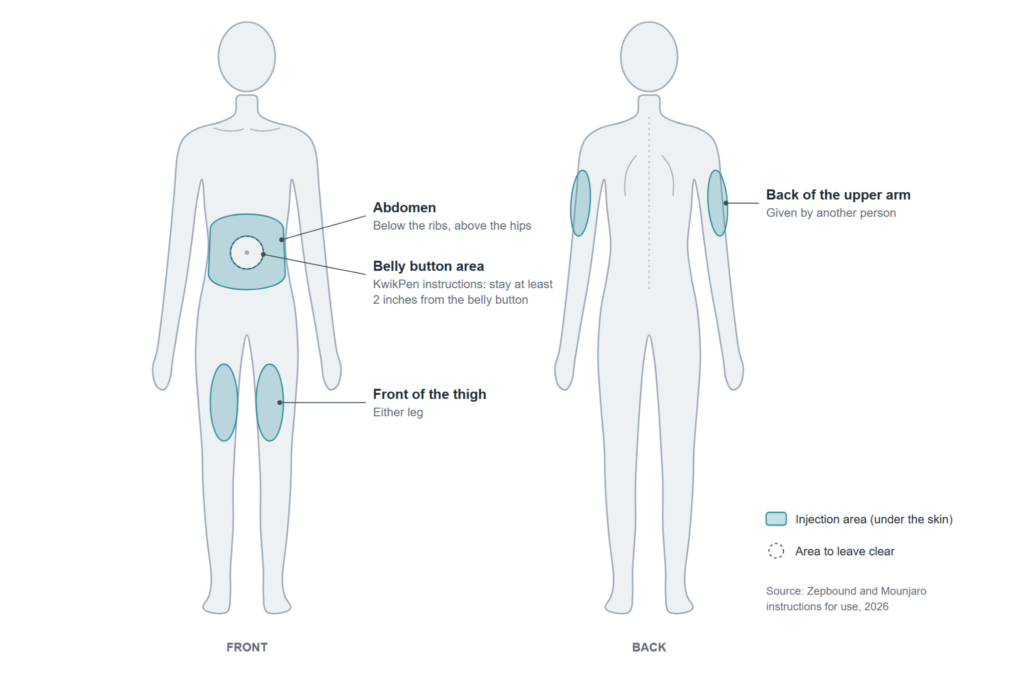
- Use your stomach at least 2 inches from the belly button, the front of either thigh, or the back of your upper arm when someone else gives the shot.
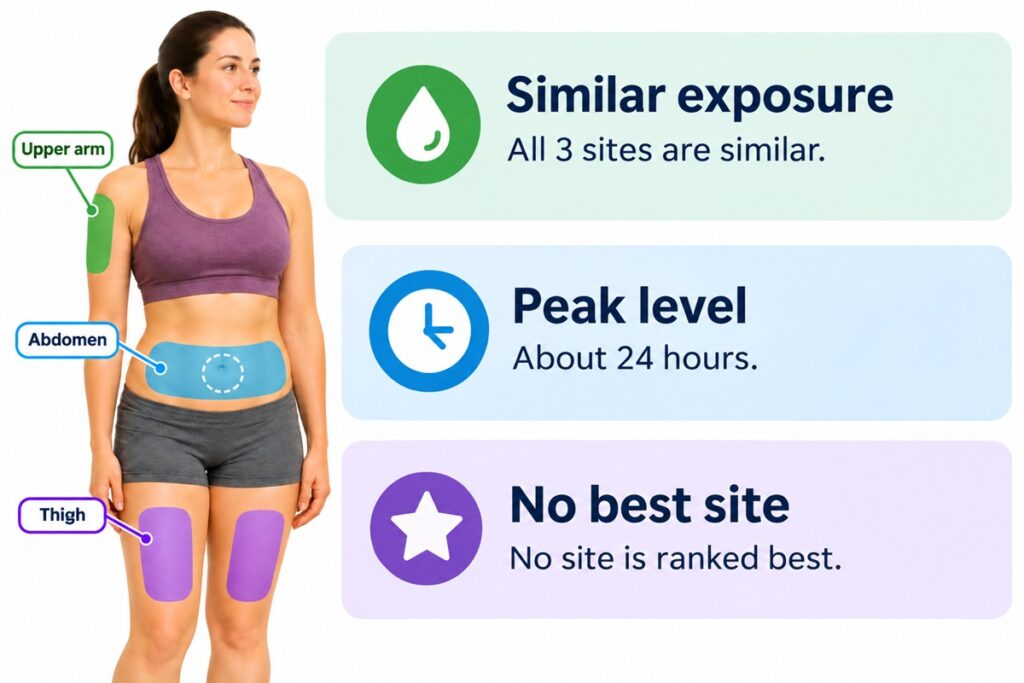
- There is no single best place to inject tirzepatide, since all three areas deliver a similar amount of medicine.
- Pick a new spot each week, a couple of inches from the last one, and staying in the same body area is fine.
- The steps and our short video show how to draw your dose from the vial and inject it so the full dose goes in.
Tirzepatide injection sites are the stomach, the front of the thigh, and the back of your upper arm, and each weekly dose goes just under the skin in a new spot. The same three areas apply to compounded tirzepatide in a vial and to Zepbound and Mounjaro pens.
Jump to the steps for your medicine:
Where to inject tirzepatide
Tirzepatide is given as a subcutaneous injection, into the layer of fat just under the skin, and never into a muscle or a vein. The Zepbound label and the Mounjaro label name the same three areas for every device.
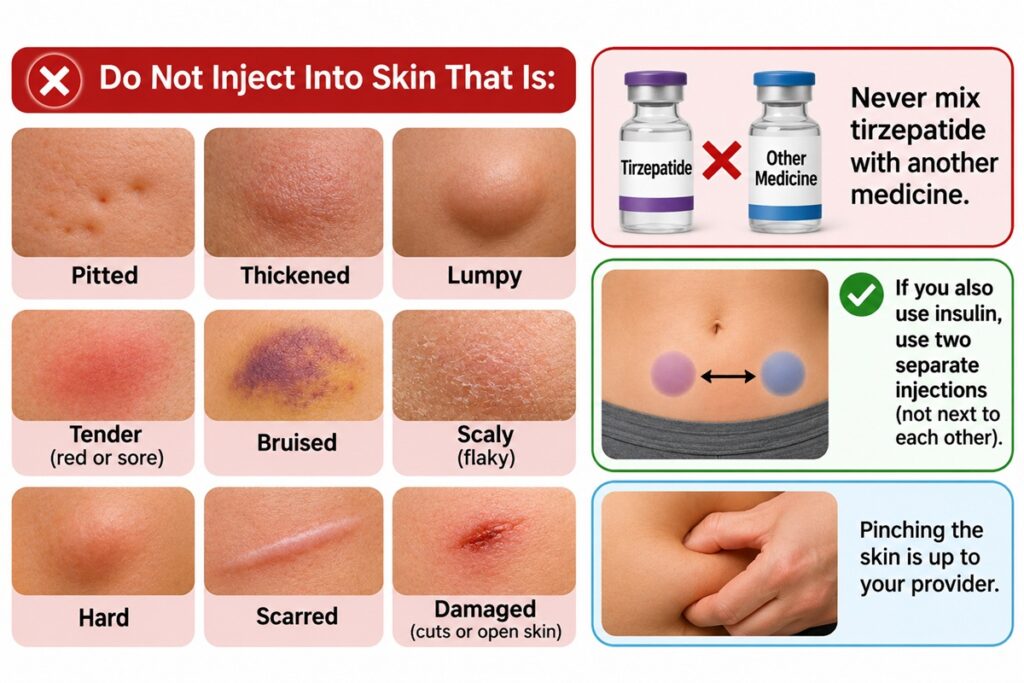
Pinching up a fold of skin before the needle goes in lifts the fat away from the muscle. Compounded vial instructions tell you to pinch, while the Zepbound and Mounjaro vial instructions leave it to your provider, so follow the instructions that came with your prescription.
Stomach (abdomen)
The stomach is the easiest area to see and reach when you are starting out. Use any part of it at least 2 inches from the belly button. Avoid skin that is bruised, tender, hardened, scarred, irritated, or otherwise damaged.
Front of the thigh
The tirzepatide injection site on the thigh is the front of the thigh, around the middle, since the labels name only the thigh and their drawings shade that area. Either leg works, and the labels give no inner thigh or outer thigh rule.
Back of the upper arm
The back of the upper arm works only when another person gives the shot. The back of your own arm is hard to see, reach, and pinch, so keep this area for weeks when someone can help.
Which injection site is best
The best injection site for tirzepatide is the one you can use comfortably every week because all three areas deliver a similar amount of medicine. Compounded vial instructions say to choose the spot that feels most comfortable and to rotate weekly.
A study run by Eli Lilly and completed in April 2020 gave 54 healthy adults one 5 mg dose in each area, in random order and at least 35 days apart. Compared with the abdomen, total medicine in the blood was 99% from the upper arm and 95% from the thigh. Peak level was 92% from the upper arm and 86% from the thigh.
The study measured only blood levels after a single dose in healthy adults. It reported no weight, blood sugar, or repeated-dose results, so no site has been shown to work better for weight loss.
Skin to avoid
Skip any spot that shows:
- pits, thickening, or lumps
- tenderness, bruising, scaliness, or hardness
- scars or damaged skin
- a spot used for other medicines
Never mix tirzepatide with another medicine in the same syringe. If you also use insulin, the Mounjaro label says to give it as a separate injection and not right next to the tirzepatide spot, even in the same body area.
In this one-minute video, a registered dietitian nutritionist at Peak Wellness shows a full injection from a vial, from washing your hands to the sharps container.
How to rotate injection sites
Use a new tirzepatide injection site every week, and staying in the same body area is fine. The labels give no set distance between spots, but a couple of inches from last week’s spot keeps you off the skin you just used.
The vial instructions explain why rotation matters. It lowers the risk of lipodystrophy (pits in the skin or thickened skin) and localized cutaneous amyloidosis (lumps in the skin) at the spots you use. You do not need a different body part every week for that.
An easy way to remember your injection site
Remembering last week’s spot gets confusing fast, and a fixed four-week routine removes the guesswork. Write down the date and the spot each week in a note on your phone.
Follow an order like the example below:
- Week 1, right side of the belly button.
- Week 2, front of the right thigh.
- Week 3, left side of the belly button.
- Week 4, front of the left thigh.
- Week 5, back to week 1.
The back of the arm can join the routine in any week when someone can give the shot.
Log every shot in our free tirzepatide injection tracker Google Sheet below, and next week’s spot will already be written down for you. Or print the PDF and keep it beside your vials.
How to inject compounded tirzepatide from a vial
Compounded tirzepatide comes in a multi-dose vial, and you measure each dose with a syringe. Compounded drugs are not FDA-approved, so no FDA review checks their safety, effectiveness, or quality before a pharmacy sells them. Follow the label on your vial and your prescriber’s instructions for your dose.
What you need before your first injection
Gather these items before you start:
- the vial
- a new syringe for every dose
- alcohol wipes
- gauze or a cotton ball
- a sharps container
Check the vial label for your name, your dose, and the beyond-use date. If the vial looks cracked, damaged, or leaking, contact your care team before you use it.
Milligrams and syringe units are not the same, and the number of units you draw depends on the strength printed on your vial. The prescribed tirzepatide dose is measured in milligrams (mg), while the amount drawn into a syringe is measured by volume, usually in milliliters (mL). Some syringes display volume using unit markings. These measurements are not interchangeable.
Because compounded tirzepatide can come in different concentrations, patients should obtain exact written instructions from their pharmacist or prescriber specifying both the injection volume and the correct syringe markings. Do not calculate or change the injection volume independently. Never change your dose unless your provider tells you to.
Step-by-step injection from a vial
Work through these steps in order:
- Wash your hands and gather your supplies.
- Pop the cap off the vial and clean the top with an alcohol wipe.
- Clean your chosen spot with an alcohol wipe and let the skin dry fully.
- Pull the plunger back to draw air into the syringe equal to your dose.
- Insert the needle into the vial, push the air in, then turn the vial upside down.
- Draw your prescribed amount slowly. If a large bubble appears, tap the syringe so it rises to the top, then adjust the plunger to your dose.
- Pinch your skin, insert the needle at a 90-degree angle, and hold it steady. Note: Many short subcutaneous needles are inserted at a 90-degree angle, but technique may vary depending on the needle and the amount of tissue beneath the skin. Follow your provider’s instructions.
- Push the plunger slowly all the way down and keep the needle in the skin for at least 5 seconds.
- Pull the needle out. If you see blood, press gauze or a cotton ball on the spot without rubbing.
- Place the syringe straight into a sharps container, and never reuse, recap, or share the syringe and needle.
Storing the vial and when to throw it away
Store the vial as the pharmacy’s label directs, and do not freeze it or let it get hot. The FDA generally recommends using a multi-dose vial within 28 days of first use and throwing it away after that, even if medicine is left.
That 28-day limit holds even when the pharmacy’s instructions allow longer. Each dose needs a fresh sterile needle and syringe, and neither is ever shared.
If you inject the wrong dose
Contact your prescriber or care team right away if you think you injected too much or the wrong dose. For severe symptoms, get medical help right away or call 911.
The FDA has received reports of side effects, some leading to hospital care, possibly caused by people measuring the wrong dose from compounded semaglutide vials. Comparing the units with your vial’s strength before every injection helps you avoid that mistake.
What is normal after an injection
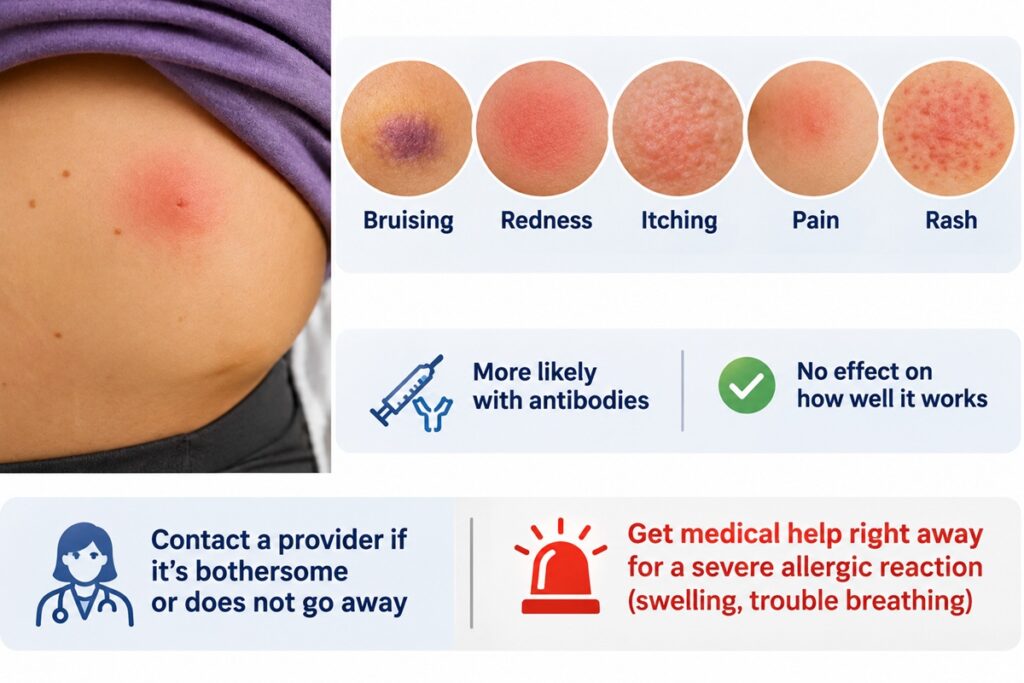
A little redness, itching, bruising, or soreness where the needle went in is a typical tirzepatide injection site reaction. In Zepbound trials lasting up to 72 weeks, reactions occurred in 6% of adults on 5 mg and 8% on 10 mg or 15 mg, compared with 2% on placebo.
In Mounjaro trials, reactions occurred in 3.2% of adults compared with 0.4% on placebo. In the Zepbound trials, they occurred in 11.3% of people who developed antibodies to tirzepatide compared with 1% of those who did not.
Talk to your provider about any reaction that bothers you or does not go away, and read about other tirzepatide side effects such as nausea. Pits, lumps, or thickened skin at old spots are the changes rotation helps prevent, so skip that skin and tell your provider when they appear.
Get medical help right away for signs of a serious allergic reaction:
- swelling of the face, lips, tongue, or throat
- trouble breathing or swallowing
- severe rash or itching
- fainting or dizziness
- a very rapid heartbeat
Zepbound and Mounjaro injection sites and pens
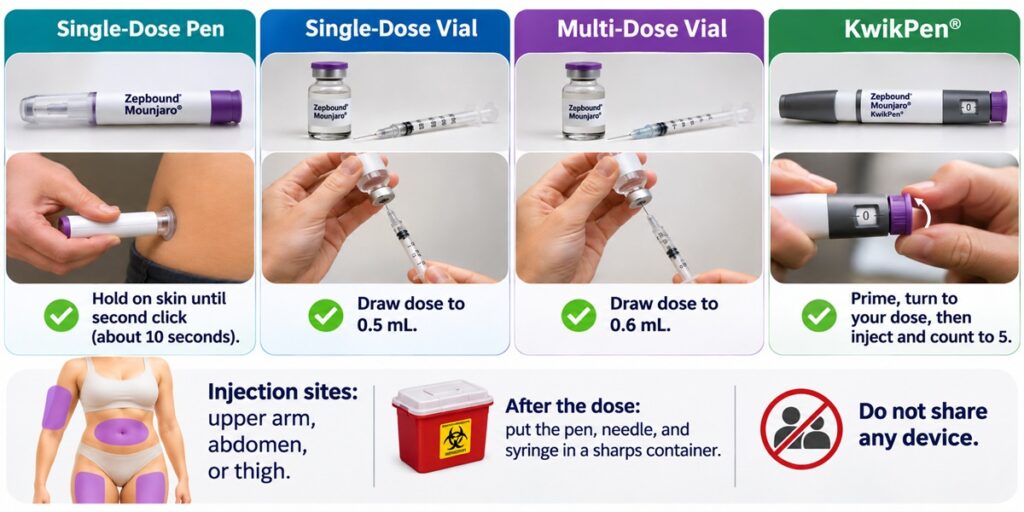
The same three areas apply to every brand device, and the back of the upper arm is still for a helper only. Lilly’s Zepbound how-to page and Mounjaro how-to page show each device with a video and step-by-step drawings.
Single-dose pen
The single-dose pen holds one fixed dose with a built-in needle, and it does not need warming first. Place the clear base flat on the skin, unlock the pen, then press and hold the button for up to 10 seconds, until the second loud click.
The first click tells you the injection has started, and the gray plunger shows when the full dose is in. The whole pen then goes into a sharps container.
KwikPen
The KwikPen holds four weekly doses. Prime it before every weekly injection and use a new pen needle each time, and keep stomach shots at least 2 inches from the belly button, as its instructions say.
Turn the dose knob until it stops, then push it in while you slowly count to 5. Throw the pen away after four doses or 30 days, and never share it, even with a new needle.
Zepbound and Mounjaro vials
The single-dose vial is drawn to the 0.5 mL line and the multi-dose vial to the 0.6 mL line, with a new 1 mL syringe each time. The rest of the injection follows the vial steps for compounded tirzepatide, including keeping the needle in for at least 5 seconds.
Note: These steps are for educational purposes and do not constitute medical advice.
Sources
- Injection sites, rotation and skin to avoid: Zepbound label, 2026; Mounjaro label, 2026
- Which site is best: Eli Lilly injection site study, NCT04050670, ClinicalTrials.gov, 2023
- Injecting from a vial: Peak Wellness How to Inject video, 2026; FDA Concerns with Unapproved GLP-1 Drugs Used for Weight Loss, 2026
- Injection site reactions: Zepbound label, 2026; Mounjaro label, 2026
- Brand pens and vials: Lilly How to Use Zepbound, 2026; Lilly How to Use Mounjaro, 2026