Key takeaways
- The 2009 harmonized definition uses any three of five measures: large waist, high triglycerides, low HDL cholesterol, raised blood pressure, and raised fasting glucose.
- Worldwide prevalence more than doubled, from 11.9% of adults in 2000 to 28.4% in 2023, reaching an estimated 1.54 billion adults.
- Metabolic syndrome is linked with a 3.53 to 5.17 times higher relative risk of type 2 diabetes, depending on the definition used.
Metabolic syndrome is a cluster of five linked measurements that together mark higher risk of type 2 diabetes and cardiovascular disease.
An estimated 1.54 billion adults worldwide had metabolic syndrome in 2023, 28.4% of adults. Fat stored deep inside the abdomen helps drive the process. That fat releases fatty substances and inflammatory signals into the blood.
Cells then respond less well to insulin, the hormone that lets glucose leave the blood and enter cells, so blood glucose, blood fats, and blood pressure rise together.
Diagnosing metabolic syndrome: the five measurements
You do not need all five in the cluster to be diagnosed with metabolic syndrome, and none is required on its own. Any three of the five following measurements qualify:
| Measurement | Cut-off for the syndrome |
|---|---|
| Waist circumference | 40 inches in men and 35 inches in women in United States guidance; the International Diabetes Federation recommends lower thresholds for some populations, including 37 inches (94 cm) for European men and 31.5 inches (80 cm) for European women, and 35.4 inches (90 cm) for South Asian men and 31.5 inches (80 cm) for South Asian women. |
| Triglycerides | 150 mg/dL or more |
| HDL cholesterol | Below 40 mg/dL in men or below 50 mg/dL in women |
| Blood pressure | 130 mm Hg systolic or more, or 85 mm Hg diastolic or more, including high blood pressure on treatment |
| Fasting glucose | 100 mg/dL or more |
Triglycerides are a type of fat carried in the blood. HDL cholesterol is the form often called “good” cholesterol. Fasting glucose is blood glucose after not eating, usually overnight. Blood values are given in milligrams per deciliter (mg/dL).
Treatment for raised triglycerides, low HDL cholesterol, raised blood pressure, or raised glucose counts toward that measure. The blood measurements usually cause no symptoms, but waist size is an easily observable metric. Very high glucose can cause thirst, frequent urination, tiredness, and blurred vision.
2009 harmonized definition; United States inch values from the 2005 AHA/NHLBI statement; other inch values converted from the published centimeter limits
How common is metabolic syndrome?
Prevalence of metabolic syndrome worldwide has more than doubled since 2000, and it rises with age, urbanization, and poverty.
| Population | Prevalence | Year | Definition used |
|---|---|---|---|
| Adults worldwide | 11.9% | 2000 | Harmonized, waist by region |
| Adults worldwide | 28.4% | 2023 | Harmonized, waist by region |
| Women worldwide | 31.0% | 2023 | Harmonized, waist by region |
| Men worldwide | 25.7% | 2023 | Harmonized, waist by region |
| Adults in the United States | 34.7%, 48.6% at age 60 and over | 2011 to 2016 | NCEP ATP III |
| Adults in the United States | 41.8% | 2017 to 2018 | At least three of five components |
The worldwide and United States figures use different definitions and are not directly comparable.
Worldwide rows from Noubiap et al. 2025; United States 2011 to 2016 rows from Hirode and Wong 2020; United States 2017 to 2018 row from Liang et al. 2023
Tirzepatide benefits and metabolic syndrome
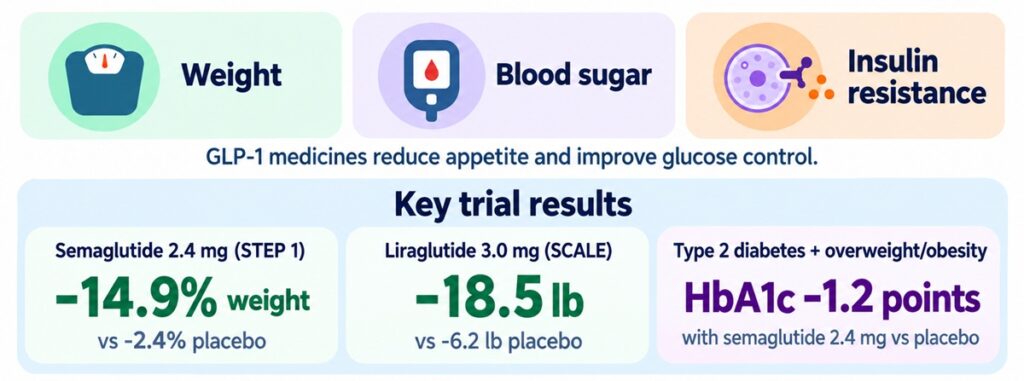
Tirzepatide (Mounjaro, Zepbound) selectively binds to and activates both the GIP and GLP-1 receptors. It enhances first- and second-phase insulin secretion, and reduces glucagon levels, both in a glucose-dependent manner. It lowers fasting and postprandial glucose concentration, decreases food intake, and reduces body weight in patients with type 2 diabetes mellitus.
Mounjaro is approved as an adjunct to diet and exercise to improve glycemic control in adults and pediatric patients 10 years of age and older with type 2 diabetes mellitus. It is also approved to reduce the risk of major adverse cardiovascular events in adults with type 2 diabetes mellitus who are at high risk for these events.
Zepbound is approved, together with a reduced-calorie diet and more physical activity, to reduce excess body weight and maintain weight reduction long term in adults with obesity or adults with overweight in the presence of at least one weight-related comorbid condition. It is also approved to treat moderate to severe obstructive sleep apnea (OSA) in adults with obesity.
The table shows cardiometabolic changes at 72 weeks. In adults with obesity or overweight without type 2 diabetes, waist circumference fell about 5.5, 7.0, and 7.3 inches with tirzepatide versus about 1.6 inches. Systolic blood pressure change from baseline was -6.6, -7.7, and -7.4 mmHg with 5 mg, 10 mg, and 15 mg versus -1.0 mmHg with placebo.
Triglycerides were -21.2%, -23.8%, and -29.1%, and HDL cholesterol was +6.9%, +9.2%, and +8.0%, versus placebo changes of -5.6% and -0.7%. In adults with type 2 diabetes and overweight or obesity, HbA1c change was -2.1 percentage points with tirzepatide versus -0.5 percentage points with placebo. Blood pressure and cholesterol findings were supportive, not primary, results.
Primary causes: abdominal fat and insulin resistance
Behind the five measurements are two linked problems: fat stored deep in the abdomen and the insulin resistance that fat helps bring about. This visceral fat, which sits around the internal organs rather than under the skin, releases free fatty acids (fat fragments that circulate in the blood) and chemicals linked with inflammation.
Those signals leave cells in muscle, fat, and liver less responsive to insulin, a state known as insulin resistance. The pancreas then makes extra insulin to hold blood glucose down, and when that extra insulin is not enough, fasting glucose rises.
The same disturbance raises triglycerides and blood pressure and lowers HDL cholesterol. Immune cells in the expanded fat add further inflammatory signals, and inflammation itself worsens insulin resistance and may contribute to heart and blood vessel disease.
No single cause of metabolic syndrome is established. The process seems to be largely insulin resistance with a large flow of fatty acids, with a proinflammatory state probably adding to it. Abdominal obesity and insulin resistance are the most important underlying factors, but inactivity, aging, hormonal imbalance, and genetic or ethnic predisposition are also associated.
Some groups are more likely to develop the syndrome. Likelihood rises with older age. Inactivity, an unhealthy diet, poor sleep, smoking, and heavy drinking all raise it.
Shift work that disturbs the daily sleep cycle is linked with it. Family history of type 2 diabetes, diabetes during pregnancy, and low socioeconomic position are linked with higher occurrence. Polycystic ovary syndrome, sleep apnea, psoriasis, and some cancer treatments that affect immunity are also associated with it.
Additionally, some medicines can contribute to weight gain, insulin resistance, or other metabolic abnormalities. Examples include systemic corticosteroids, some atypical antipsychotics, selected antidepressants, and certain antiretroviral medications. The degree of risk varies considerably among individual drugs.
In general, overweight and obesity rank as the leading risk factors, since they can raise triglycerides, LDL cholesterol, and blood pressure and lower HDL cholesterol. In older adults, women have it more often than men, in part through changes after menopause.
US National Heart, Lung, and Blood Institute, 2022; AHA/NHLBI statement, 2005; a 2005 review in The Lancet
Can metabolic syndrome cause other cardiovascular diseases?
Your relative risk for some cardiovascular conditions increases with metabolic syndrome. Relative risk compares the chance of an event in people with the cluster against the chance in people without it. A relative risk of 2.0 means twice the chance over the study period, not a 2% chance and not twice the chance for every person.
| Outcome | Relative risk with the syndrome |
|---|---|
| Cardiovascular disease | 2.35 times |
| Death from cardiovascular disease | 2.40 times |
| Stroke | 2.27 times |
| Heart attack | 1.99 times |
| Death from any cause | 1.58 times |
| Type 2 diabetes | 3.53 to 5.17 times, depending on the definition used |
Cardiovascular rows from Mottillo et al. 2010, in Journal of the American College of Cardiology; diabetes rows from Ford et al. 2008; MASLD from the 2023 nomenclature consensus in Hepatology
The diabetes link strengthens as more components are present. In people with four or more abnormal components, estimates for later diabetes ranged from 10.88 to 24.4 times. The cardiovascular link remains high in people with the syndrome who do not have diabetes.
Without diabetes, the absolute chance of a major coronary event in the next 10 years is not necessarily high, because that short-term chance also depends on age, sex, smoking, and total cholesterol. The figure citing an increase for cardiovascular disease comes from prospective studies using NCEP definitions.
The condition often described as the liver form of the syndrome, fatty liver disease, was renamed in 2023 to MASLD. It stands for metabolic dysfunction-associated steatotic liver disease, which is caused by fat buildup in the liver with at least one cardiometabolic risk factor. Its criteria are not meant to diagnose metabolic syndrome or to predict cardiovascular outcomes on their own.
Metabolic syndrome, type 2 diabetes, and cardiovascular disease are often grouped as cardiometabolic disease. Obstructive sleep apnea is also common in people with the syndrome, because excess weight drives both. Bed partners can share the symptoms, but sleep apnea is not contagious.
Can metabolic syndrome be reversed?
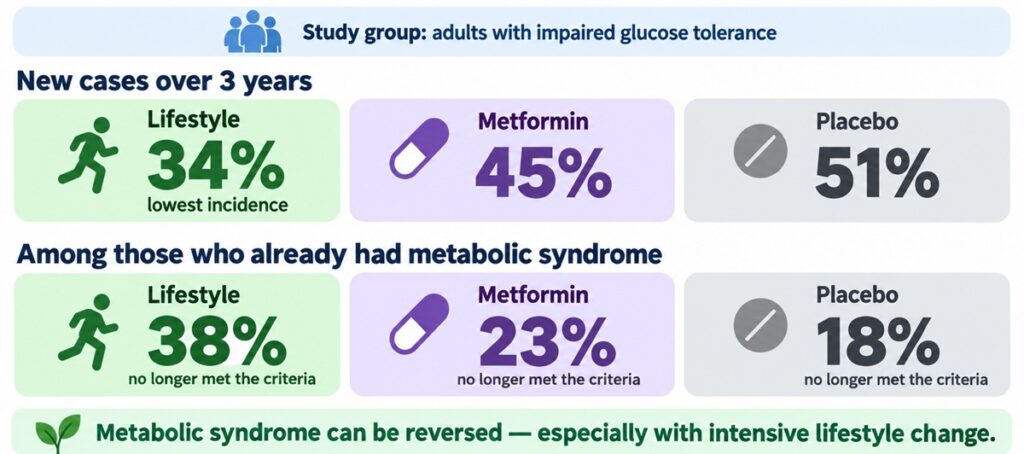
Yes, with the Diabetes Prevention Program, reported in Orchard et al. 2005, enrolled volunteers in the United States with impaired glucose tolerance, blood glucose above normal but below the diabetes range. Just over half, 53%, met the syndrome criteria at the start.
One group followed an intensive lifestyle program aimed at 7% weight loss and 150 minutes of activity per week. A second group received metformin. A third received placebo. Over about three years, new cases of the syndrome fell by 41% in the lifestyle group and by 17% in the metformin group, compared with placebo. By three years, approximately 38% of participants in the lifestyle group, 47% in the metformin group, and 53% in the placebo group had developed metabolic syndrome. The same weight loss that prevents the syndrome can also produce remission after sustained weight loss in people who already have type 2 diabetes.
Among those who had the syndrome at the start, 38% in the lifestyle group, 23% in the metformin group and 18% in the placebo group no longer met the criteria after three years. Note that the trial population was volunteers with impaired glucose tolerance, so the result may not generalize to all adults with the syndrome.
Disparities in worldwide estimates
Five definitions from 1998 to 2009 disagree on whether any component is mandatory, on the glucose and blood pressure limits, and on waist size by population. That disagreement affects prevalence data even when the same people are measured.
| Definition | Required component | Glucose cut-off | Blood pressure cut-off | Waist rule |
|---|---|---|---|---|
| WHO 1998 | Insulin resistance | Impaired tolerance, impaired fasting glucose, diabetes, or clamp-measured resistance | 140/90 mm Hg | Waist-to-hip ratio above 0.90 in men or 0.85 in women, or body mass index above 30 |
| NCEP ATP III 2001 | None, any three of five | 110 mg/dL or higher | 130/85 mm Hg | 40 in in men, 35 in in women |
| IDF 2005 | Large waist plus any two others | 100 mg/dL, includes diabetes | 130/85 mm Hg | About 37 in and 31.5 in in Europid populations; about 35.5 in and 31.5 in in Asian populations |
| AHA/NHLBI 2005 | None, any three of five | 100 mg/dL | 130/85 mm Hg, or treatment | 40 in and 35 in, with lower limits for Asian Americans |
| Harmonized 2009 | None, any three of five | 100 mg/dL | 130/85 mm Hg, or treatment | Population and country specific |
The 2001 glucose limit of 110 mg/dL fell to 100 mg/dL in 2004, in line with a revised fasting glucose threshold. Drug treatment for triglycerides, HDL cholesterol, blood pressure, and glucose counts from 2005 onward. Only the earliest definition counts microalbuminuria, small amounts of protein in urine.
Applied to pooled data on about 28 million people, those choices gave worldwide prevalence from 12.5% to 31.4% depending on the definition, in a 2022 meta-analysis. Waist limits still vary by country, including a higher limit for women than men in Japan, so a person counted in one country can fall outside the count in another without any change in health.
Global health monitoring and metabolic syndrome

No indicator in the global Sustainable Development Goal framework names metabolic syndrome, blood pressure, blood glucose, or adult obesity. Indicator 3.4.1 counts deaths from cardiovascular disease, cancer, diabetes, and chronic respiratory disease between exact ages 30 and 70.
The syndrome enters that count only through the deaths it may lead to, since the syndrome itself is not recorded as an underlying cause of death. It belongs with the noncommunicable diseases as a risk cluster, not as a counted cause.
The global monitoring framework for noncommunicable disease, adopted in 2013, counts components rather than the cluster. It defines raised blood pressure from 140/90 mm Hg and raised fasting glucose from 126 mg/dL. The syndrome counts the same signals from 130/85 mm Hg and 100 mg/dL. Its figures therefore cannot be combined into a syndrome figure, and a person can meet the syndrome limits for blood pressure and glucose without appearing in either monitoring indicator.
UN Statistics Division, global indicator framework after the 2025 review and indicator 3.4.1 metadata, 2024; WHO NCD Global Monitoring Framework, 2013
Is metabolic syndrome a diagnosis?
The standing of the cluster as a diagnosis is disputed. A 2005 joint statement of two diabetes associations found it “imprecisely defined,” citing considerable doubt about its value as a marker of cardiovascular risk, and judged that too much was missing for it to be called a syndrome. A 2010 expert consultation, reported in Diabetologia, called it useful for teaching but of “limited practical utility as a diagnostic or management tool,” describing it as “a pre-morbid condition rather than a clinical diagnosis.”
The same consultation held that the concept ought to exclude people with established diabetes or known cardiovascular disease, since it was meant to flag risk before disease. The 2009 definition takes the opposite practical position, noting that most people with type 2 diabetes meet its criteria. Whether the cluster predicts events beyond its combined components remains open, with calls for direct tests of that added value.
ICD, or International Classification of Diseases, is the system used to code causes of illness and death. Since 1 October 2023, the clinical version used in the United States has a specific code for the syndrome, E88.810, under metabolic disorders. The international ICD-10 has no dedicated category for it. ICD-11 lists metabolic syndrome as an index term under 5A44, insulin-resistance syndromes, alongside rare insulin resistance conditions, with no code of its own.
This page describes definitions and population figures for reference and gives no guidance on diagnosis or treatment for any person.
Sources
- Noubiap JJ et al., Worldwide trends in metabolic syndrome from 2000 to 2023: a systematic review and modeling analysis, Nature Communications, 6 Dec 2025.
- Noubiap JJ et al., Geographic distribution of metabolic syndrome and its components in the general adult population: a meta-analysis of global data from 28 million individuals, Diabetes Research and Clinical Practice, 2022.
- Hirode G, Wong RJ, Trends in the prevalence of metabolic syndrome in the United States, 2011-2016, JAMA, 2020.
- Liang X et al., Prevalence of metabolic syndrome in the United States National Health and Nutrition Examination Survey 2011-18, Postgraduate Medical Journal, 2023.
- Grundy SM et al., Diagnosis and management of the metabolic syndrome, Circulation, Oct 2005.
- Alberti KG et al., Harmonizing the metabolic syndrome, Circulation, 20 Oct 2009.
- Eckel RH et al., The metabolic syndrome, The Lancet, 2005.
- Mottillo S et al., The metabolic syndrome and cardiovascular risk, Journal of the American College of Cardiology, 2010.
- Ford ES et al., Metabolic syndrome and incident diabetes, Diabetes Care, 2008.
- Rinella ME et al., A multisociety Delphi consensus statement on new fatty liver disease nomenclature, Hepatology, 2023.
- Orchard TJ et al., The effect of metformin and intensive lifestyle intervention on the metabolic syndrome, Annals of Internal Medicine, 2005.
- Wilding JPH et al., Once-weekly semaglutide in adults with overweight or obesity, New England Journal of Medicine, 2021.
- Kosiborod MN et al., Semaglutide improves cardiometabolic risk factors in adults with overweight or obesity: STEP 1 and 4 exploratory analyses, Diabetes, Obesity and Metabolism, 2023.
- Pi-Sunyer X et al., A randomized, controlled trial of 3.0 mg of liraglutide in weight management, New England Journal of Medicine, 2015.
- Kahn R et al., The metabolic syndrome: time for a critical appraisal, Diabetes Care, 2005.
- Simmons RK et al., The metabolic syndrome: useful concept or clinical tool?, Diabetologia, 2010.
- National Heart, Lung, and Blood Institute, Metabolic syndrome causes and risk factors, 18 May 2022.
- DailyMed, Wegovy labeling, Saxenda labeling, Ozempic labeling 2026.
- CDC NCHS, ICD-10-CM FY2024 addenda, 2023.
- World Health Organization, ICD-10 2019, 2019.
- World Health Organization, ICD-11 MMS 2026-01, 2026.
- United Nations Statistics Division, Global indicator framework, after 2025 review.
- United Nations Statistics Division, SDG indicator metadata for 3.4.1, last updated 20 Dec 2024.
- World Health Organization, NCD Global Monitoring Framework, 2013.