Key takeaways
- Sleep apnea and snoring are not contagious and cannot pass from one person to another.
- Bed partners share disturbed nights, not narrowed airways; loud snoring, gasps and pauses can keep them awake.
- A 1999 Minnesota study of 10 married couples found CPAP raised spouses’ sleep efficiency from 74% to 87%, about 62 extra minutes nightly.
- Snoring is not the same as OSA: many snorers have no OSA, and some with OSA snore little. Loud snoring alone does not show apnea.
Sleep apnea is not contagious and cannot pass from one person to another. In obstructive sleep apnea (OSA), soft tissue in the throat and the tongue narrow or close the airway during sleep. Breathing stops or becomes shallow until the brain briefly wakes the sleeper and air flows again.
No germ causes that narrowing, so sleep apnea is a non-communicable condition and not an infection. Central sleep apnea, a rarer form in which the brain’s signal to breathe falters, involves no germ either. OSA lasts for years and is closely linked with weight, blood pressure and blood sugar.
Why sleep apnea can seem to pass between bed partners

If you share a bed with someone who has OSA, you share their disturbed nights, not their narrowed airway. Loud snoring, gasps and pauses keep the partner awake, and the partner’s daytime tiredness can look like the same condition.
A 1999 study in Minnesota measured this in 10 married couples. Both partners had overnight sleep studies, and partway through the night the patient was given CPAP, a machine that blows air through a mask to hold the throat open.
Once the patient was treated, the spouses woke less often. Their sleep efficiency, the share of time in bed spent asleep, rose from 74% to 87%, which the authors put at about 62 extra minutes of sleep a night.
OSA is also common enough for both people in a home to have it. A Wisconsin cohort analysis used sleep studies in 1,520 adults aged 30 to 70 to estimate US rates for 2007 to 2010. It counted moderate to severe apnea as 15 or more pauses and shallow-breathing episodes an hour, a measure called the apnea-hypopnea index (AHI).
On that measure, 10% of men and 3% of women aged 30 to 49 had it, rising to 17% of men and 9% of women aged 50 to 70.
The GIP and GLP-1 medicine approved for sleep apnea
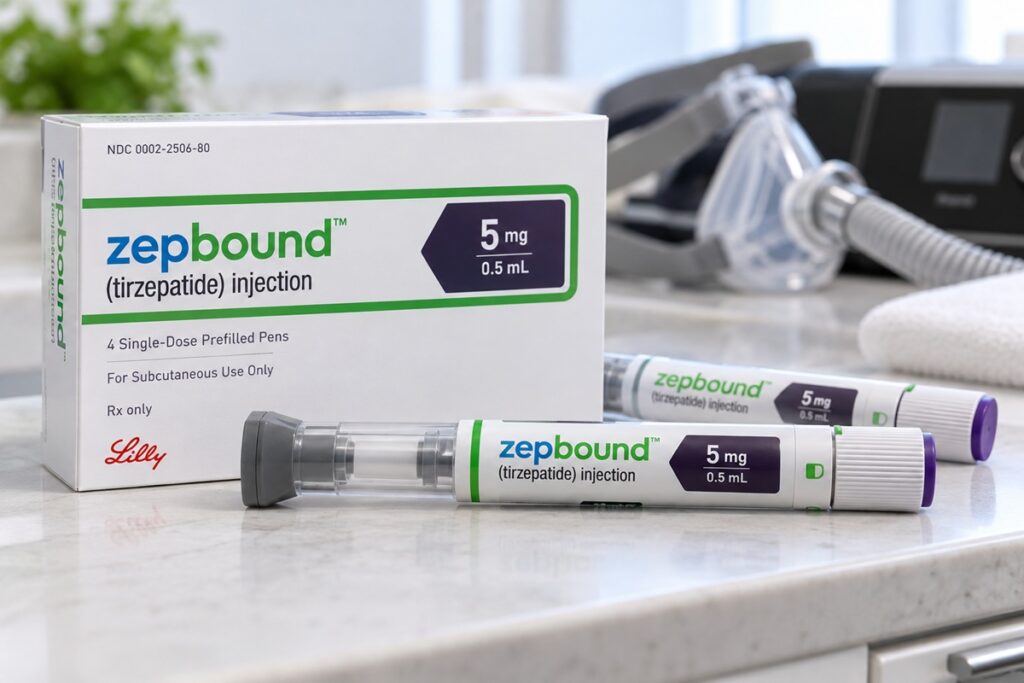
Excess weight makes OSA worse, so a medicine that lowers weight can reduce the number of breathing pauses. In December 2024 the FDA approved Zepbound (tirzepatide) for moderate to severe OSA in adults with obesity, alongside diet and exercise. Tirzepatide activates the receptors for two gut hormones, GIP and GLP-1, and lowers appetite.
The FDA called it the first medicine for OSA itself, since earlier OSA medicines treat only daytime sleepiness.
The approval rested on SURMOUNT-OSA, two 52-week randomized trials reported in 2024. They enrolled 469 adults with obesity, an AHI of 15 or more and no diabetes. Among people not using CPAP, AHI fell by 25.3 events an hour on tirzepatide and by 5.3 on placebo. Body weight fell 17.7% against 1.6%.
By week 52, 42.2% against 15.9% had an AHI under 5, or 5 to 14 with little daytime sleepiness. The approval notice links the improvement to weight loss.
Is sleep apnea a chronic disease?
Sleep apnea is a chronic disease because it fits CDC’s definition of chronic diseases. That definition covers conditions that last a year or more and need ongoing medical attention, limit daily activities, or both. A 2009 clinical guideline for adults states that OSA “should be approached as a chronic disease requiring long-term, multidisciplinary management.”
Treatment controls OSA only while it is used. A 2011 trial in Switzerland assigned 41 people already using CPAP, at random, to two weeks of real or sham CPAP. In the sham group, OSA came back within a few days, along with daytime sleepiness and higher morning blood pressure.
Without treatment, OSA tends to stay or get worse. A 2026 study in Israel repeated sleep studies about 3.8 years apart in 538 adults who had declined treatment. Severity rose over that time, and rose more in people who gained weight.
Untreated OSA commonly worsens over time, so readings taken years apart can stay in the same range or rise. A 44-year-old with about 22 pauses and shallow breaths an hour at two tests, years apart, has readings in the moderate range both times, since that range starts at 15. The count can still fall with large weight loss.
A Wisconsin study of weight change gave 690 employed adults sleep studies four years apart between 1989 and 2000, and a 10% weight loss predicted a 26% lower AHI.
How sleep apnea is tied to weight, blood pressure and blood sugar
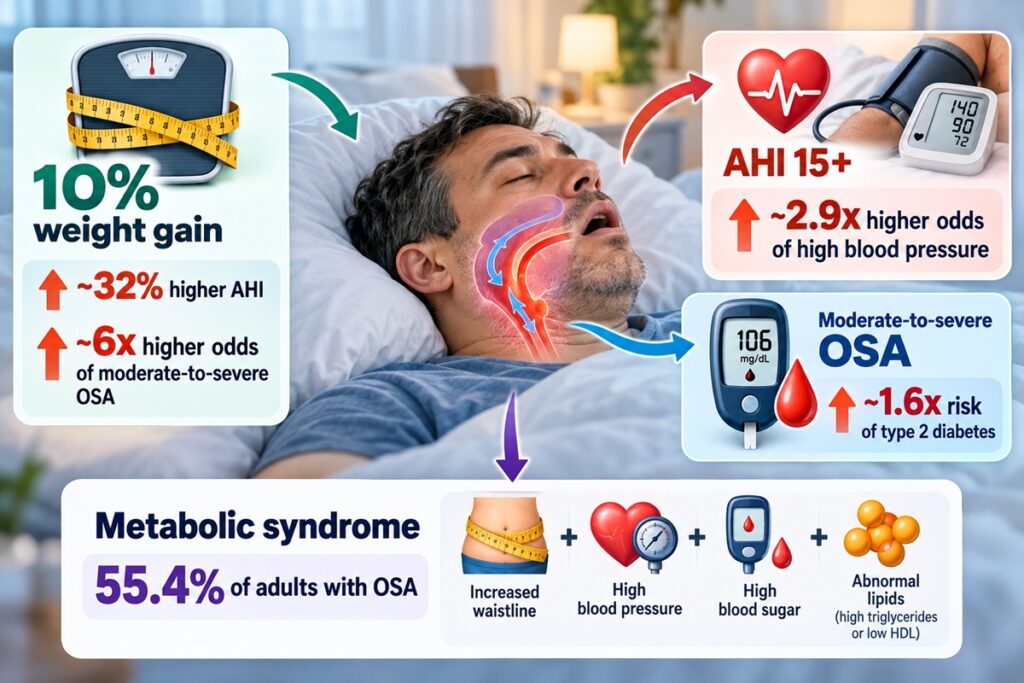
In cohort studies, weight gain comes before worse sleep apnea, and higher blood pressure and blood sugar are linked with it too. In the same Wisconsin study, a 10% weight gain predicted about a 32% higher AHI and about sixfold higher odds of developing moderate to severe apnea. If you weigh 200 pounds, a 10% gain is 20 pounds.
A second Wisconsin study, on blood pressure, reported in 2000, gave 709 adults sleep studies and blood pressure checks four years apart. People with an AHI of 15 or more at the start had about 2.9 times the odds of high blood pressure four years later, compared with people with no apnea. The analysis allowed for weight, neck and waist size, age, sex, alcohol and smoking.
The authors called sleep-disordered breathing a likely risk factor for high blood pressure. In the Israeli study, apnea that was more severe at the start was linked with new heart and blood vessel disease, which is not contagious either.
Moderate to severe OSA has been linked with about 1.6 times the risk of type 2 diabetes occurring later. The figure comes from a 2013 pooled analysis of six cohort studies with 5,953 people, followed for 2.7 to 16 years. Weight explains part of that link: in the Israeli study of untreated adults, new diabetes followed weight at the start and age, not apnea severity.
Like sleep apnea, type 2 diabetes does not pass between people, and the two share risk factors such as excess weight.
More than half of adults with OSA also meet the criteria for metabolic syndrome, a cluster of a large waist, high blood pressure, high blood sugar and abnormal blood fats.
A 2026 pooled analysis of 102 studies, covering 34,013 adults in 28 countries whose OSA was confirmed by a sleep study, put the share at 55.4%. The studies varied widely, and the result describes the two conditions occurring together; it cannot show whether one causes the other.
Is snoring contagious?
Snoring is not contagious because it is a sound made by vibrating tissue, not an infection. In sleep, air passing through a narrowed throat makes the soft tissue vibrate, and the vibration is the noise a partner hears. If your partner starts to snore, it is for reasons of their own, such as weight, age, alcohol or a blocked nose.
Loud snoring is common, and people often learn about it when someone else tells them. In a CDC survey of 59,108 adults in eight states and the District of Columbia in 2017, 41.1% had been told they snore loudly. In the same survey, 13.6% had been told that someone saw them stop breathing in their sleep. Married adults and people living with a partner reported snoring more often than single adults, which the authors say could partly reflect who is there to hear it.
Snoring is also not the same as OSA. A 2019 study in Toronto recorded snoring sounds and AHI in 235 adults sent for sleep studies.
How often people snored was only weakly related to their AHI: many snorers had no OSA, and some people with OSA snored little. The study used clinic patients, so it cannot give the share of all snorers who have OSA. Loud snoring on its own does not show that you have apnea.
Sleep apnea in parents, children and siblings
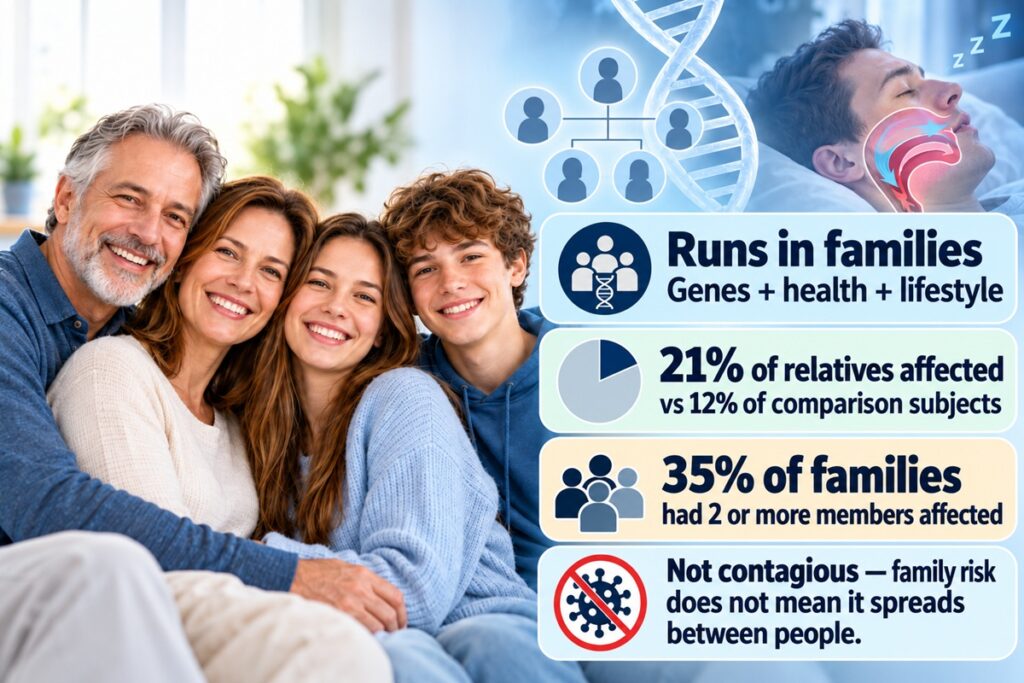
Sleep apnea runs in families through a mix of genetic, health and lifestyle factors, including genes linked to face and head shape and to appetite. A 2018 National Library of Medicine genetics summary describes many genetic variations with small effects, including some that shape the face and head and some that affect appetite.
Family studies with sleep tests show how often it runs in families. The Cleveland Family Study, published in 1995, tested 561 members of 91 families. Sleep-disordered breathing was found in 21% of relatives of people with sleep apnea, against 12% of comparison subjects from the same neighborhoods. In 35% of the families, two or more members were affected.
A 2008 analysis of 1,802 people from 310 families linked about one third of the differences in AHI between people to their genes. Close to 40% of that genetic part was shared with obesity. The authors point to other routes for the rest, such as the shape of the face and head, the control of breathing and the regulation of sleep.
A family history of OSA raises your own chance of having it. If your parent has been diagnosed with OSA, you are in the same position as the relatives in the Cleveland study. Nothing about the condition is caught from the parent.
Infections, enlarged tonsils and blocked noses
A virus can pass from person to person, but sleep apnea cannot, even where an infection is linked with a narrowed airway. In children, OSA is often caused by enlarged tonsils and adenoids (lymph tissue at the back of the throat and nose), and removing them is one of several treatments.
A 2012 pediatric technical report found OSA in 0% to 5.7% of children across the studies it reviewed.
Viruses are often found in that enlarged tissue. A 2016 study in Buffalo, New York tested tonsils and adenoids removed from children who were not acutely ill. Respiratory viruses were present in 70.9% of tonsils and 94.7% of adenoids, and several viruses were linked with more blockage by the adenoids.
The study shows an association and cannot show that the infections cause OSA.
In adults, a blocked nose is linked with snoring and apnea. A 1997 Wisconsin study combined questionnaires from 4,927 adults with laboratory sleep studies in 911. People with nighttime nasal symptoms snored more often, and those with nasal congestion from allergy were about 1.8 times as likely to have moderate to severe sleep-disordered breathing. The blocked nose of a cold clears when the cold does.
A 2026 study in the Bronx, New York looked for new OSA diagnoses after COVID-19 in the health records of 910,393 adults tested between March 2020 and August 2024.
Among people not admitted to hospital, those who tested positive were diagnosed with OSA later about 1.3 times as often as those who tested negative. The study relied on diagnosis codes and shows only an association. The coronavirus passes between people, as other communicable diseases do, but the airway narrowing diagnosed later does not.
Note: This article is for educational purposes only and is not medical advice.
Sources
- US Food and Drug Administration and DailyMed: Zepbound approval for sleep apnea, 2024; Zepbound label, 2026
- Centers for Disease Control and Prevention: About Chronic Diseases, 2026; Liu et al., sleep disorder symptoms, 2021
- Trial and guideline: Malhotra et al., SURMOUNT-OSA, 2024; Epstein et al., 2009
- Wisconsin Sleep Cohort: Peppard et al., prevalence, 2013; Peppard et al., weight change, Peppard et al., blood pressure, 2000; Young et al., 1997
- Partners, treatment and course: Lavie, 2026; Kohler et al., 2011; Beninati et al., 1999; Luyster, 2017
- Weight, diabetes and metabolic syndrome: Pant et al., 2026; Wang et al., 2013
- Families: MedlinePlus Genetics, 2018; Patel et al., 2008; Redline et al., 1995
- Snoring and infections: Changela et al., 2026; Alshaer et al., 2019; Faden et al., 2016; Marcus et al., 2012
- National Heart, Lung, and Blood Institute and MedlinePlus: Sleep apnea, 2025; Sleep apnea in children, 2025; Snoring, 2025
- Transmission and diabetes: World Health Organization, COVID-19, 2021; CDC, common cold; American Diabetes Association, diabetes myths; NIDDK, type 2 diabetes risk factors, 2022