Key takeaways
- Cardiovascular disease is a group of conditions affecting the heart and blood vessels, including coronary disease, stroke, heart failure, arrhythmias, valve disease, and congenital conditions.
- An estimated 19.8 million people died from cardiovascular disease in 2022, about 32% of all deaths worldwide. It is the leading global cause of death.
- Most heart attacks and strokes begin with atherosclerosis, plaque buildup that narrows arteries and may block blood flow after plaque ruptures.
- A heart attack or stroke is a medical emergency. Call 911 immediately, even if stroke symptoms disappear after a few minutes.
Cardiovascular disease refers to a group of conditions that affect the heart and blood vessels. These include coronary artery disease, stroke, heart failure, abnormal heart rhythms, heart valve disease, and certain heart conditions present at birth.
An estimated 19.8 million people died from cardiovascular disease in 2022, about 32% of all deaths worldwide, according to the World Health Organization (WHO). That makes it the leading cause of death globally.
Most heart attacks and strokes begin with atherosclerosis, a buildup of fatty deposits inside artery walls. This deposit, called plaque, is made of fat, cholesterol, calcium, and other substances carried in the blood. It narrows the channel, often without symptoms, until a plaque ruptures and a clot blocks blood flow to the heart or brain.
How common is cardiovascular disease?
| Measure | Value | Reference year |
|---|---|---|
| Deaths from cardiovascular disease | 19.8 million | 2022 |
| Deaths from cardiovascular disease in modeling estimates | 19.2 million | 2023 |
| People living with cardiovascular disease | 626 million, up from 311 million in 1990 | 2023 |
| Deaths due to heart attack and stroke | 85% of cardiovascular deaths | 2022 |
| Deaths from ischemic heart disease, the largest single cause | 9.1 million, 13% of all deaths | 2021 |
| Share of cardiovascular deaths in low- and middle-income countries | Over three quarters | No year given |
Sources: rows 1, 4 and 6, World Health Organization fact sheet, July 2025; row 5, its causes-of-death fact sheet, August 2024; rows 2 and 3, Global Burden of Disease 2023 study, published 2025
Population growth and aging are the main drivers of the rise since 1990. In low- and middle-income countries, however, detection often comes late, and deaths occur at younger ages.
Tirzepatide and cardiovascular disease
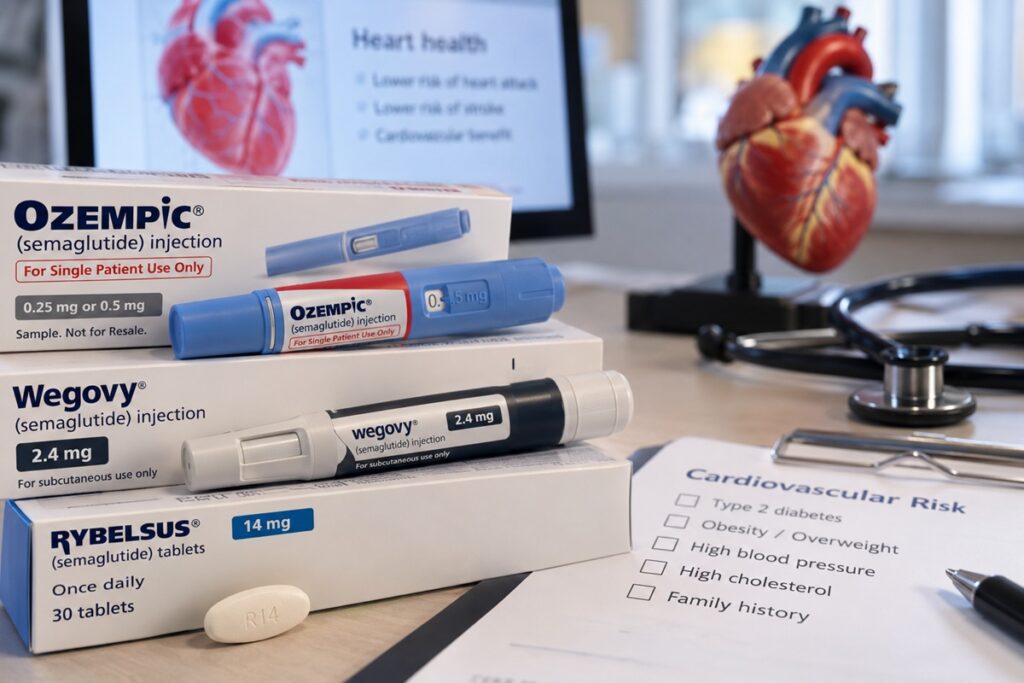
Tirzepatide (Mounjaro, Zepbound) activates both GIP and GLP-1 receptors. It improves blood glucose control in people with type 2 diabetes and can reduce body weight. Major adverse cardiovascular events, or MACE, include cardiovascular death, nonfatal heart attack, or nonfatal stroke.
SURPASS-CVOT randomized 13,299 adults with type 2 diabetes and established cardiovascular disease to once-weekly tirzepatide, up to 15 mg, or dulaglutide at 1.5 mg. After a median 210.1 weeks, tirzepatide was noninferior to dulaglutide for the first MACE event. The event rate was 12.2% versus 13.1%, and the hazard ratio was 0.92 (95.3% confidence interval, 0.83 to 1.01). The trial did not establish superiority over dulaglutide.
The US Mounjaro prescribing label includes an indication to reduce the risk of MACE in adults with type 2 diabetes who are at high risk for these events. This MACE indication is separate from Zepbound’s approved uses.
Zepbound is approved to reduce excess body weight and maintain weight reduction long term in adults with obesity or overweight with at least one weight-related comorbid condition. It is also approved to treat moderate to severe obstructive sleep apnea in adults with obesity. For comparison, semaglutide’s SELECT trial studied adults with established cardiovascular disease and overweight or obesity without diabetes.
Signs and symptoms
Cardiovascular disease often produces no symptoms while it develops. In some patients, heart attack or stroke can be the earliest indication of underlying disease.
These symptoms may be signs of a heart attack:
- discomfort or pain in the center of the chest
- discomfort or pain in the arms, left shoulder, elbows, jaw, or back
- difficulty breathing or shortness of breath
- nausea or vomiting
- light-headedness or faintness
- a cold sweat with pale skin
Women are more likely to experience other symptoms, including shortness of breath, nausea, unusual fatigue, and pain in the back, shoulder, or jaw.
A heart attack or stroke is a medical emergency. Call 911 immediately if you or someone else develops symptoms. Do not wait to see if they improve. Even stroke symptoms that disappear after a few minutes may signal a serious problem that needs emergency care.
Signs of a stroke come on suddenly, whether the cause is a blocked vessel feeding the brain (an ischemic stroke) or bleeding from a vessel in the brain (a hemorrhagic stroke):
- sudden weakness of the face, arm, or leg, usually on one side
- sudden numbness
- confusion or difficulty speaking
- difficulty seeing or walking
- dizziness or loss of balance
- severe headache with no known cause
- fainting
Consider using the “BEFAST” acronym for stroke –
BE FAST: Recognizing a stroke
| Letter | Warning sign |
|---|---|
| B — Balance | Sudden dizziness or loss of balance |
| E — Eyes | Sudden vision changes |
| F — Face | Drooping on one side of the face |
| A — Arms | Sudden arm weakness or numbness |
| S — Speech | Slurred speech or trouble speaking |
| T — Time | Call 911 immediately |
Based on the American Heart Association’s stroke warning signs.
Rheumatic heart disease, which is more common in low- and middle-income countries and damages the heart valves, brings shortness of breath, fatigue, irregular heartbeats, chest pain, and fainting.
Source: World Health Organization fact sheet on cardiovascular diseases, July 2025
Types of cardiovascular disease
| Condition | What goes wrong |
|---|---|
| Coronary heart disease | Blood vessels supplying the heart muscle narrow or become blocked. |
| Cerebrovascular disease | Blood vessels supplying the brain narrow, become blocked, or bleed. |
| Peripheral arterial disease | Vessels supplying the arms, legs, or abdominal organs narrow or become blocked. |
| Aortic disease | The large vessel carrying blood from the heart dilates or tears. |
| Deep vein thrombosis and pulmonary embolism | Clots form in leg veins and can travel to the heart and lungs. |
| Heart failure | The heart does not pump or fill up with blood as well as it should, so fluid builds up. Symptoms may include shortness of breath, fatigue, and swelling. |
| Arrhythmia | The heartbeat is too slow, too fast, or irregular. |
| Heart valve disease | Valves narrow and do not open fully. They can also leak or bulge backward. |
| Cardiomyopathy | The heart muscle can become enlarged, thickened, or stiff. |
| Pericardial disease | The sac around the heart becomes inflamed or fills with fluid. |
| Rheumatic heart disease | Results from scarring of the heart valve after rheumatic fever in childhood. |
| Congenital heart disease | The heart or its vessels have a structural defect present from birth. |
Sources: WHO fact sheet, July 2025; American Heart Association, January 2024; Cleveland Clinic, September 2022; World Heart Federation
Heart failure means reduced pumping, not a stopped heart, and how heart failure develops depends on which conditions damaged or overworked it first. Arrhythmia means an abnormal rhythm, including slow rates below 60 beats per minute and fast rates above 100.
Rheumatic heart disease follows an abnormal response to infection with streptococcal bacteria, usually beginning as a sore throat or tonsillitis in childhood. The inflammation can permanently damage the heart valves. Although the original bacterial infection is contagious, rheumatic fever and the resulting heart disease cannot spread from person to person. Because it starts with an infection, it straddles the line between communicable and noncommunicable disease. The same fact sheet relates about 2% of cardiovascular deaths to rheumatic heart disease, with no year given.
What causes cardiovascular disease?
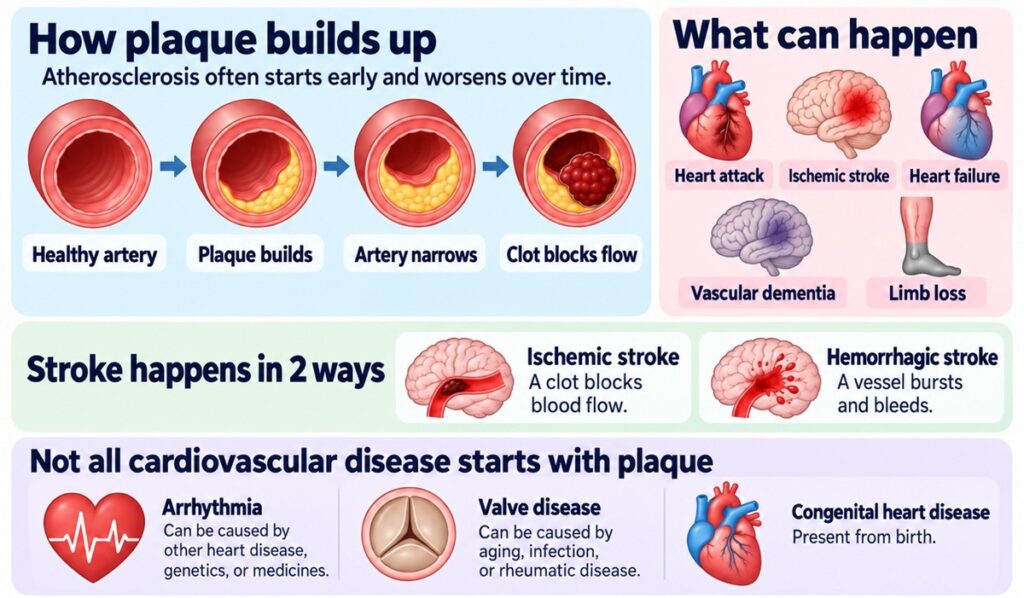
Cardiovascular disease is mainly caused by atherosclerosis, a buildup of plaque in the artery walls that narrows blood flow. Atherosclerosis often starts in childhood and worsens with age. As plaque accumulates, the channel narrows, and the tissue beyond gets less oxygen-rich blood. Full or partial blockage can then cause heart attack, stroke, vascular dementia, heart failure, or limb loss.
A heart attack occurs when a clot blocks flow to part of the heart muscle. Without oxygen and nutrients, that part begins to die. An ischemic stroke occurs when a vessel feeding the brain blocks blood flow, usually from a clot, cutting supply, and brain cells begin to die within minutes. Most strokes are ischemic. A hemorrhagic stroke occurs when a vessel in the brain bursts and leaked blood presses on brain cells.
Not all forms of cardiovascular disease begin with plaque. Coronary artery disease, scarring of heart muscle, genetic problems, or medicines can cause arrhythmia. Aging, infection, and rheumatic disease can cause valve disease. Congenital forms reflect malformations present from birth.
Sources: US National Heart, Lung, and Blood Institute, 2023 and 2024; American Heart Association, 2024; Cleveland Clinic, 2022
Risk factors
The most common risk factors for cardiovascular disease:
- an unhealthy diet with excess salt, sugar, and fats
- physical inactivity
- tobacco use
- harmful use of alcohol
- air pollution
Additional factors that may raise risk of cardiovascular disease:
- aging
- urbanization
- globalization
- poverty
- stress
- heredity
- family history
- pre-eclampsia
- gestational diabetes
- chronic inflammatory or autoimmune conditions
- chronic kidney disease
Heredity and family history raise risk because families share genes and habits. Heart disease is not contagious, although some infections can damage the heart. Cardiovascular disease, type 2 diabetes, and metabolic syndrome are often grouped as cardiometabolic disease.
Several risk factors for cardiovascular disease can be measured during routine medical care. These include high blood pressure, high blood sugar, abnormal cholesterol levels, and excess body weight. They often cause no noticeable symptoms but can increase the risk of heart attack, stroke, and other cardiovascular problems.
| Risk factor in adults | Global size | Reference year |
|---|---|---|
| Hypertension, 140/90 mmHg or higher on two days | 1.4 billion aged 30–79, 33% of that age group | 2024 |
| Overweight, body mass index 25 and above, including obesity at 30 and above | 2.5 billion overweight, including 890 million with obesity | 2022 |
| Insufficient physical activity, below 150 minutes of moderate activity per week | 31% of adults, 1.8 billion people | 2022 |
| Tobacco use | 1.2 billion users; more than 7 million deaths each year including secondhand smoke | No year given |
Sources: World Health Organization fact sheets on cardiovascular diseases, hypertension, obesity, physical activity, and tobacco, 2024 to 2026; Cleveland Clinic, 2022, for the clinical additions
The Global Burden of Disease study attributed 79.6% of cardiovascular burden in 2023 to modifiable risks, led by high systolic blood pressure, dietary risks, high low-density lipoprotein cholesterol, and air pollution.
Prevention
WHO describes most cardiovascular disease as preventable by addressing behavioral and environmental risks. Giving up tobacco, using less salt, eating more fruit and vegetables, staying physically active, and avoiding harmful use of alcohol all lower risk. Policies that make healthy choices affordable and available and that clean up polluted air help people adopt those habits and keep them.
Drug treatment of hypertension, diabetes, and high blood lipids among people with those conditions reduces cardiovascular risk and prevents heart attacks and strokes. Most people with hypertension do not have it under control. In WHO’s figures for 2024, 44% of adults with hypertension were unaware of it and 23% had it controlled. Two-thirds of adults with hypertension live in low- and middle-income countries, a share given without a year.
How are cardiovascular deaths counted?
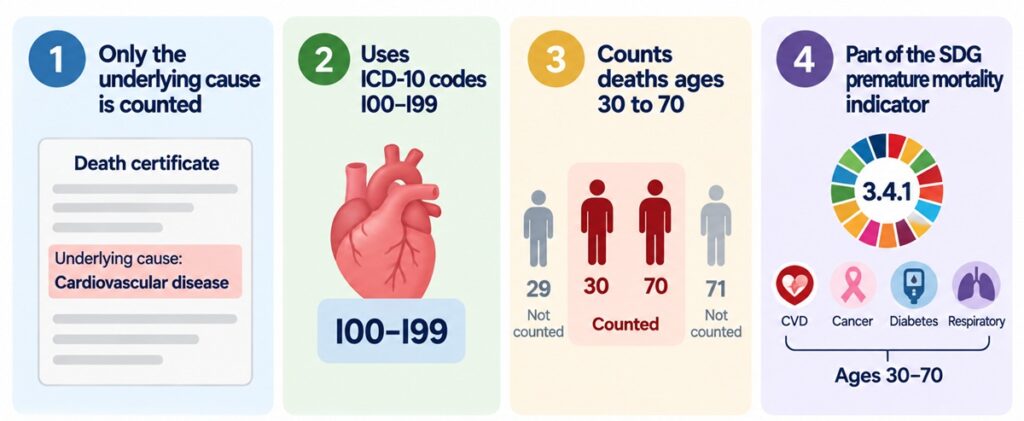
Cardiovascular deaths are counted using only the underlying cause of death listed on a death certificate, coded under ICD-10 (International Classification of Diseases, 10th revision) codes I00–I99. If cardiovascular disease isn’t the underlying cause, the death isn’t counted as cardiovascular, even if it played a role.
Sustainable Development Goal target 3.4 reads, “By 2030, reduce by one third premature mortality from noncommunicable diseases through prevention and treatment and promote mental health and well-being.”
Its indicator 3.4.1, the SDG measure that tracks that mortality, is the probability of dying between the exact ages of 30 and 70 from cardiovascular disease, cancer, diabetes, or chronic respiratory disease, expressed as a percentage and assuming current death rates at every age. A death at 71 or at 29 falls outside it, and only the underlying cause of death is counted.
The classification behind the count is ICD-10, the tenth revision of the International Classification of Diseases, the coding system for causes of death. Indicator 3.4.1 counts ICD-10 codes I00-I99 for cardiovascular disease. That range includes heart failure (I50), atrial fibrillation (I48), and hypertensive diseases (I10-I15), none of which the six-group fact-sheet list names.
Cardiovascular disease is one of the four groups of noncommunicable diseases that the indicator counts.
In WHO’s figures for 2021, at least 38% of the 18 million premature deaths from noncommunicable disease were cardiovascular. Premature there means any death before 70, a wider band than the indicator’s 30 to 70. The 19.8 million deaths for 2022 in the first table and the Global Burden of Disease study’s 19.2 million for 2023 come from different years and methods, so they are reported side by side rather than averaged.
Note: This page is for educational purposes only and does not constitute medical advice.
Sources
- World Health Organization, Cardiovascular diseases (CVDs) fact sheet, 31 July 2025
- Global Burden of Cardiovascular Diseases and Risks 2023 Collaborators, Global Burden of Cardiovascular Diseases and Risk Factors in 204 Countries and Territories, 1990-2023, Journal of the American College of Cardiology, 2025
- World Health Organization, The top 10 causes of death, 7 August 2024
- National Heart, Lung, and Blood Institute, Atherosclerosis, 28 October 2024
- National Heart, Lung, and Blood Institute, Stroke, 26 May 2023
- American Heart Association, What Is Cardiovascular Disease?, 10 January 2024
- Cleveland Clinic, Cardiovascular Disease, 1 September 2022
- World Heart Federation, What is cardiovascular disease
- World Health Organization, Hypertension, 25 September 2025
- World Health Organization, Obesity and overweight, 8 December 2025
- World Health Organization, Physical activity, 26 June 2024
- World Health Organization, Tobacco and nicotine, 26 June 2026
- UN Statistics Division, SDG indicator 3.4.1 metadata, 20 December 2024
- World Health Organization, ICD-10 Version 2019, chapter IX, 2019 version
- Marso et al., SUSTAIN-6, LEADER, New England Journal of Medicine, 2016
- Gerstein et al., REWIND, The Lancet, 2019
- Pfeffer et al., ELIXA, New England Journal of Medicine, 2015
- Holman et al., EXSCEL, New England Journal of Medicine, 2017
- DailyMed, Ozempic label, Wegovy label, Rybelsus label, 2026, US