Key takeaways
- Heart disease is not contagious: you cannot catch coronary artery disease, heart failure or high-blood-pressure heart disease from another person.
- Some infections can injure the heart, but the heart damage stays with the infected person. The germs, not the heart damage, may spread.
- An infection can briefly raise heart-attack risk in the infected person. In flu studies, the extra risk was concentrated in the first seven days.
Heart disease is not contagious, and you cannot catch it from someone else. Coronary artery disease, heart failure and heart disease caused by high blood pressure all develop inside one body. None of them passes between people at home, at work or at school, and all three belong to the wider group of cardiovascular diseases.
Heart disease is a chronic cardio-metabolic condition: it lasts, and it is tied closely to blood pressure, cholesterol, blood sugar and body weight.
It builds over years and is managed by bringing those numbers down. A small number of infections can injure the heart, but the injury stays with the person who has it.
Is heart disease a chronic disease?
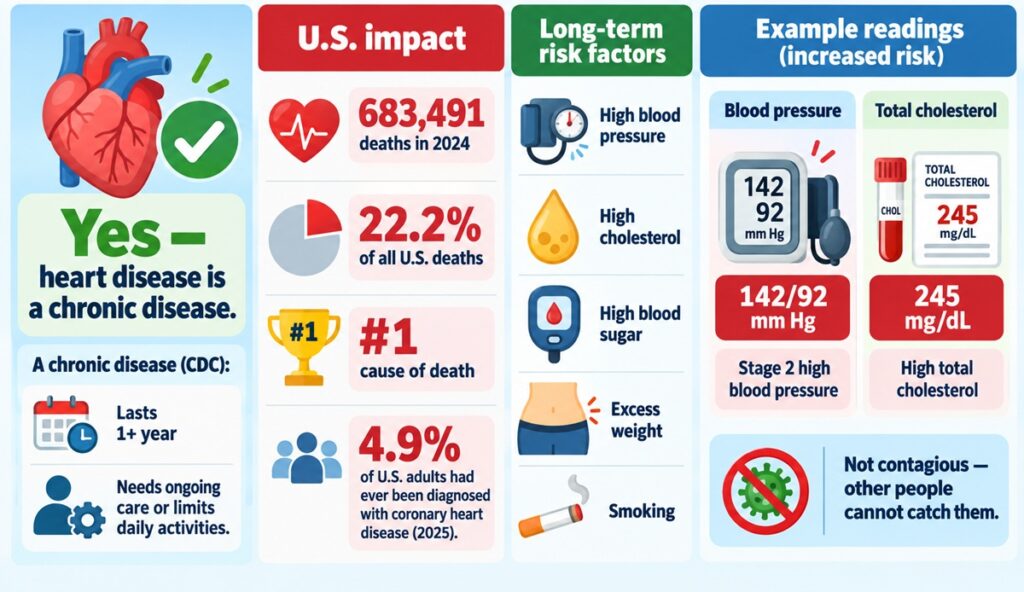
Yes, heart disease is a chronic disease because it lasts for a year or more and needs ongoing medical care or limits daily activities. That is how CDC defines chronic diseases, and the same page names heart disease among the leading causes of US deaths and disability.
In 2024 heart disease caused 683,491 deaths in the United States, 22.2% of all deaths that year. Final mortality data for 2024 place it first among causes of death, ahead of cancer. In 2025, 4.9% of US adults had at some point been diagnosed with coronary heart disease.
The main risk factors for heart disease last for years too. They include high blood pressure, high cholesterol, high blood sugar, excess weight and smoking.
Blood pressure and cholesterol can both stay high in one person for years. If your blood pressure reads around 142/92 mm Hg at one check-up after another, it is in the range the 2025 AHA and ACC guideline calls stage 2 high blood pressure. That range starts at 140 for the top number or 90 for the bottom number.
A total cholesterol of around 245 mg/dL would also count as high, since CDC’s cut-off is 240 mg/dL. Both are lasting conditions inside one body, and a partner who shares your home cannot catch either of them.
Tirzepatide for heart disease

Tirzepatide activates both GIP and GLP-1 receptors. Mounjaro is approved with diet and exercise for type 2 diabetes in adults and pediatric patients 10 years and older. Mounjaro is also approved to reduce major cardiovascular event risk in adults with type 2 diabetes at high risk. Zepbound is approved in combination with a reduced-calorie diet and increased physical activity for weight reduction and long-term maintenance in adults with obesity or overweight in the presence of at least one weight-related comorbid condition. Zepbound is also approved for moderate to severe obstructive sleep apnea in adults with obesity.
In the SURPASS-CVOT trial, 13,299 adults with inadequately controlled type 2 diabetes and established cardiovascular disease were assigned to weekly tirzepatide, up to 15 mg, or dulaglutide, 1.5 mg. Over a median 210.1 weeks, major cardiovascular events occurred in 12.2% on tirzepatide and 13.1% on dulaglutide. Tirzepatide was noninferior; superiority was not established.
The SUMMIT trial included 731 adults with obesity and heart failure with preserved ejection fraction. After a median 104 weeks, cardiovascular death or worsening heart failure occurred in 9.9% on tirzepatide compared with 15.3% on placebo. Tirzepatide also improved health status.
Is heart disease a communicable disease?
Heart disease is not a communicable disease because its common forms arise without any germ passing from one person to another. Communicable diseases depend on an infectious agent, such as a virus or a bacterium. The agent reaches a new host through touch, the air, food and water, shared objects or insect bites. Coronary artery disease, high blood pressure and most heart failure develop with no such agent involved.
The World Health Organization lists cardiovascular diseases among the main non-communicable diseases, and the same non-communicable group includes cancers, chronic lung diseases and diabetes. Infections such as flu and strep throat fall in the other group, and the two groups are told apart by whether an infectious agent causes the illness.
Is a heart infection contagious?
No, a heart infection is not contagious in the sense that the damage to your heart cannot pass to anyone else. Some of the germs behind these heart infections do spread between people, and the four infections below show how the germ and the damage differ.
Rheumatic heart disease usually begins with strep throat, a bacterial infection that spreads through close contact and often passes between people at home. CDC guidance says rheumatic fever follows some strep infections, usually one to five weeks later, and is partly an immune reaction. The heart becomes inflamed in 50% to 70% of first episodes, and scarring of the mitral valve, or less often the aortic valve, can last for life. That lasting valve damage is rheumatic heart disease, and in the United States a first episode of rheumatic fever is rare after the age of 35.
A 2021 global estimate counted 54.8 million people living with rheumatic heart disease and 373,345 deaths from it that year.
Endocarditis develops when germs in the blood settle on damaged heart valves or implanted devices. Germs can enter the blood through dental problems or procedures, skin infections, other infections in the body, implanted heart devices, or injection drug use. A US hospital study covering 2005 to 2014 found that hospital stays for endocarditis rose from 12 to 15 per 100,000 people.
Over the same years, the share of those stays linked to opioid use rose from 6.3% to 11.6%. Valves already scarred by rheumatic fever are more likely to become infected later.
Myocarditis, inflammation of the heart muscle, and pericarditis, inflammation of the sac around the heart, often follow viral infections. A 2023 review found that acute myocarditis affects 4 to 14 people per 100,000 each year worldwide.
A 2021 review of viral myocarditis names enteroviruses, adenoviruses, parvovirus B19 and herpesviruses among the common causes. An analysis of US hospital records from March 2020 to January 2021 found myocarditis in 0.146% of patients with COVID-19.
Among patients without COVID-19 the figure was 0.009%, which made myocarditis about 16 times as likely with the infection.
The fourth infection that can damage the heart is Chagas disease, caused by a parasite found mainly in rural parts of Mexico and Central and South America. People are infected mainly through the droppings of triatomine bugs that carry the parasite.
It does not spread through everyday contact, but it can pass through blood transfusion, organ transplant or pregnancy. About 20% to 30% of people with the infection go on to develop serious heart or digestive problems.
The four infections differ in how the germ travels, but none of them passes the heart damage on.
| Infection | How the germ reaches a person | What it does to the heart | Can the heart damage pass to another person |
|---|---|---|---|
| Rheumatic heart disease | Strep bacteria through close contact | Immune injury and lasting valve scarring | No |
| Endocarditis | Germs from the mouth, skin, other infections, heart devices or injection drug use | Infection of the valves or heart lining | No |
| Myocarditis and pericarditis | Viruses passed between people by several routes | Inflammation of the heart muscle or its sac | No |
| Chagas disease | Parasite, mainly through insect droppings | Enlarged heart, heart failure or rhythm problems | No |
Is heart failure contagious?
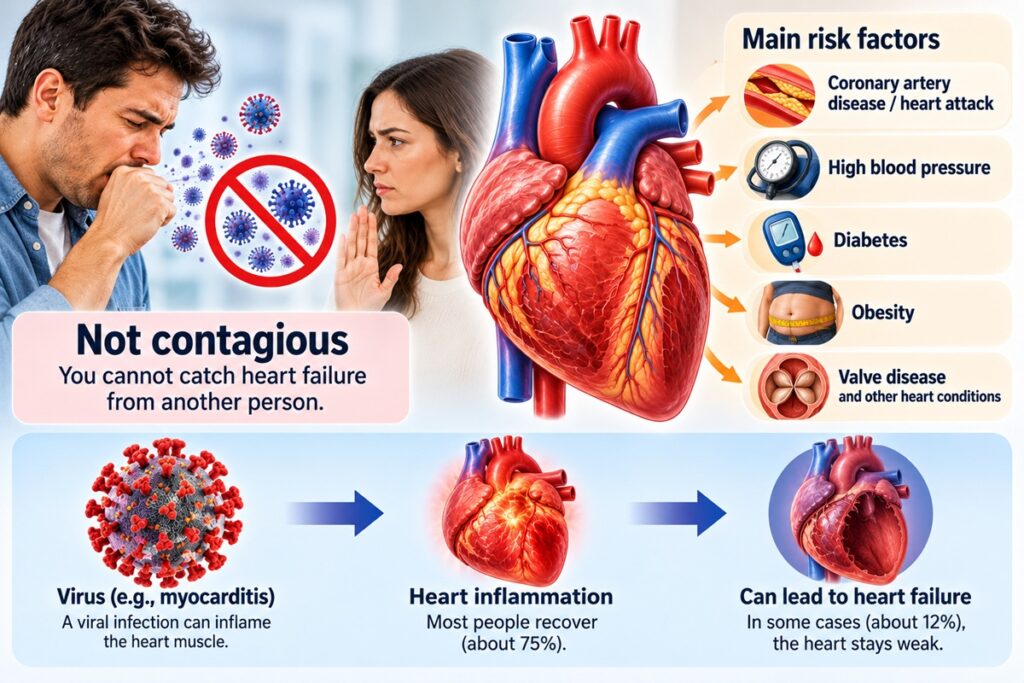
No, heart failure is not contagious because it is the result of earlier damage to the heart, not an infection. You cannot catch it from another person. The main risk factors for heart failure include coronary artery disease and heart attacks, high blood pressure, diabetes, obesity, valve disease and other heart conditions.
Myocarditis is one way a virus can lead to heart failure. About 75% of people admitted to hospital with myocarditis recover without complications, and very few of them die. When myocarditis comes with heart failure or dangerous heart rhythms, about 12% die in hospital or need a heart transplant. Why some hearts recover fully while others stay weak is still unclear.
A 38-year-old whose heart muscle stayed weak after a viral illness is in that second group. The virus could have passed to other people while the illness was active, but the heart failure that followed cannot. Chagas disease is another infection that can lead to heart failure, when a long-standing parasite infection enlarges the heart and disturbs its rhythm.
Can an infection trigger a heart attack?
Yes, an infection can trigger a heart attack in the infected person for a short time after the illness. In flu studies, the extra risk was concentrated in the first seven days after a positive test. The higher risk stays inside that one person and does not spread to anyone else.
A 2018 study from Ontario, Canada looked at heart attacks after laboratory-confirmed flu. It compared each person with themselves across the year before and after a positive flu test, and counted 364 hospital admissions for heart attack. In the seven days after the positive test, the weekly rate of admissions was about six times the rate at other times. No rise appeared after the seventh day.
In a 2025 review of 155 studies, researchers measured how often heart attacks and strokes came after viral infections. In the first month after flu, heart attacks were about four times as common as at other times. COVID-19 was linked to about 1.7 times the risk of coronary heart disease.
Heart complications after flu are also recorded in US hospitals. Among 80,261 adults admitted with confirmed flu between the 2010 to 2011 and 2017 to 2018 seasons, 11.7% had a sudden heart complication. Most involved heart failure that came on quickly or a sudden drop in blood flow to the heart.
The next study looked inside the arteries themselves. A team from Finnish universities and the University of Oxford reported in 2025 on a search for bacteria inside the fatty plaques that narrow arteries. The team examined coronary plaques taken after 121 sudden deaths, along with artery tissue removed from 96 people during surgery.
DNA from common mouth bacteria was found in 42.1% of the coronary plaques, and staining for these bacteria was linked to severe artery disease. The authors wrote that hidden bacterial inflammation may contribute to plaque rupture, and the study showed nothing about spread between people.
A separate question is whether prevention helps. A randomized trial published in 2021 gave flu vaccine or placebo to people shortly after a heart attack, in eight countries, none of them the United States. After 12 months, 5.3% of the vaccine group had died, had another heart attack or had a clot in a heart stent, against 7.2% of the placebo group.
Why heart disease runs in couples and families
Heart disease runs in couples and families because relatives share habits, partners tend to be alike and families pass on inherited risk. If your partner or a close relative has heart disease, that can raise your own risk over time. None of this involves a germ.
A US study of workplace health checks scored the heart health of 5,364 couples between 2014 and 2018. In 79% of couples neither partner reached an ideal overall score, and in 94% both partners ate an unhealthy diet. Couples also tend to share type 2 diabetes risk.
In a 2009 pooled analysis of 71 studies covering more than 100,000 couples, researchers compared partners on heart risk factors. Smoking and body mass index were the most closely matched. The authors found that people often pick partners who already resemble them, which accounts for part of the match.
A study of married couples in Japan followed people for about eight years between 2008 and 2018. Among people whose spouse had cardiovascular disease, 0.6% were later hospitalized for heart failure, stroke or a heart attack, against 0.4% of matched people whose spouse did not. The link was modest, and the data came from employer health insurance records. The extra risk was statistically significant in men but not in women.
Inherited risk adds to shared habits. A Framingham study of adults with an average age of 44 looked at parents with early cardiovascular disease, meaning before 55 in a father or before 65 in a mother. After other risk factors were taken into account, men with such a parent had about twice the odds of cardiovascular disease, while the result for women was not significant. A second Framingham study found that having a sibling with cardiovascular disease was linked to about 1.45 times the odds after a similar adjustment.
Two siblings in their 30s whose parent had early heart disease share both the inherited risk and the upbringing these studies describe. Neither study gives a figure for people in their 30s alone.
Note: The page describes evidence for educational purposes and should not be taken as medical advice. Talk to your doctor before making decisions about your health.
Sources
- Centers for Disease Control and Prevention: About Chronic Diseases, 2026; Acute rheumatic fever guidance, 2025; Strep throat, 2026; About Chagas Disease, 2024; High Cholesterol Facts, 2024; About Heart Failure; Appendix A: How Infections Spread
- National Center for Health Statistics: Mortality in the United States, 2024, FastStats: heart disease, 2026
- World Health Organization, Noncommunicable diseases fact sheet, 2025
- Heart outcome trials and labels: Wegovy label, Ozempic label, 2026; SELECT trial, 2023; SUSTAIN-6 trial, 2016
- Heart infections: Safiri et al., 2026; Ammirati and Moslehi, 2023; Tschöpe et al., 2021; Boehmer et al., 2021; Mori et al., 2020
- Infections and heart attacks: Karhunen et al., Kawai et al., 2025; Fröbert et al., 2021; Chow et al., 2020; Kwong et al., 2018
- Couples and families: Ohbe et al., 2021; Shiffman et al., 2020; Di Castelnuovo et al., 2009; Murabito et al., 2005; Lloyd-Jones et al., 2004
- Guidelines and clinical references: AHA and ACC high blood pressure guideline, 2025; American Heart Association, Infective Endocarditis; StatPearls, Epidemiology of Prevention of Communicable Diseases, 2022