Goal 2Figures published c. 2005 by the World Bank. The Millennium Development Goals program concluded in 2015; this site is preserved as a historical record.
Education is development. It creates choices and opportunities for people, reduces the twin burdens of poverty and diseases, and gives a stronger voice in society. For nations it creates a dynamic workforce and well-informed citizens able to compete and cooperate globally – opening doors to economic and social prosperity. The 1990 Conference on Education for All pledged to achieve universal primary education by 2000. But in 2000, 104 million school-age children were still not in school, 57 percent of them girls and 94 percent were in developing countries – mostly in South Asia and Sub-Saharan Africa. The Millennium Development Goals set a more realistic, but still difficult, deadline of 2015 when all children everywhere should be able to complete a full course of primary schooling.
Target 3 Ensure that, by 2015, children everywhere, boys and girls alike, will be able to complete a full course of primary schooling. Reading, Writing, and Retention Then they must keep them in school. While the majority of developing countries have already built sufficient schools to educate their primary school-age children, only about a quarter of these countries retain all the children through primary gradation
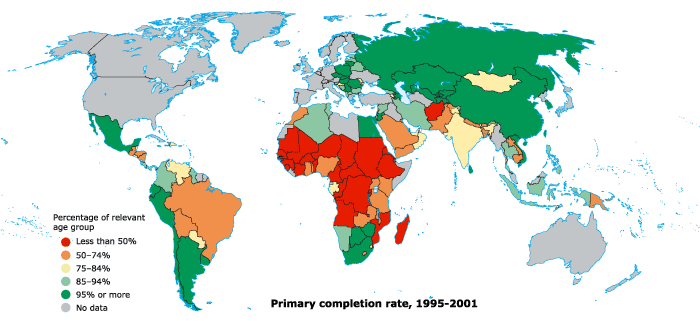
According to a World Bank study, only 37 of 155 developing countries analyzed have achieved universal primary completion.
Based on trends in the 1990s, another 32 are likely to achieve that goal. But 70 countries risk not reaching the goal unless progress is accelerated. In several of them completion rates have stagnated or even fallen in recent years.
Progress in the 1990s and the future progress needed to achieve universal primary completion
Three regions – East Asia and the Pacific, Europe and Central Asia, and Latin America and the Caribbean – are on track to achieve the goal. But three others, with 150 million primary-school-age children, are in danger of falling short. Sub-Saharan Africa lags farthest behind, with little progress since 1990. South Asia has chronically low enrollment and completion rates. And completion rates in the Middle East and North Africa stagnated in the 1990s
Why measure primary completion rate?
Primary school completion is the number of students successfully completing the last year of (or graduating from) primary school in a given year, divided by the number of children of official graduation age in the population. Although not officially included as one of the MDG indicators, primary completion rate is increasingly used as a core indicator of an education system’s performance. Because it measures both the coverage of the education system and the educational attainment of students, the primary completion rate is a more accurate indicator of human capital formation and the quality and efficiency of the school system than are gross and net enrollment ratios. It is also the most direct measure of national progress toward the Millennium Development Goal of universal primary education.
Current context: primary education and health literacy. School completion does not directly measure whether someone can understand health information. WHO describes health literacy as the ability to find, understand, evaluate, and use health information and services. Education supports those skills. For noncommunicable diseases, clear explanations of risk factors and treatment are part of that information.
High enrollments may not produce high completion rates
In many countries, school enrollment rate provides a very different picture from one given by the completion rate. In Madagascar, for example, 80 percent of the students do not manage to complete the primary school education despite the country’s high enrollment rate. Many countries are on track to achieve the goal. Many countries have already reached the target. China, Mexico, and Russia are at near or full enrollment. Others, such as Brazil, Bulgaria, and Laos made rapid progress in the 1990s and are likely to reach the target by 2015. Yet, if current trends persist, children in more than half of developing countries will not complete a full course of primary education in 2015.
| | | | | | | | | | | Full list of goals and indicators East Asia & the Pacific | Europe & Central Asia | Middle East & North Africa Latin America & the Caribbean | South Asia | Sub-Saharan Africa Last update September 2004 with data from WDI 2004