Key takeaways
- NAFLD is liver fat not caused by heavy drinking. Insulin resistance can trigger it; excess weight, raised blood sugar and genetics may contribute.
- About 30% of adults worldwide were living with NAFLD across studies from 1990 to 2019.
- Obesity is not always present: 19.2% of people with fatty liver were lean, and 40.8% were not obese in a 2020 global meta-analysis.
- Symptoms may be absent, and normal liver enzymes can accompany advanced disease. Guidance uses FIB-4, then a liver stiffness scan, to assess scarring.
Nonalcoholic fatty liver disease (NAFLD) is a buildup of fat in the liver (steatosis) that is not caused by heavy drinking and is closely tied to excess weight, raised blood sugar, and abnormal blood fats.
Since 2023, it has been called metabolic dysfunction-associated steatotic liver disease (MASLD). About 30% of adults worldwide were living with it across studies from 1990 to 2019, according to a 2023 review of 92 studies.
Insulin resistance, a state in which cells respond poorly to insulin (the hormone that moves glucose into cells), can trigger and worsen fatty liver disease, and vice versa.
The 2023 name change explained

The 2023 multi-society consensus did not remove alcohol from the diagnosis. How much a person drinks still decides whether liver fat is classed as MASLD, as MetALD (MASLD with increased alcohol intake), or as alcohol-related liver disease. MASLD itself rests on liver fat plus at least one of five cardiometabolic criteria:
- excess weight or a large waist
- raised blood sugar
- high blood pressure
- high triglycerides
- low HDL cholesterol
Steatohepatitis, the inflamed form (fat with inflammation and liver-cell damage), was renamed at the same time from nonalcoholic steatohepatitis (NASH) to metabolic dysfunction-associated steatohepatitis (MASH).
Nearly everyone diagnosed with NAFLD meets the new definition, 98% in a European specialist registry and 99% in a US tertiary database, so figures gathered under the old name describe the same group.
Prevalence worldwide and in higher-risk groups
Estimates rose from about 25% of adults in studies from 1990 to 2006 to 38% in 2016 to 2019, though the latest period rests on only 23 studies.
| Group | Prevalence | Study and period |
|---|---|---|
| Adults worldwide | 30.05% | 92 studies, 1990 to 2019 |
| Adults worldwide | 32.4% | Imaging studies published to 2021 |
| Type 2 diabetes | 65% | 156 studies, 2023 |
| Obesity | 75% | 151 studies, 2023 |
| Children, general population | 7.6% to 13% | Two meta-analyses, 2015 and 2024 |
The two worldwide figures come from separate study sets.
Tirzepatide fatty liver and NAFLD
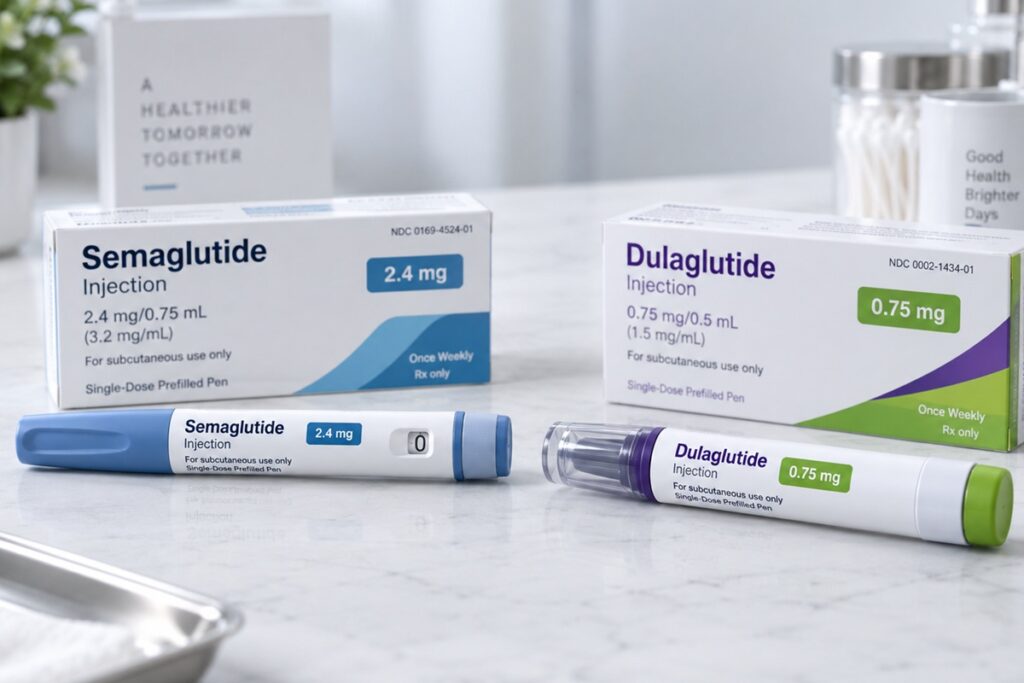
Tirzepatide (Mounjaro, Zepbound) is a dual glucose-dependent insulinotropic polypeptide (GIP) and GLP-1 receptor agonist. It reduces food intake and body weight in patients with type 2 diabetes mellitus, which may help improve fatty liver disease. It has no US approval for MASH or NAFLD.
In the phase 2, 52-week SYNERGY-NASH trial, researchers randomly assigned 190 participants to once-weekly subcutaneous tirzepatide (5 mg, 10 mg, or 15 mg) or placebo. All participants had biopsy-confirmed MASH and stage F2 or F3 (moderate or severe) fibrosis. Among 190 randomized participants, 157 had evaluable liver-biopsy results at week 52, and missing values were imputed.
Criteria for resolution of MASH without worsening fibrosis were met by 10% of the placebo group. The rate was 44% in the 5-mg tirzepatide group, 56% in the 10-mg tirzepatide group, and 62% in the 15-mg tirzepatide group. Improvement of at least one fibrosis stage without worsening of MASH occurred in 30% of the placebo group. The rates were 55% in the 5-mg group, 51% in the 10-mg group, and 51% in the 15-mg group. Larger and longer trials are needed. Gastrointestinal events were the most common adverse events in the trial. Most were mild or moderate.
For now, tirzepatide for fatty liver remains in the research stage and is not an approved liver treatment. In August 2025, Wegovy (semaglutide) became the first GLP-1 medicine approved in the United States for MASH with moderate to advanced scarring (F2 to F3) and no cirrhosis. Resmetirom (Rezdiffra), a thyroid hormone receptor beta agonist and not a GLP-1 medicine, also has this approval. Which treatment is appropriate depends on a person’s liver disease and other health conditions.
Signs, symptoms, and diagnosis
Few people notice anything until the disease is advanced; some have only tiredness or vague discomfort in the upper right abdomen.
Discovery more often follows a scan done for another reason or raised liver enzymes in routine blood tests, yet normal enzyme levels can still accompany advanced disease.
US clinical guidance from 2023 and European guidance from 2024 use a stepwise path: first a score calculated from routine blood results (FIB-4), then a liver stiffness scan (transient elastography, an ultrasound-based measure) to rule advanced scarring in or out.
Guidelines do not recommend standard ultrasound for detecting liver fat. It can show fat, but it may miss milder cases. When they are available, US guidelines favor more sensitive methods, such as controlled attenuation parameter (CAP) testing or MRI-based techniques. Since the Wegovy approval, a November 2025 update to the US guidance selects candidates for semaglutide by the blood score and stiffness scan rather than by biopsy.
How fatty liver develops
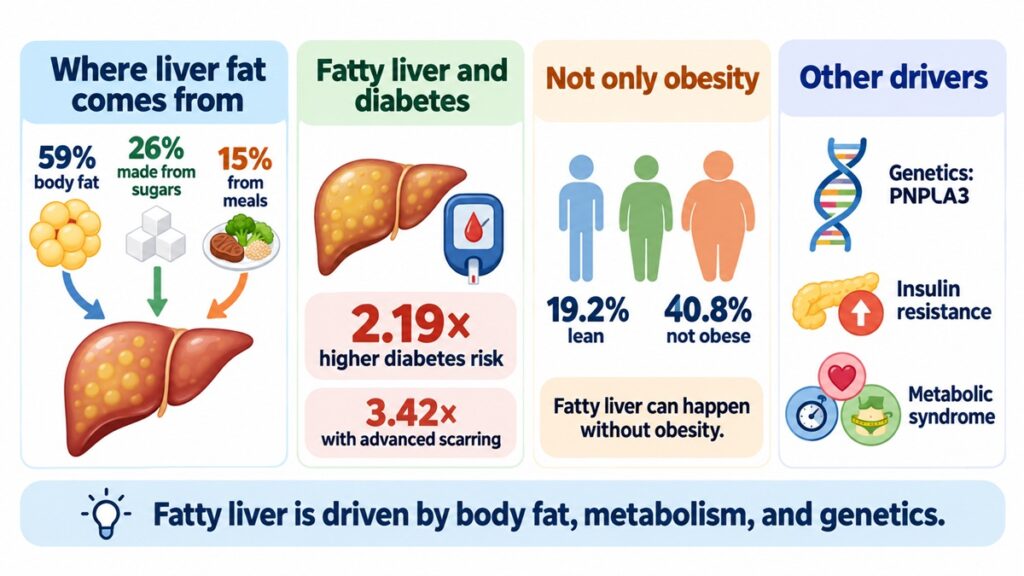
A 2005 tracer study in nine people with obesity found 59% of stored liver fat came from fatty acids released by body fat, 26% was made in the liver from sugars, and 15% came straight from meals. Insulin resistance links the liver and blood sugar in both directions.
A 2021 meta-analysis of 501,022 adults found new diabetes at 2.19 times the rate in people with fatty liver, and at 3.42 times with advanced scarring, independent of age, sex, and body fat. Fatty liver has long been called “the hepatic manifestation of the metabolic syndrome,” and that link runs through the metabolic syndrome cluster of waist size, blood sugar, blood pressure, and blood fats.
Genetics can play a role in the development of fatty liver. The rs738409 variant of PNPLA3 was strongly tied to liver fat and inflammation in a US multi-ancestry cohort, and it was most common in Hispanic participants.
Obesity is not always present. In a 2020 global meta-analysis, 19.2% of people with fatty liver were lean and 40.8% were not obese, and in those two groups 39% had steatohepatitis and 29% significant scarring (F2 or worse). Most still meet MASLD once one metabolic criterion is present.
Fat builds up from inside the body, so fatty liver disease is not contagious. Hepatitis B and C also inflame the liver, but they are viruses. Hepatitis B spreads through infected blood and some body fluids, and hepatitis C mainly through infected blood.
Progression: from fat to scarring to cirrhosis
Fatty liver disease can progress from fat buildup to inflammation, liver scarring, and eventually cirrhosis. However, not everyone follows this path, and many people never develop advanced liver disease. The sequence runs from steatosis through steatohepatitis to fibrosis, and scarring is graded from F0 (none) to F4 (cirrhosis), after which liver cancer and liver failure become the main risks. The current international classification notes steatohepatitis in 10% to 20% of cases.
A 2015 meta-analysis of 11 paired-biopsy cohorts found that fibrosis advanced by one stage every 14.3 years on average with fat alone and every 7.1 years with steatohepatitis.
Over follow-up, a third of patients progressed, 43% stayed stable and 22% improved. Among people with type 2 diabetes and fatty liver, 35.5% had clinically significant fibrosis (F2 to F4) and 15% had advanced fibrosis (F3 to F4) in a 2023 meta-analysis. Scarring, not fat or inflammation, tracked long-term outcomes in a 2015 cohort of 619 patients followed for a median of 12.6 years:
| Fibrosis stage | Risk of death or liver transplant, compared with no fibrosis |
|---|---|
| F1 | 1.88 times |
| F2 | 2.89 times |
| F3 | 3.76 times |
| F4 | 10.9 times |
Compared with F0, meaning no scarring on biopsy
A larger 2020 meta-analysis of 13 studies and 4,428 patients found 3.42 times the risk of death from any cause, and 11.13 times the risk of liver-related death, at stage F4 compared with no scarring.
Liver cancer can also develop without cirrhosis. Among 1,500 US veterans with liver cancer from 2005 to 2010, about 13% had no cirrhosis, and fatty liver and metabolic problems were the main risk factors in that group. Averages hide fast progressors, and biopsied cohorts do not represent all people with liver fat.
Fatty liver and weight loss
In a 2015 single-center cohort in Havana, 293 people with biopsy-proven steatohepatitis followed a year of diet and exercise, and 261 had repeat biopsies. Steatohepatitis resolved in 25% and scarring regressed in 19% overall.
Weight loss was linked to improvements in liver health. Among participants who lost at least 5% of their body weight, 58% no longer had steatohepatitis on their follow-up biopsy. Those who lost at least 10% had even greater improvements: 90% had resolution of steatohepatitis, and 45% showed reduced liver scarring. Improvement grew with the amount of weight lost. But the study ran at one center without randomization, few participants reached 10%, and cirrhosis was not studied, so reversal here means a better repeat biopsy, not a cure.
Fatty liver and terminal illness

While liver disease is not always the cause of death among those who have it, it’s not far behind the leads. United States guidance from 2023 records cardiovascular disease and cancers outside the liver as the leading causes of death overall, followed by liver disease.
Liver disease predominates once scarring is advanced, and the part played by fatty liver itself in cardiovascular disease stays unclear. An analysis of Global Burden of Disease 2021 data attributed about 97,400 deaths from MASLD-related cirrhosis and about 40,900 deaths from MASH-related liver cancer in 2021.
In a separate analysis of the same data, MASH was the only cause of cirrhosis and other chronic liver disease whose age-standardized incidence rose, by about 0.86% a year.
Among people on the US liver transplant waiting list in 2019 without liver cancer, steatohepatitis was the second most common reason (28%) after alcohol-related disease (38%).
Among those with liver cancer, it was also second (24%), after hepatitis C (40%). It led among women without liver cancer, at 34%, and was the most rapidly rising indication.
The new definition
The consensus set out to replace a name built on exclusion with one that does not stigmatize, using criteria for what is present rather than for what is absent, with these adult thresholds:
| Criterion | Adult threshold in the 2023 definition |
|---|---|
| Body size | Body mass index 25 or above (23 in Asian populations), or waist above 37 inches (94 cm) for men or 31.5 inches (80 cm) for women |
| Blood sugar | Fasting glucose 100 mg/dL or above, 2-hour glucose 140 mg/dL or above, HbA1c 5.7% or above, or type 2 diabetes or its treatment |
| Blood pressure | 130/85 mmHg or above, or treatment |
| Triglycerides | 150 mg/dL or above, or treatment |
| HDL cholesterol | 40 mg/dL or below (men), 50 mg/dL or below (women), or treatment |
Definition thresholds, not a diagnostic test for an individual
MetALD describes people who have fat buildup in the liver, at least one metabolic risk factor, and increased alcohol intake. The definition uses weekly alcohol amounts of 140–350 grams for women and 210–420 grams for men. These amounts refer to pure alcohol, not the total weight of alcoholic drinks.
The consensus itself noted that the chosen risk factors do not predict insulin resistance equally, and diastolic blood pressure and HDL cholesterol are only weakly linked.
Where the old name is still in use
Three years after the rename, the current international classification and the 2025 United Nations declaration still use the old name.
| Classification or document | Year | Term used | Code |
|---|---|---|---|
| International Classification of Diseases, 10th revision (ICD, the global coding system) | 2019 | Fatty change of liver, not elsewhere classified | K76.0 |
| United States clinical modification (ICD-10-CM, the United States adaptation) | 2025 | MASLD added under K76.0, MASH added under K75.81 | K76.0 and K75.81 |
| International Classification of Diseases, 11th revision | 2026 | Nonalcoholic fatty liver disease and nonalcoholic steatohepatitis | DB92, DB92.1 |
| United Nations political declaration on noncommunicable diseases | 2025 | Nonalcoholic fatty liver disease | none |
| World Health Assembly resolution WHA79.4 | 2026 | Steatotic liver disease | none |
The declaration, adopted in December 2025 in UN resolution 80/117, calls for “strengthening screening and management for nonalcoholic fatty liver disease” beside hepatitis B and C care, hepatitis B vaccination, and early detection of liver cancer.
It came out of the fourth UN high-level meeting on noncommunicable diseases. The Assembly resolution on steatotic liver disease from May 2026 was the first text from the World Health Assembly (the decision-making body of the World Health Organization) on the topic.
It notes inadequate recognition, underdiagnosis, and limited data, and asks countries to add steatotic liver disease to national noncommunicable disease strategies and monitoring. Liver cancer deaths fall inside the cancer range counted by Sustainable Development Goal indicator 3.4.1, while cirrhosis deaths fall outside it.
Note: This page is for educational purposes only and does not constitute medical advice.
Sources
- Liver society guidance: nomenclature consensus and AASLD practice guidance, 2023; EASL-EASD-EASO guidelines, 2024; AASLD semaglutide update, 2026.
- Prevalence meta-analyses: Lee et al., 2024; Younossi et al., En Li Cho et al. and Quek et al., 2023; Riazi et al., 2022; Ye et al., 2020; Anderson et al., 2015.
- Causes: Mantovani et al., 2021; Romeo et al., 2008; Donnelly et al., 2005.
- Progression, outcomes and weight loss: Taylor et al., 2020; Mittal et al., 2016; Singh et al., Angulo et al. and Vilar-Gomez et al., 2015.
- Deaths and transplants: Kan et al., 2026; Tham et al., 2025; Younossi et al., 2021.
- GLP-1 medicine trials: ESSENCE, 2025; semaglutide in cirrhosis, 2023; LEAN (liraglutide), 2016.
- US Food and Drug Administration: Wegovy prescribing label, 2026; Wegovy MASH approval letter, 2025.
- Classifications and declarations: ICD-11 DB92 and WHA79.4, 2026; UN resolution 80/117 and ICD-10-CM 2026 addenda, 2025; SDG indicator 3.4.1 metadata, 2024; ICD-10 K76.0, 2019.