Key takeaways
- Type 1 and type 2 diabetes can both develop at any age, but they have different causes: autoimmunity versus insulin resistance.
- Type 1 is not just a childhood disease: median age at onset was 39 in 2021, and about 57% of 2025 new cases were adults.
- Type 2 accounted for 96% of diabetes cases in 2021; type 1 accounted for 4%.
- The types can overlap: people with type 1 can develop insulin resistance and obesity, but type is set by cause, not treatment.
Type 1 diabetes develops when the immune system destroys beta cells (the cells in the pancreas that make insulin), mostly by an autoimmune (self-attacking) process, eventually leaving little or no insulin. Despite being known as a juvenile disease, type 1 diabetes can develop at any age.
Type 2 diabetes also develops at any age but from insulin resistance rather than a simple lack of it. In patients with type 2 diabetes, insulin works less well, and the pancreas gradually makes less of it. Unlike type 1, it’s not caused by autoimmunity. Instead, type 2 diabetes results from a combination of genetic and lifestyle factors.
Type 2 accounted for 96% of diabetes cases in 2021, according to the Global Burden of Disease study.
Side-by-side comparison
A 2025 study (Ogle et al.) estimated 9.5 million people worldwide were living with type 1 diabetes in 2025. Of those, 1.8 million were under age 20. In that same year, there were 513,000 new diagnoses. The rest, about 57%, were adults over the age of 20.
| Type 1 | Type 2 | |
|---|---|---|
| What goes wrong | Immune attack destroys insulin-making beta cells | Tissues respond weakly to insulin, secretion declines |
| Immune markers | Islet autoantibodies* to GAD, IA-2, ZnT8, insulin | Not autoimmune; no islet autoantibodies expected |
| Insulin | Needed for survival from diagnosis onward | Some need insulin or other glucose-lowering medicines |
| Share of all diabetes, 2021 | 4% of cases, derived remainder | 96% of cases |
| Age at diagnosis | Any age; most new cases in adults | Any age; increasingly diagnosed in children |
| How it starts | Often rapid in children, slower in adults | Mild symptoms, often less marked, unnoticed for years |
| Weight at diagnosis | Usually not obese; obesity does not exclude it | Most people carry excess weight at diagnosis |
| Prevention or delay | No known means; one US medicine delays onset | Onset delayed by lifestyle program or metformin in high-risk adults |
| Glucose-lowering GLP-1 labels, US | None approved to lower blood glucose | Several approved to lower blood glucose |
*Islet autoantibodies are proteins that can predict type 1 diabetes.
Is tirzepatide a GLP-1? Tirzepatide and type 1 vs. type 2 diabetes

Tirzepatide (Mounjaro, Zepbound) is both a glucose-dependent insulinotropic polypeptide (GIP) receptor agonist and a GLP-1 receptor agonist. Tirzepatide is a GLP-1, but it activates GIP receptors too. It raises first- and second-phase insulin secretion and lowers glucagon levels in a glucose-dependent manner.
Mounjaro is approved as an adjunct to diet and exercise to improve blood glucose in adults and children ages 10 and older with type 2 diabetes. It is not FDA approved to treat type 1 diabetes.
Zepbound is approved to reduce excess body weight and maintain weight reduction long term in adults with obesity, or in adults with overweight who have at least one weight-related comorbid condition, and to treat moderate to severe obstructive sleep apnea in adults with obesity. It is not approved as a treatment for either type of diabetes.
A small phase 2, 12-week trial studied once-weekly tirzepatide in adults with type 1 diabetes and a BMI above 30. Participants received 2.5 mg for 4 weeks, then 5 mg for 8 weeks, or placebo. Twenty-two of 24 adults completed the study. Tirzepatide produced greater weight loss than placebo.
How diabetes develops
Diabetes looks different depending on what type you have. Type 1 diabetes results from an autoimmune attack that kills the cells that make insulin. In type 2, the response to insulin weakens first, so the pancreas eventually stops releasing it.
In type 1, an immune attack removes beta cells, and islet autoantibodies are often present. Links to HLA genes (inherited immune-system variants that alter susceptibility) are strong, meaning some people are just born with immune-system genes that make it easier for their body to mistakenly attack its own insulin-making cells.
Loss of beta cells is fast in some people, mainly children, and slow in others, mainly adults. Ultimately, little or no insulin remains, shown by low or undetectable C-peptide (a fragment released with insulin, so it shows how much the pancreas still makes).
Type 1 is now described in stages 1 to 3 (presymptomatic autoimmunity with normal glucose, presymptomatic autoimmunity with abnormal glucose, then symptomatic diabetes). The glucose numbers for stage 2 match the prediabetes ranges, so antibodies, not glucose, separate stage 2 from prediabetes.
In type 2, tissues in muscle, liver, and fat respond weakly to insulin, a state called insulin resistance (a weaker effect from the same amount of insulin). The pancreas compensates with extra output, then secretion declines over time. Most people carry excess weight at diagnosis.
The types can overlap. People with type 1 can also develop insulin resistance and obesity, and a US guideline allows recording features of both to help access monitoring and weight-related treatment. Once high blood glucose is present, the same long-term complications can develop in either type, at rates that may differ.
Type 1 in adults
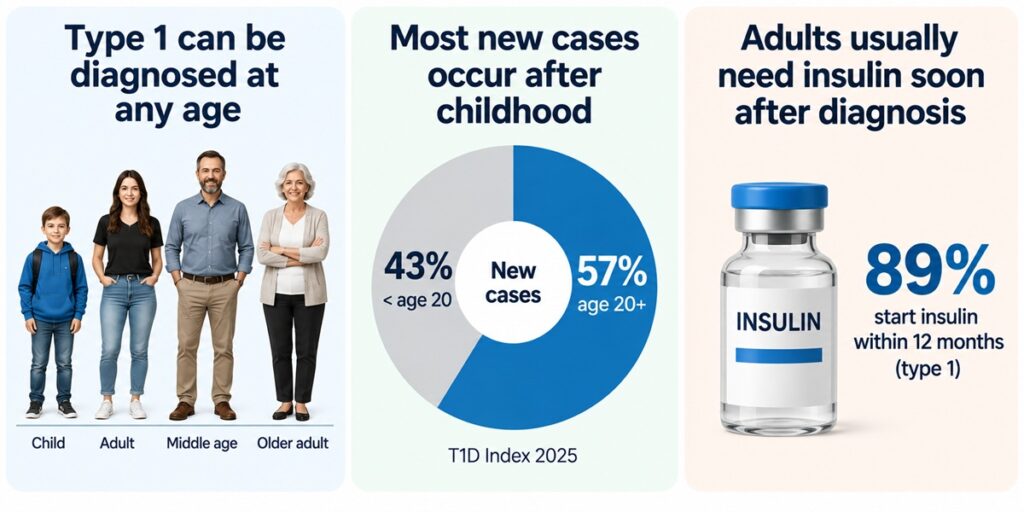
Type 1 is diagnosed at every age, and most new cases occur after childhood. The T1D Index put median age at onset at 39 years in 2021, and the 2025 age bands point the same way, with about 57% of new cases at age 20 or older. In adults, progression is often slower and the classic symptoms may be muted.
Thomas et al. 2018 studied genetically defined type 1 in white European participants in the UK Biobank, a large population cohort. Among those cases, 42% were diagnosed at ages 31 to 60. At those ages, mean body mass index for patients with type 1 diabetes was 27.4, and the BMI for those with type 2 diabetes was 32.4. The percentage of patients who had to start taking insulin injections or using an insulin pump within 12 months of being diagnosed was 89% for type 1 diabetes and 6% for type 2.
In an English cohort of insulin-treated people diagnosed after age 30, 38% of those meeting type 1 criteria did not receive insulin at diagnosis, a finding about initial treatment rather than proof of misdiagnosis.
Type is set by cause rather than by treatment. Needing insulin later does not turn type 2 into type 1. Considering type 2 is increasingly diagnosed in children as well, age alone cannot assign the type.
Differences at onset
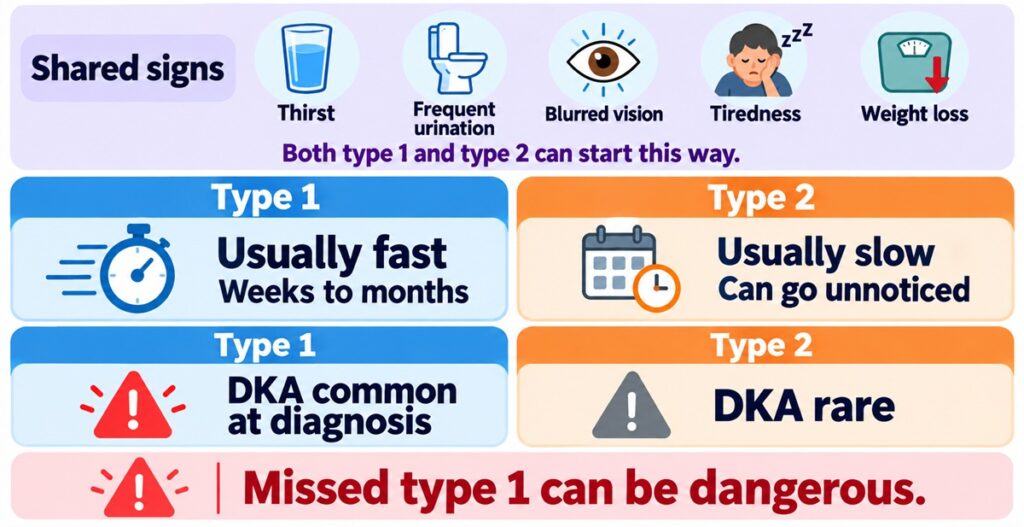
Both types of diabetes share raised glucose and its early effects, including strong thirst, passing urine often, blurred vision, tiredness, and weight loss without trying. Type 1 often develops within weeks or months in children, while type 2 is mild, often less marked, and can pass unnoticed for years.
About half of children with new type 1 in US studies have diabetic ketoacidosis (DKA) at diagnosis. Across 31 countries, in a review of studies to 2011, the share of patients with diabetic ketoacidosis ranged from 12.8% to 80% (Usher-Smith et al. 2012), lower where national income, latitude, and background incidence of type 1 were higher.
DKA rarely arises on its own in type 2, with ketosis-prone type 2 as the exception. Of an estimated 174,000 premature type 1 deaths in 2025, 17.2% followed non-diagnosis soon after onset. In layman’s terms, that means of the nearly 1 in 6 people who die prematurely from type 1 diabetes, their doctors or families did not realize they had the disease until it was too late.
When diabetes fits neither type
Not everyone with diabetes fits neatly into the type 1 or type 2 category. Some people have features of both types, while others have less common forms of diabetes. Medical organizations sometimes classify these conditions differently.
The American Diabetes Association counts latent autoimmune diabetes in adults (LADA, slow adult-onset autoimmune diabetes) as type 1. The 2019 classification from the World Health Organization moves it into a new hybrid group, renamed slowly evolving immune-mediated diabetes of adults, which more often shows features of the metabolic syndrome (a cluster of raised blood pressure, abnormal lipids, excess abdominal fat, and raised glucose).
That hybrid group also holds ketosis-prone type 2, which presents with ketones and insulin lack yet later may not need insulin. An unclassified category serves for use near diagnosis when the type is unclear.
Some people initially diagnosed with type 2 diabetes actually have autoimmune diabetes. Blood tests can help doctors distinguish between diabetes types. These include tests for antibodies that attack insulin-producing cells and C-peptide, which helps show how much insulin the pancreas is making. Limited access to these tests can lead to incorrect diagnoses and affect diabetes statistics.
Where the two types are recorded separately
Doctors and health organizations track type 1 and type 2 diabetes separately when diagnosing people, but global health trackers often lump them together. Hence, disease coding keeps the types apart even where mortality statistics later combine them.
In ICD (the International Classification of Diseases, the global coding system for causes of illness and death), ICD-10 places type 1 at E10 and type 2 at E11 within E10 to E14. ICD-11 places them at 5A10 and 5A11, beside 5A12 malnutrition-related, 5A13 other specified and 5A14 unspecified diabetes.
According to ICD-11, “diabetes mellitus type 1 (type 1 diabetes, T1DM, formerly insulin dependent or juvenile diabetes) is a form of diabetes mellitus that results from destruction of insulin-producing beta cells, mostly by autoimmune mechanisms. The subsequent lack of insulin leads to increased blood and urine glucose.”
Global monitoring then merges them. SDG indicator 3.4.1 (the Sustainable Development Goal measure of premature mortality from selected chronic diseases) is the probability of dying between ages 30 and 70 from four noncommunicable disease groups, and the UN metadata counts E10 to E14 together, so it cannot separate the types.
Because people with type 1 diabetes will die without insulin, the World Health Organization demands 100% universal access to affordable insulin and testing supplies for them by 2030, supported by four essential types of insulin listed on their global medicine guide.
Can diabetes be prevented or delayed?
The diseases are different in this way as well. For type 1 diabetes, its exact causes are not fully understood, and there is currently no established way to prevent it. However, treatment can delay the onset of symptoms in some people with early-stage disease. Many cases of type 2 diabetes can be prevented or delayed through healthy eating, regular physical activity, and maintaining a healthy weight.
Teplizumab, sold as Tzield, has held US approval since 2022. It may delay stage 3 type 1 diabetes in people aged one year or older who have stage 2 disease. In patients aged eight to 17 newly diagnosed with stage 3, it may slow the loss of insulin production. The label reports a median of 50 months to stage 3 in its main trial, compared with 25 months on placebo. The medicine delays onset; it does not prevent the disease.
For type 2 diabetes, the US Diabetes Prevention Program found that lifestyle changes and metformin can delay the disease in adults at high risk. Over 2.8 years, an intensive lifestyle program led to 58% fewer new cases. Metformin, a glucose-lowering medicine that can cause modest weight loss, led to 31% fewer.
Some people with type 2 diabetes can achieve remission, meaning their HbA1c, a measure of average blood sugar, stays below 6.5% for at least three months without glucose-lowering medication. However, remission is not a cure, and blood sugar may rise again.
People with newly diagnosed type 1 diabetes may experience a temporary period called the ‘honeymoon phase.’ During this time, the pancreas still produces some insulin, so less insulin treatment may be needed. This phase can last for months or sometimes longer, but most people eventually need more insulin as the disease progresses.
The honeymoon phase in type 1 diabetes is different from remission in type 2 diabetes. People with type 1 diabetes should not stop insulin treatment without medical supervision.
Note: This page is for educational purposes only and is not medical advice.
Sources
- GBD 2021 Diabetes Collaborators, Global, regional, and national burden of diabetes from 1990 to 2021, with projections of prevalence to 2050: a systematic analysis for the Global Burden of Disease Study 2021, The Lancet, 2023.
- Type 1 estimates from the IDF Diabetes Atlas and T1D Index: Ogle GD et al., Global type 1 diabetes prevalence, incidence, and mortality estimates 2025: Results from the International Diabetes Federation Atlas, 11th Edition, and the T1D Index Version 3.0, Diabetes Research and Clinical Practice, 2025; Gregory GA et al., Global incidence, prevalence, and mortality of type 1 diabetes in 2021 with projection to 2040: a modeling study, Lancet Diabetes & Endocrinology, 2022.
- American Diabetes Association, Standards of Care in Diabetes 2026, Diabetes Care: 2. Diagnosis and Classification of Diabetes and 9. Pharmacologic Approaches to Glycemic Treatment, 2026.
- US Food and Drug Administration / DailyMed, prescribing labels: Ozempic (semaglutide) injection, oral semaglutide tablets, Trulicity (dulaglutide), Mounjaro (tirzepatide), Wegovy (semaglutide), Saxenda (liraglutide), Zepbound (tirzepatide) and Tzield (teplizumab-mzwv), 2026; Victoza (liraglutide) and Byetta (exenatide), 2025; Ozempic (semaglutide) injection, earlier version, 2020.
- World Health Organization: Diabetes fact sheet, 2024; Classification of diabetes mellitus, 2019; HEARTS-D: diagnosis and management of type 2 diabetes, 2020; First-ever global coverage targets for diabetes adopted at the 75th World Health Assembly, 2022; The selection and use of essential medicines, 2025, 2025.
- World Health Organization, classification browsers: ICD-11 for Mortality and Morbidity Statistics 2025-01: 5A10 Type 1 diabetes mellitus, 2025; ICD-10 Version 2019 browser: E10, 2019.
- United Nations Statistics Division, SDG indicator metadata for 3.4.1, 2024.
- Thomas NJ et al., Frequency and phenotype of type 1 diabetes in the first six decades of life: a cross-sectional, genetically stratified survival analysis from UK Biobank, Lancet Diabetes & Endocrinology, 2018; Type 1 diabetes defined by severe insulin deficiency occurs after 30 years of age and is commonly treated as type 2 diabetes, Diabetologia, 2019.
- Usher-Smith JA et al., Variation between countries in the frequency of diabetic ketoacidosis at first presentation of type 1 diabetes in children: a systematic review, Diabetologia, 2012.
- Liraglutide added to insulin in type 1 diabetes, Diabetes Care, 2016: Mathieu C et al., Efficacy and Safety of Liraglutide Added to Insulin Treatment in Type 1 Diabetes: The ADJUNCT ONE Treat-To-Target Randomized Trial; Ahrén B et al., Efficacy and Safety of Liraglutide Added to Capped Insulin Treatment in Subjects With Type 1 Diabetes: The ADJUNCT TWO Randomized Trial.
- Trials in adults with type 1 diabetes and obesity: Shah VN et al., Semaglutide in Adults with Type 1 Diabetes and Obesity, NEJM Evidence, 2025; Snaith JR et al., Tirzepatide in Adults With Type 1 Diabetes: A Phase 2 Randomized Placebo-Controlled Clinical Trial, Diabetes Care, 2026.
- Knowler WC et al., Reduction in the incidence of type 2 diabetes with lifestyle intervention or metformin, New England Journal of Medicine, 2002.
- Riddle MC et al., Consensus Report: Definition and Interpretation of Remission in Type 2 Diabetes, Diabetes Care, 2021.