Key takeaways
- The ADA says to minimize sugar-sweetened beverages, sweets and added sugars, refined grains, red meat, and processed and ultraprocessed foods; avoid trans fat.
- Keep sodium below 2,300 mg a day as clinically appropriate.
- Replace sugary drinks, including juice, with water or low-calorie or no-calorie drinks to manage blood sugar and reduce cardiometabolic disease risk.
- Drinkers: up to one drink daily for women, two for men; nondrinkers should not start. Alcohol can cause delayed low blood sugar, especially with insulin or sulfonylureas.
US diabetes guidelines list sugar-sweetened beverages, sweets, refined grains, red meat, and processed and ultraprocessed foods as foods to minimize for people with type 2 diabetes. They also limit saturated fat, sodium, and alcohol, and say trans fat should be avoided, according to the American Diabetes Association (ADA) 2026 Standards of Care.
An estimated 40.1 million people in the United States had diagnosed or undiagnosed diabetes of any type in 2023, according to the CDC diabetes report. About seven in 10 new cases of type 2 diabetes in adults worldwide in 2018 were attributed to suboptimal diet, according to a 2023 modeling study.
No single eating pattern fits everyone with diabetes, and meal planning should be individualized, according to the ADA. The January 2026 Dietary Guidelines for Americans differ from the ADA on full-fat dairy, butter, red meat, and low-calorie sweeteners.
What US guidelines say to limit
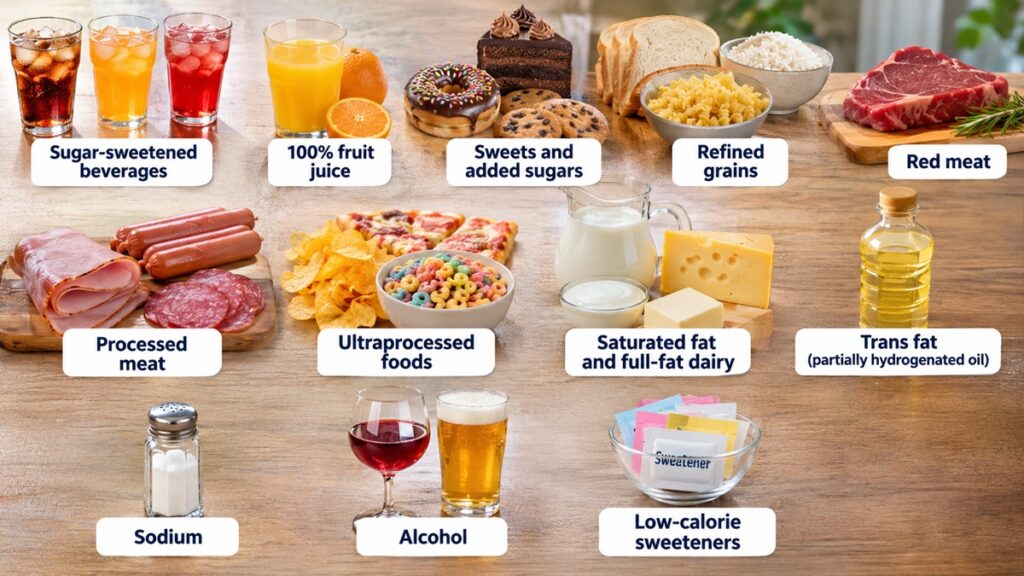
The table lists ADA and federal positions on each food or drink and the evidence in people with type 2 diabetes. The ADA writes for people with prediabetes and diabetes, and the federal guidelines cover the general population.
| Food or drink | ADA 2026 Standards | Dietary Guidelines 2025–2030 | Evidence in people with type 2 diabetes |
|---|---|---|---|
| Sugar-sweetened beverages | Minimize | Avoid | Higher death rate (one US cohort) |
| 100% fruit juice | Counted with sugar-sweetened beverages | Limited portions or diluted with water | No clear difference in death rate (same cohort) |
| Sweets and added sugars | Minimize | No more than 10 g of added sugars per meal; no amount is recommended | No study cited |
| Refined grains | Minimize | Significantly reduce | No study cited |
| Red meat | Minimize | Listed among protein foods to eat | No study cited |
| Processed meat | Not named in the minimize list | Meat with no or limited chemical additives | No study cited |
| Ultraprocessed foods | Minimize | Avoid highly processed foods that are salty or sweet | Higher death rate (one Italian cohort, abstract only) |
| Saturated fat and full-fat dairy | Limit foods high in saturated fat; low-fat dairy | Include full-fat dairy with no added sugars; saturated fat no more than 10% of calories | No clear difference for full-fat milk (same cohort) |
| Trans fat (partially hydrogenated oil) | Avoid | Not named | No study cited |
| Sodium | Less than 2,300 mg a day, as clinically appropriate | Less than 2,300 mg a day, ages 14 and older | Lower sodium lowered blood pressure (one feeding study) |
| Alcohol | Up to one drink a day for women, two for men | Drink less; no numeric limit | Long-term effects unknown (ADA) |
| Low-calorie sweeteners | Acceptable in moderation, short term | Limit | No clear effect on blood sugar (ADA) |
One of the ADA’s stated nutrition goals is to keep the pleasure of eating through “nonjudgmental messages about food choices,” limiting certain foods only when scientific evidence supports it.
Where ADA and the 2025–2030 federal guidelines disagree
The ADA and the federal guidelines differ on these points:
- Dairy and cooking fat: The ADA emphasizes low-fat dairy and favors vegetable oils such as canola or olive in place of butter and lard. The federal guidelines include full-fat dairy with no added sugars and name butter or beef tallow as cooking options after oils such as olive oil, according to the 2025–2030 Dietary Guidelines.
- Red meat: The ADA lists red meat among foods to minimize. The federal guidelines list red meat among protein foods to eat.
- Low-calorie sweeteners: The ADA accepts them in place of sugar-sweetened products in moderation and for the short term. The federal guidelines list them among ingredients to limit. The World Health Organization (WHO) advises against using non-sugar sweeteners for weight control or the prevention of certain chronic diseases in the general population. That recommendation explicitly excludes those with pre-existing diabetes.
- Alcohol limits: The ADA cites the 2020–2025 limits of up to one drink a day for women and two for men. The 2025–2030 federal guidelines set no number.
- Juice: The ADA groups any juices with sugar-sweetened beverages. The federal guidelines call for 100% juice in limited portions or diluted with water. WHO counts the sugars in fruit juice as free sugars.
The ADA and the 2025–2030 guidelines both keep a saturated-fat limit. The ADA’s nutrition section predates the 2025–2030 edition.
Starchy vegetables such as white potatoes, corn, and peas are among the foods to limit, according to MedlinePlus, from the National Library of Medicine. The ADA’s list of foods to minimize does not name them.
GLP-1 medicines and food

None of the US labels for Ozempic, Mounjaro, Rybelsus, Trulicity, Victoza, Wegovy, and Zepbound lists foods to avoid or mentions drinking alcohol.
The Ozempic (semaglutide) and Mounjaro (tirzepatide) labels describe each medicine as an addition to diet and exercise for blood sugar control in type 2 diabetes. Ozempic, Mounjaro, and Trulicity can be taken with or without food, and Victoza independently of meals.
Only oral semaglutide carries food-timing instructions among these labels. The Rybelsus label gives these:
- one tablet once daily on an empty stomach in the morning, with up to 4 fl oz (118 mL) of plain water and no other liquids
- a wait of at least 30 minutes before eating, drinking other beverages, or taking other oral medicines
About a third of people taking Ozempic had stomach or bowel side effects such as nausea, vomiting, or diarrhea in placebo-controlled trials, compared with about one in seven on a placebo. These side effects may cause a loss of fluids that may lead to kidney problems, and drinking fluids helps reduce the chance of dehydration, according to all seven Medication Guides.
Use with insulin or an insulin secretagogue, such as a sulfonylurea, may increase the risk of hypoglycemia (low blood sugar), including severe hypoglycemia, according to the Ozempic, Mounjaro, and Trulicity labels.
A 2025 joint advisory from four obesity and nutrition societies advises counseling people on GLP-1 therapy for obesity to avoid refined carbohydrates, sugar-sweetened beverages, red and processed meats, and most fast foods, ultraprocessed sweets, and savory snacks. It also says alcohol may worsen nausea and reflux and should be minimized. The advisory is expert opinion, not label text, and it covers obesity treatment rather than type 2 diabetes specifically.
Sugary drinks and fruit juice
Sugar-sweetened beverages, including any juices, should be replaced with water or low-calorie or no-calorie drinks to manage blood sugar and reduce the risk of cardiometabolic disease, according to the ADA.
Among 15,486 US men and women with type 2 diabetes followed for an average of 18.5 years, those drinking more than one serving of sugary drinks a day had a death rate from any cause 1.20 times (a 20% higher adjusted risk) that of those drinking less than one serving a month, according to a 2023 BMJ study. Their rate of death from cardiovascular disease was 1.29 times as high. Fruit juice and artificially sweetened drinks showed no clear difference in death rate.
The participants were mostly white US health professionals, intake was self-reported, and the study was observational.
About one in 10 new type 2 diabetes cases in adults worldwide in 2020 were attributed to sugar-sweetened beverages, in a separate modeling study. From 1990 to 2020, US cases attributed to these drinks rose by 671 per million adults as intake fell slightly, according to an author correction.
Refined grains, sweets, and ultraprocessed foods
Refined grains, sweets, and processed and ultraprocessed foods are among the foods to minimize, according to the ADA. Reducing carbohydrate intake can improve blood sugar for some adults with diabetes, and limiting processed foods is an effective way to do it, the ADA adds.
The 2025–2030 federal guidelines name white bread, packaged breakfast options, flour tortillas, and crackers as refined carbohydrates to reduce. They name chips, cookies, and candy as highly processed foods to avoid.
Among 1,065 adults with type 2 diabetes in the MOLI-SANI Study in Italy, followed for a median of 11.6 years, the quarter who ate the most ultraprocessed food had a death rate from any cause 1.70 times that of the quarter who ate the least, according to the study’s abstract. Intake was measured as a share of food weight, so the figure should not be compared with US calorie-share figures.
Fats, fried foods, and red and processed meat
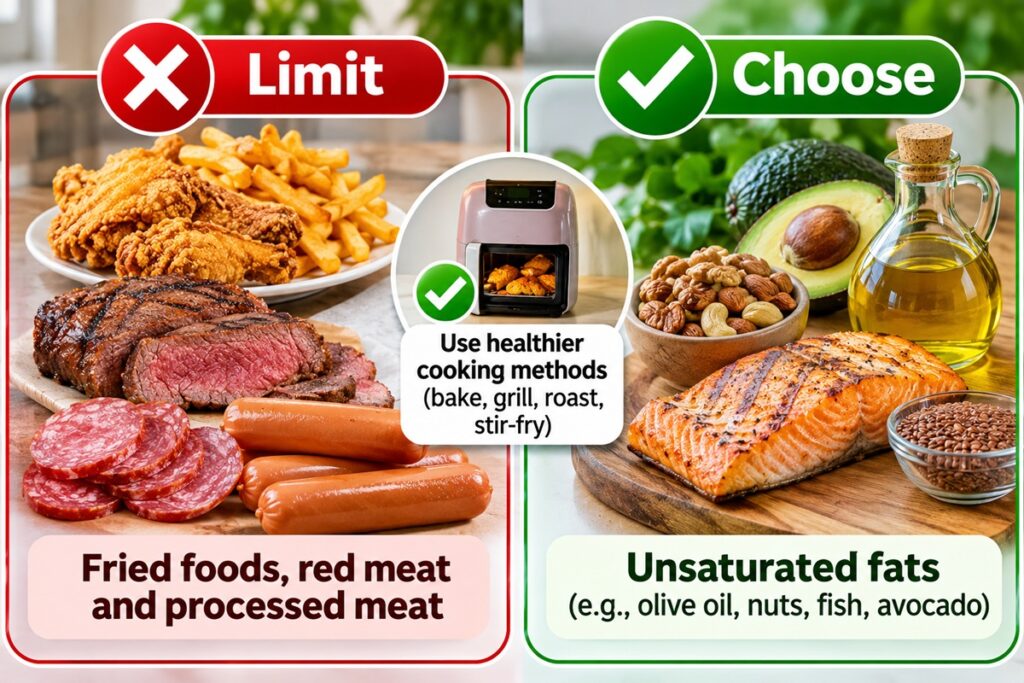
Foods high in saturated fat should be limited and replaced with foods high in unsaturated fats, not refined carbohydrates, according to the ADA.
Trans fat raises LDL (“bad”) cholesterol, according to the FDA trans fat page. In 2015, the FDA determined that partially hydrogenated oils, the main source of artificial trans fat, are no longer generally recognized as safe. For most uses, manufacturers could not add them to foods after 18 June 2018, with final compliance on 1 January 2021. Trans fat that occurs naturally in some animal products is not affected.
The federal guidelines recommend baking, broiling, roasting, stir-frying, or grilling in place of deep-frying.
Red meat is among the foods to minimize, the ADA says. No study cited here followed people with type 2 diabetes to compare red or processed meat intake with later health.
Excess processed meat and excess unprocessed red meat were each attributed to about one in five new type 2 diabetes cases in adults worldwide in 2018, in one model. In 2012, high processed meat intake was associated with about one in six US deaths from type 2 diabetes, in another model. These models do not prove cause, and their shares overlap.
Sodium and salt
The ADA and the 2025–2030 federal guidelines set a limit of less than 2,300 mg of sodium a day (about 5.8 g of salt). WHO sets a lower global limit of less than 2,000 mg a day (5 g of salt). Processed and ultraprocessed foods are major sources of sodium, the ADA says.
In the DASH4D feeding study of adults with type 2 diabetes and high blood pressure, 1,500 mg of sodium a day lowered the top blood pressure number by 4.6 mm Hg and the bottom number by 2.3 mm Hg compared with a typical US diet containing higher sodium, the ADA reports.
Alcohol
Adults with diabetes who drink should stay within one drink a day for women or two for men, and people who do not drink should not start, according to the ADA. One drink is 12 fl oz (355 mL) of beer, 5 fl oz (148 mL) of wine, or 1.5 fl oz (44 mL) of distilled spirits.
The risks of drinking include hypoglycemia and delayed hypoglycemia, especially for people using insulin or insulin secretagogues, according to the ADA. The long-term effects of alcohol in people with diabetes are unknown.
The 2025–2030 federal guidelines list people taking medicines or with medical conditions that can interact with alcohol among those who should avoid it completely.
When diabetes medicines change the guidance
The ADA’s guidance changes for two kinds of diabetes medicines: insulin or insulin secretagogues, and SGLT2 inhibitors.
For people taking SGLT2 inhibitors, the ADA discourages a ketogenic eating pattern, a very-low-carbohydrate diet. The reason is the potential risk of ketoacidosis, a condition in which the blood becomes acidic. This recommendation is grade E, meaning expert consensus.
Excessive alcohol should also be avoided with SGLT2 inhibitors, the ADA says. Very-low-carbohydrate plans are not currently recommended for people who are pregnant or breastfeeding, children, people with kidney disease, or people with or at risk for disordered eating, the ADA adds.
How diet and diabetes are counted
Diet and type 2 diabetes are counted through dietary surveys, statistical models, and global targets. The table lists five measures.
| Measure | Value | Year | Who was counted | Source |
|---|---|---|---|---|
| Average share of calories from ultraprocessed foods | 53.0% | August 2021 to August 2023 | US adults 19 and older | NCHS survey |
| New type 2 diabetes cases attributed to suboptimal diet | 70.3%, about 14.1 million cases | 2018 | Adults in 184 countries | Model (O’Hearn 2023) |
| New type 2 diabetes cases attributed to sugary drinks | 9.8%, about 2.2 million cases | 2020 | Adults worldwide | Model (Lara-Castor 2025) |
| Type 2 diabetes deaths associated with diet | 48.2%, an estimated 32,732 deaths | 2012 | US adults | Model (Micha 2017) |
| Average sodium intake | 4,278 mg a day (about 11 g of salt) | 2021 | Adults worldwide | WHO |
The rows cover different years, populations, and methods, so they should not be compared directly or added together. Both dietary recalls behind the 53.0% figure were done by phone, according to NCHS Data Brief 536.
UN Sustainable Development Goal target 3.4 aims to cut premature deaths from noncommunicable diseases by one third by 2030. Its indicator is the chance of dying between ages 30 and 70 from four noncommunicable diseases: cardiovascular disease, cancer, diabetes, or chronic respiratory disease. Diet enters this indicator only through these deaths.
In 2013, the World Health Assembly agreed a target of a 30% relative reduction in salt intake by 2025, according to WHO.
Frequently asked questions
Which fruits do guidelines say to limit?
The guidelines cited here name forms of fruit to limit, such as juice, rather than any whole fruit. The ADA encourages whole fruit that is fresh, frozen, or canned in its own juice or with no added sugar, and it groups any juices with sugar-sweetened beverages.
Are there foods people with type 2 diabetes can eat without limits?
No guideline cited here names foods people with type 2 diabetes can eat without limits. The ADA emphasizes non-starchy vegetables and names water as the main drink.
What do the guidelines say about breakfast foods?
The 2025–2030 federal guidelines name ready-to-eat or packaged breakfast options among refined carbohydrates to reduce significantly. The ADA’s nutrition section sets no rule for breakfast.
This page summarizes dietary guidelines and group-level research on type 2 diabetes. It does not tell any individual what diet or medicine to use.
Sources
- Guidelines and definitions: ADA Standards of Care 2026, 2026; Dietary Guidelines for Americans 2025–2030, 2026; FDA trans fat, 2024; WHO healthy diet fact sheet, 2026; WHO sodium reduction fact sheet, 2026; MedlinePlus diabetic diet, 2025; MedlinePlus diabetic ketoacidosis, 2025
- Studies in people with type 2 diabetes: Ma et al., BMJ, 2023; Bonaccio et al., AJCN, 2023
- Diet and new cases or deaths: O’Hearn et al., Nat Med, 2023; Lara-Castor et al., Nat Med, 2025; Lara-Castor author correction, 2025; Micha et al., JAMA, 2017
- GLP-1 labels and advisory: Ozempic label, 2026; Mounjaro label, 2026; Rybelsus label, 2026; Trulicity label, 2026; Victoza label, 2025; Wegovy label, 2026; Zepbound label, 2026; Mozaffarian et al., AJCN, 2025
- Counting: CDC National Diabetes Statistics Report, 2026; NCHS Data Brief 536, 2025; UN SDG indicator 3.4.1 metadata, 2024