Key takeaways
- No. Type 2 diabetes does not become type 1. When type 1 is diagnosed later, it was usually present from the start.
- Type 1 involves autoimmune beta-cell destruction. Type 2 involves insulin resistance and reduced insulin production, so needing insulin does not change the type.
- More than four in 10 people with type 1 diagnosed after age 30 are first treated as type 2, a 2026 consensus report says.
- Islet autoantibody tests are recommended when an adult’s risk factors overlap with type 1. C-peptide testing is recommended only for people treated with insulin.
No, type 2 diabetes does not turn into type 1 diabetes. Type 1 usually results from autoimmune destruction of beta cells, the insulin-making cells of the pancreas. In type 2, the body does not use insulin well and the pancreas gradually makes too little, without an autoimmune attack.
About 589 million adults aged 20 to 79 had diabetes in 2024, and more than nine in 10 people with diabetes have type 2, according to the International Diabetes Federation (IDF). In the United States, 40.1 million people had diagnosed or undiagnosed diabetes in 2023, including 2.1 million with diagnosed type 1, according to the Centers for Disease Control and Prevention’s diabetes statistics report.
When a person with a type 2 diagnosis is later found to have type 1, the usual explanation is that type 1 was present from the start. More than four in 10 people with type 1 diabetes diagnosed after age 30 are first treated as having type 2, according to a 2026 consensus report from the American Diabetes Association (ADA) and the European Association for the Study of Diabetes (EASD).
Why type 2 cannot change into type 1
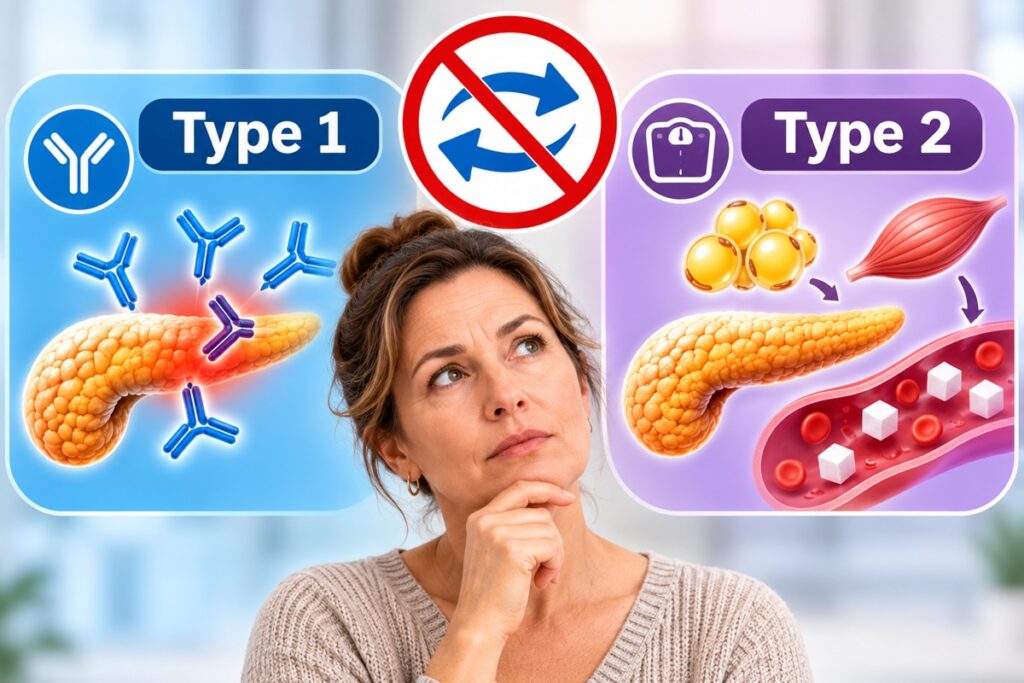
The type of diabetes is defined by its cause, not by its treatment. Because type 1 and type 2 have different causes, needing insulin later does not turn type 2 into type 1.
Every form of diabetes caused by autoimmune beta-cell destruction counts as type 1, at any age of onset, according to ADA. Type 2 results from a nonautoimmune, progressive loss of insulin secretion, often alongside insulin resistance.
What makes type 2 look like it became type 1
Four situations can look like type 2 diabetes becoming type 1:
- Type 1 diabetes that was first labeled type 2, including latent autoimmune diabetes in adults (LADA)
- Type 2 diabetes that comes to need insulin
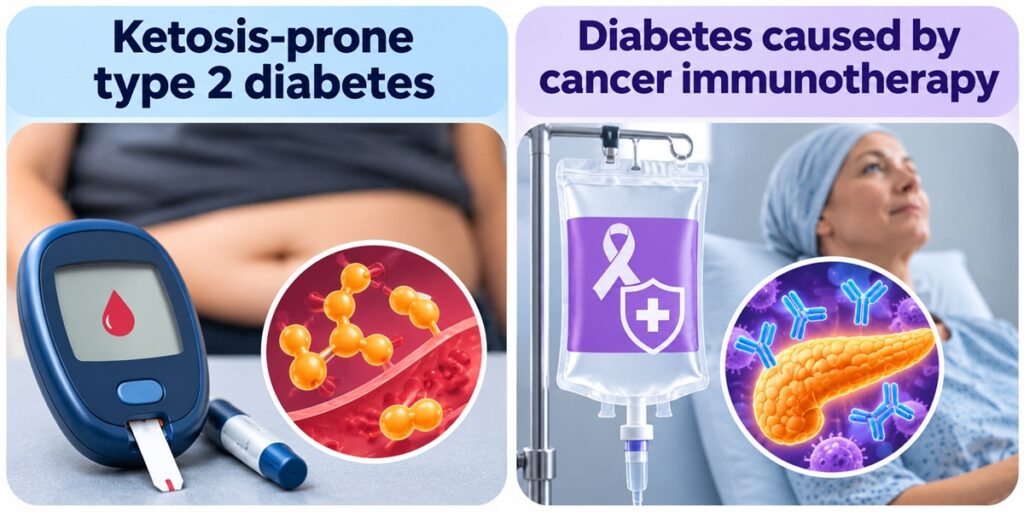
- Ketosis-prone type 2 diabetes, which can begin with diabetic ketoacidosis (DKA), a buildup of blood acids from a severe lack of insulin
- Diabetes caused by cancer immunotherapy
Type 1 diabetes first labeled type 2
Type 1 diabetes in adults is often misclassified, particularly in people with overweight or obesity, according to the ADA and EASD. Needing insulin within three years of diagnosis strongly suggests type 1 at any age.
The table lists three studies of adults whose type 1 diabetes was first treated or labeled as type 2.
| Study | Who was counted | Finding |
|---|---|---|
| Thomas et al., 2019, Exeter, England | 583 insulin-treated participants diagnosed with diabetes after 30 years of age, assessed a median 13 years after diagnosis; 123 met the study’s type 1 criteria | 38% of the 123 were not given insulin at diagnosis, and 47% of those reported a type 2 diagnosis |
| Muñoz et al., US survey, June 2016 to February 2017 | 2,526 online respondents diagnosed with type 1 in the US, adults and parents | 38.6% of those diagnosed at 18 or older reported a missed type 1 diagnosis; 76.8% of them were first diagnosed with type 2 |
| StartRight, 2023, 55 UK sites | 1,798 adults within 12 months of diabetes onset; 385 had two or more islet autoantibodies | Diagnosed over 35 vs 35 or younger: treated with insulin at diagnosis 73% vs 93%; reported a type 1 diagnosis at enrollment 87% vs 96% |
The three studies measure different things, so their figures should not be compared directly. The England study counted people not given insulin at diagnosis, which is not the same as a recorded type 2 diagnosis. The US figures are self-reported, and the survey’s authors note possible recall bias.
Most diagnostic data on adult type 1 come from White European populations and may not represent other ethnic groups, the consensus report notes.
LADA: type 1 that starts slowly in adults

LADA is autoimmune diabetes that starts in adulthood and develops slowly. People with LADA have islet autoantibodies against proteins associated with pancreatic islet cells. These antibodies are markers of an autoimmune process that damages beta cells. They may not need insulin for several months after diagnosis, according to the National Institute of Diabetes and Digestive and Kidney Diseases (NIDDK).
No universally agreed criteria for LADA exist, according to the World Health Organization (WHO). Common criteria are onset after age 30 or 35, GAD or other islet antibodies, and no need for insulin for at least six months after diagnosis.
ADA’s classification counts LADA as type 1 diabetes. WHO’s 2019 classification lists it as a hybrid form instead. Using the LADA label may be misleading and risks delaying the start of insulin, according to the ADA and EASD.
How common LADA is depends on who is counted:
- Among people clinically diagnosed with type 2 in Europe, North America, and Asia, 5% to 14% had GAD antibodies, according to WHO’s 2019 summary.
- In the UK Prospective Diabetes Study (UKPDS), about one in three white patients with type 2 aged 25 to 34 had GAD antibodies, compared with about one in 14 aged 55 to 65.
In the same UKPDS group, more than eight in 10 GAD-positive patients younger than 35 needed insulin within six years, compared with about one in three of those older than 55, according to the UKPDS 25 report. This historical UK cohort was diagnosed from 1977 to 1991.
A single positive antibody result does not always mean type 1. Low-level GAD antibodies are found in about 1% to 2% of the general adult population and may give false-positive results, the consensus report adds. A 2021 analysis by Jones and colleagues concluded that groups labeled LADA likely include some people with type 2.
Type 2 that needs insulin is still type 2
Type 2 diabetes treated with insulin is still type 2 diabetes, and US diagnosis coding keeps it under type 2.
In UKPDS, blood glucose rose over six years with every treatment in 4,209 people newly diagnosed with type 2. The rise was associated with a progressive loss of beta-cell function.
HbA1c is a blood test of average glucose over the past two to three months. In UKPDS, about half of 4,075 adults aged 25 to 65 with newly diagnosed type 2 reached an HbA1c below 7% (53 mmol/mol) on one medicine after three years. About one in four did so at nine years.
Many people with type 2 need more than one diabetes medicine over time, the UKPDS authors concluded.
Other conditions that can look like a switch
Ketosis-prone type 2 diabetes
Ketosis-prone type 2 diabetes can begin with DKA, but the early need for insulin is usually temporary, according to ADA. It occurs particularly in Black and Hispanic or Latino adults.
In a 2024 meta-analysis of 11 studies with 2,010 patients who had ketosis or DKA when diabetes began, about one in three had ketosis-prone type 2.
Diabetes caused by cancer immunotherapy
Immune checkpoint inhibitors are cancer medicines that help the immune system attack cancer cells. Autoimmune diabetes develops in 0.6% to 1.4% of people treated with them, according to ADA.
This form often begins with DKA and almost always needs lifelong insulin. Fewer than half of the people affected have islet autoantibodies.
How doctors tell the types apart
Two blood tests help classify diabetes: islet autoantibodies and C-peptide. C-peptide shows how much insulin the pancreas still makes.
These features point most strongly to type 1 in adults, according to the ADA and EASD:
- Diagnosis before age 35
- Body mass index (BMI) below 25
- Unintentional weight loss
- DKA
- Glucose above 360 mg/dL (20 mmol/L)
Islet autoantibody tests are recommended to classify diabetes in adults whose risk factors overlap with type 1, according to ADA’s 2026 Standards of Care. Testing starts with GAD antibodies, and IA-2 or ZnT8 antibodies are checked if GAD is negative.
People with two or more islet autoantibodies should be considered to have type 1 even if they do not need insulin at diagnosis, according to the ADA and EASD consensus. Antibody tests miss more cases the longer a person has had diabetes. About 5% to 10% of White European people with new-onset type 1 test negative.
C-peptide testing is recommended only for people treated with insulin, using a random blood sample and glucose reading taken within five hours of eating. The table gives ADA’s 2026 cutoffs and timing rule.
| Measure | Result | What it suggests |
|---|---|---|
| Random C-peptide | Below 0.6 ng/mL (below 200 pmol/L) | Type 1 range |
| Random C-peptide | 0.6 to under 1.8 ng/mL (200 to under 600 pmol/L) | Indeterminate; possible in insulin-treated type 2, especially after long duration |
| Random C-peptide | 1.8 ng/mL or higher (600 pmol/L or higher) | Type 2 range |
| Timing | Within two weeks of a crisis of very high blood sugar | Testing not recommended |
Note: These values support classification but should not be interpreted alone. A normal C-peptide level does not exclude recently diagnosed type 1 diabetes, and a low level does not establish an autoimmune cause.
GLP-1 medicines and the type 1 question

None of the seven US labels for semaglutide, tirzepatide, dulaglutide, and liraglutide are FDA-approved specifically to improve glucose control in type 1 diabetes. Five of the labels are for type 2 diabetes medicines. Only the Wegovy label mentions type 1.
The table lists each current US label’s approved uses and type 1 wording.
| Medicine | Selected approved indications on the US label | Type 1 wording |
|---|---|---|
| Semaglutide (Ozempic) | Type 2 diabetes in adults | No mention |
| Semaglutide tablets (Rybelsus) | Type 2 diabetes in adults | No mention |
| Tirzepatide (Mounjaro) | Type 2 diabetes in adults and children 10 and older | No mention |
| Dulaglutide (Trulicity) | Type 2 diabetes in adults and children 10 and older | No mention |
| Liraglutide (Victoza) | Type 2 diabetes in adults and children 10 and older | No mention |
| Semaglutide (Wegovy) | Weight management; heart event risk reduction in adults with heart disease and obesity or overweight; MASH, a fatty liver disease, with moderate to advanced liver scarring | Use in type 1 diabetes “has not been evaluated” |
| Tirzepatide (Zepbound) | Weight management; moderate to severe obstructive sleep apnea in adults with obesity | No mention |
In the ADJUNCT ONE trial of 1,398 adults with type 1, liraglutide 1.8 mg added to insulin for 52 weeks lowered HbA1c slightly more than placebo. Low blood sugar and high blood sugar with ketosis became more common, which the authors said limits its use in type 1.
The ADJUST-T1D trial gave semaglutide up to 1 mg weekly or a placebo for 26 weeks to 72 adults with type 1 who used automated insulin delivery and had a BMI of 30 or higher. More than one in three patients on semaglutide met a combined goal for glucose control, low blood sugar, and weight loss, compared with none on placebo. Weight fell 19.4 lb (8.8 kg) more with semaglutide, and neither group had DKA.
In a post hoc analysis of three dulaglutide trials in type 2 diabetes, done after the trials ended, 7.6% of 2,466 tested adults had GAD antibodies. HbA1c fell by a similar amount whether or not people had them.
How the type is counted and coded
US diagnosis coding uses ICD-10-CM, which codes type 1 as E10, type 2 as E11, and other specified diabetes as E13. If a medical record does not state the type, the default code is E11, type 2. If the record notes insulin use but no type, the code is still E11, with Z79.4 added for long-term insulin use, according to the FY2027 ICD-10-CM guidelines.
In ICD-11, WHO lists LADA and immune-related type 1 diabetes under 5A10, type 1. It lists insulin-requiring type 2 diabetes under 5A11, type 2.
The UN Sustainable Development Goal indicator 3.4.1 tracks the chance of dying between ages 30 and 70 from four noncommunicable diseases: cardiovascular disease, cancer, diabetes, and chronic respiratory disease. It counts diabetes deaths of all types together, as codes E10 to E14, so the indicator does not separate type 1 from type 2, according to UN indicator metadata.
Frequently asked questions
Can type 1 diabetes turn into type 2?
Type 1 diabetes does not turn into type 2 diabetes. No diagnostic criteria allow a later type 2 diagnosis in someone with established type 1, according to the ADA and EASD. People with type 1 can also have insulin resistance or obesity, and a second diagnosis may be recorded to help them get non-insulin medicines.
At what age does type 1 diabetes start?
Type 1 diabetes can start at any age, according to NIDDK. It occurs more commonly in children and young adults.
Can type 2 diabetes be reversed?
Type 2 diabetes can go into remission in some people, and remission keeps the type 2 label. ICD-10-CM codes E11.A identifies type 2 diabetes without complications, in remission, based on provider documentation. This page summarizes group-level research and guidelines on how diabetes is classified. It does not tell any individual what tests or medicine to use.
Sources
- Global and US figures: IDF Diabetes Atlas factsheet, 2025; CDC National Diabetes Statistics Report, 2026
- Definitions and classification: NIDDK Type 1 Diabetes, 2025; NIDDK What Is Diabetes?, 2023; ADA Standards of Care, section 2, 2026; WHO Classification of diabetes mellitus, 2019; ADA and EASD consensus report, 2026
- Adult type 1 and misdiagnosis: Thomas et al., Diabetologia, 2019; Muñoz et al., Clin Diabetes, 2019; Thomas et al., Diabetes Care (StartRight), 2023
- LADA: Buzzetti et al., Diabetes, 2020; Turner et al., Lancet (UKPDS 25), 1997; Jones et al., Diabetes Care, 2021
- Type 2 over time: UKPDS Group, Diabetes (UKPDS 16), 1995; Turner et al., JAMA (UKPDS 49), 1999
- Other forms: Kovacs et al., Diabetes Metab Res Rev, 2024
- GLP-1 medicines: Ozempic prescribing label, 2026; Rybelsus prescribing label, 2026; Mounjaro prescribing label, 2026; Trulicity prescribing label, 2026; Victoza prescribing label, 2025; Wegovy prescribing label, 2026; Zepbound prescribing label, 2026; Mathieu et al., Diabetes Care (ADJUNCT ONE), 2016; Shah et al., NEJM Evidence (ADJUST-T1D), 2025; Pozzilli et al., Diabetes Obes Metab, 2018
- Coding and counting: ICD-10-CM Official Guidelines, FY2027; ICD-10-CM codes, NLM Clinical Tables, 2026; ICD-11 type 1 diabetes, 5A10, 2025; ICD-11 type 2 diabetes, 5A11, 2025; UN SDG indicator 3.4.1 metadata, 2024