Key takeaways
- Some people with type 2 diabetes reach remission: HbA1c below 6.5% for at least three months without glucose-lowering medicine. It is not a cure.
- Remission is rare in routine care: 4.8% of adults with type 2 diabetes in Scotland were in remission in 2019.
- Keeping off more than 10% of body weight may lead to remission. Once in remission, test HbA1c at least once a year.
- Normal blood sugar while taking a diabetes medicine, including tirzepatide (Mounjaro, Zepbound), does not count as remission. See the evidence
Type 2 diabetes can be reversed in some people, in the sense that blood glucose may fall back below the diabetes range and stay there without medicine. The accepted term for that lasting state is remission, not cure, because high blood glucose often returns.
Diabetes of all types affected 589 million adults aged 20 to 79 in 2024, by the International Diabetes Federation’s count. Type 2 made up 96% of all diabetes cases in 2021, according to the Global Burden of Disease study.
Profound weight loss removes excess fat from inside the liver and pancreas. In some people, this improves insulin sensitivity and helps the pancreas release more insulin. These changes may allow blood sugar to return to the nondiabetic range without medication. Outside clinical trials, remission is uncommon, and it often ends when weight comes back.
What counts as remission
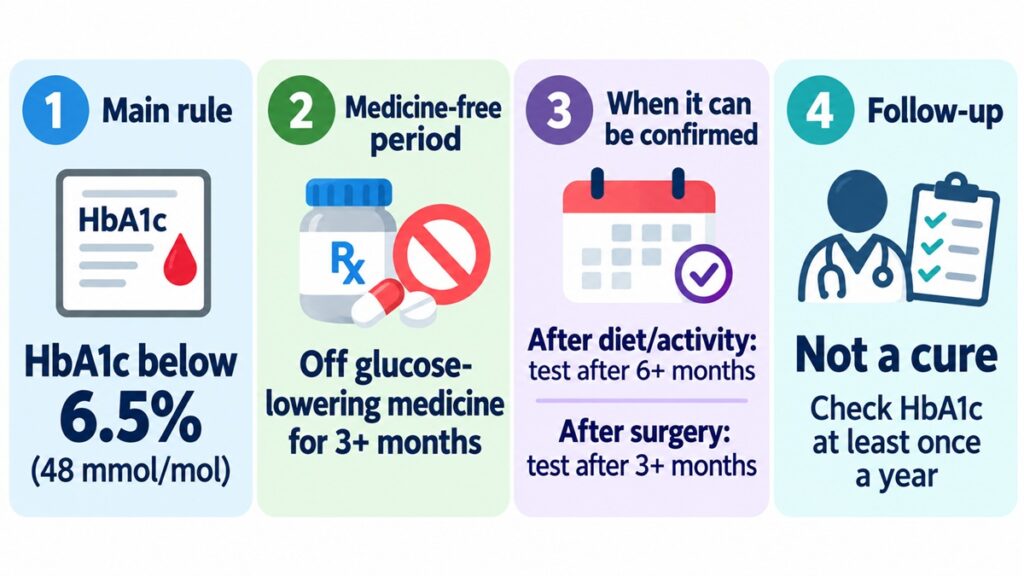
A 2021 international consensus set one test for type 2 diabetes remission. It requires a result below 6.5% on HbA1c for at least three months without glucose-lowering medication. HbA1c measures average blood sugar over approximately two to three months. If HbA1c is unreliable because of certain medical conditions, doctors may use fasting blood sugar or other glucose measurements. The panel chose the word remission because reversal describes only the fall in blood glucose, and cure would wrongly suggest that no further checks are needed.
The 2021 consensus proposed HbA1c below 6.5%, for at least three months without usual glucose-lowering medication, as the standard criterion for type 2 diabetes remission. After a change in diet or activity, the test can come no sooner than six months after the change begins, and after surgery no sooner than three months. So, a remission cannot be confirmed within three months of starting a diet. Once remission is confirmed, the consensus advises an HbA1c test at least once a year, because blood glucose often rises again.
How often remission happens outside trials
Remission is much rarer in routine care than in trials. A national study in Scotland found 4.8% of 162,316 adults aged 30 and over with type 2 diabetes in remission in 2019. It counted people whose HbA1c stayed below 6.5% for at least a year without glucose-lowering medicine.
In Kaiser Permanente Northern California, one US health system, 1.60% of 122,781 adults with type 2 diabetes and no weight-loss surgery reached remission over seven years. Among those diagnosed less than two years earlier, the share was 4.6%.
Can tirzepatide (Mounjaro, Zepbound) lead to remission of type 2 diabetes?
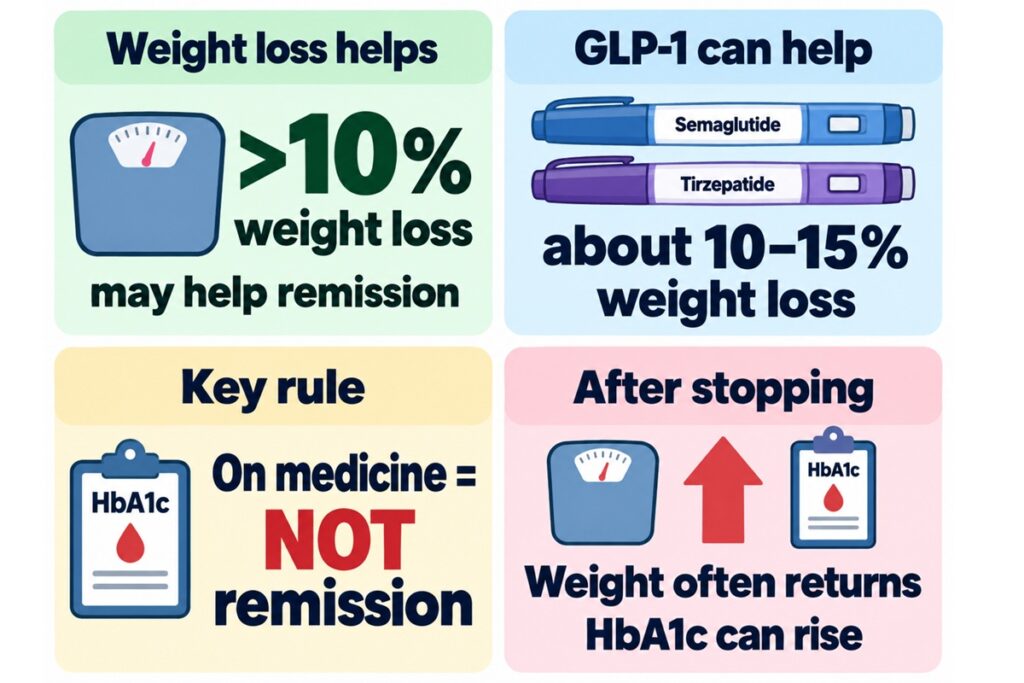
Remission becomes possible with major weight loss, and tirzepatide (Mounjaro, Zepbound) offers one way to lose that much weight, alongside diet programs and bariatric surgery. These medicines act on both GIP and GLP-1 receptors. But normal blood sugar while taking diabetes medication is not considered remission under the 2021 definition.
The 2026 US diabetes guideline says that keeping off more than 10% of body weight may lead to remission. For people with diabetes and excess weight, the 2026 ADA Standards guideline favors semaglutide or tirzepatide as the preferred medicines because of their greater weight-loss efficacy.
In the STEP 2 trial, people with type 2 diabetes took semaglutide 2.4 mg a week for 68 weeks. They lost 9.6% of body weight on average. Those given a placebo lost 3.4%.
In the SURMOUNT-2 trial, people with type 2 diabetes took tirzepatide 10 mg or 15 mg a week for 72 weeks. They lost 12.8% of body weight on average when taking 10 mg and 14.7% when taking 15 mg. Those given a placebo lost 3.2%.
A combined analysis of treatment discontinuation looked at people with type 2 diabetes who stopped a GLP-1 medicine. On average, they gained about 4.5 pounds, and their HbA1c rose by 0.65 points. The type 2 diabetes trials in that analysis tested liraglutide and exenatide, not tirzepatide. The 2026 US guideline advises continuing weight-management medicines because weight often returns after stopping.
What tirzepatide trials show about type 2 diabetes remission
In SURPASS-1, about one-third to one-half of adults on tirzepatide reached an HbA1c below 5.7%, the normal range. They were still taking tirzepatide, so this is not type 2 diabetes remission under the 2021 definition.
The table lists the share of people who reached an HbA1c below 5.7%.
| Trial | Who took part | Length | HbA1c below 5.7% |
|---|---|---|---|
| SURPASS-1 | 478 adults on diet and exercise alone, with diabetes for 4.7 years on average | 40 weeks | 31%–52% across three tirzepatide doses, compared with 1% on placebo |
| SURPASS-5 | 475 adults already on basal insulin, with or without metformin, with diabetes for 13.3 years on average | 40 weeks | 24%, 42%, and 50% on 5 mg, 10 mg, and 15 mg, compared with 3% on placebo |
| SURPASS-1 to -5 | Adults taking the highest dose, 15 mg, in each of the five trials | 40 or 52 weeks | 43%–62%, depending on the trial |
All figures were measured during the trials, not after stopping tirzepatide. SURPASS-1 counted results only while people stayed on the study medicine, and SURPASS-5 counted everyone assigned to each group.
People who reached a normal HbA1c had had diabetes for less time, according to a pooled analysis of SURPASS-1 to SURPASS-4. They also started with a lower HbA1c. Over 40 weeks, they lost about 29 pounds on average, compared with about 10 pounds in those who ended above 6.5%.
The analysis left out people who stopped tirzepatide, missed more than a quarter of their doses, or needed rescue medicine. The results may not apply to everyone who takes tirzepatide, the authors say.
In SURPASS-1, weight loss accounted for about 12%–27% of the HbA1c gap between tirzepatide and placebo, a 2025 analysis estimated. Tirzepatide can also lower blood sugar in ways that do not depend on weight loss.
A SURPASS-3 substudy measured liver fat in 296 adults with type 2 diabetes and a fatty liver index of 60 or higher. Their liver fat averaged about 16% of the liver at the start. Over 52 weeks, it fell about 8 percentage points on tirzepatide 10 mg or 15 mg and about 3 points on insulin degludec. The decrease was linked to weight loss.
The 2021 definition tests for remission at least three months after all glucose-lowering medicine has stopped. Under that definition, tirzepatide would count as a glucose-lowering medicine because Mounjaro is approved to lower blood sugar. Remission after stopping tirzepatide has not been reported in published trials.
In SURMOUNT-4, adults with obesity or overweight and no diabetes took tirzepatide for 36 weeks. Those switched to placebo then regained about 14% of body weight over a year. Those who stayed on tirzepatide lost 5.5% more.
The Mounjaro label lists two approved uses:
- Improving blood sugar, with diet and exercise, in adults and children 10 and older with type 2 diabetes
- Lowering the risk of cardiovascular death, nonfatal heart attack, or nonfatal stroke in adults with type 2 diabetes at high risk of these events
The Zepbound label lists two approved uses, both alongside a reduced-calorie diet and more physical activity:
- Reducing excess weight and keeping it off in adults with obesity, or adults with overweight and at least one weight-related condition
- Treating moderate to severe obstructive sleep apnea in adults with obesity
Mounjaro is not approved for weight loss, and Zepbound is not approved to treat type 2 diabetes. Neither label lists remission as a use. Both labels set the highest adult tirzepatide dose at 15 mg, injected once a week. Compounded tirzepatide is also sold, but it is not FDA-approved and is not the same as either brand; read what to check in a compounding provider before you use one.
The Mounjaro and Zepbound labels both carry a boxed warning, which the FDA uses to highlight serious risks, concerning thyroid C-cell tumors observed in rats. It is unknown whether tirzepatide causes these tumors in people, both labels say.
Remission rates in diet, surgery, and lifestyle trials
The highest remission rates came from trials of people diagnosed within the past few years who lost a large amount of weight.
| Study and country | Who took part | What was compared | Follow-up | In remission |
|---|---|---|---|---|
| DiRECT, United Kingdom | Adults aged 20 to 65, diagnosed within six years, overweight or obese, not using insulin | Formula diet and weight-loss support compared with usual best-practice care | 12 months | 46% of the diet group (68 of 149) compared with 4% of the usual-care group (6 of 149) |
| DiRECT, United Kingdom | The same people | The same comparison | 24 months | 36% of the diet group (53 of 149) compared with 3% of the usual-care group (5 of 149) |
| DiRECT extension, United Kingdom | Diet-group members still taking part, and the original usual-care group | Three more years of light support compared with the original usual-care group | 5 years | 13% of the extension group (11 of 85) compared with 5% of the usual-care group (5 of 93) |
| DIADEM-I, Qatar | Adults aged 18 to 50 from the Middle East and North Africa, diagnosed within three years, overweight or obese | Formula diet, food reintroduction, and activity support compared with usual care | 12 months | 61% of the diet group compared with 12% of the usual-care group |
| Look AHEAD, United States | 4,503 adults with type 2 diabetes who were overweight or obese | Intensive diet and exercise program compared with support and education | 1 and 4 years | Year 1: 11.5% compared with 2%; year 4: 7.3% compared with 2%; all four years: 3.5% compared with 0.5% |
| NHS program, England | Adults aged 18 to 65 diagnosed within six years | 12-month program starting with three months of formula diet; no comparison group | About 12 months | 27% of starters with two test results (190 of 710); 32% of those who finished (145 of 450) |
| Rome surgery trial, Italy | 60 adults with diabetes for over five years and a BMI of 35 or more | Medical care compared with gastric bypass or biliopancreatic diversion (an operation that bypasses most of the small intestine) | 10 years | 50% after diversion, 25% after bypass, 5.5% with medical care; 37.5% of all surgery patients stayed in remission throughout |
| Swedish Obese Subjects, Sweden | 343 people who had surgery and 260 who did not, all with type 2 diabetes | Mostly older types of weight-loss operation compared with usual care | 2 and 15 years | Year 2: 72.3% compared with 16.4%; year 15: 30.4% compared with 6.5% |
Each study set its own definition for remission. DiRECT required two months off medicine, the Rome trial one year off medicine, and the Swedish study a glucose level below 110 mg/dL without medicine.
DiRECT, run in UK general practices, replaced all meals with a formula diet providing 825–853 kcal a day for three to five months. Food was then brought back over two to eight weeks, with support to keep the weight off. Diabetes and blood pressure medicines were stopped at the start under medical supervision.
Two serious problems in the diet group, biliary colic (gallstone pain) and abdominal pain, were judged possibly linked to the diet. The 2026 US guideline limits diets this low in calories to supervised medical care for up to about three months. Very-low-calorie diets, such as the formula diet used in DiRECT, should only be followed under medical supervision. People with diabetes may need changes to their medications to prevent dangerously low blood sugar or low blood pressure. These diets are not appropriate for everyone.
Look AHEAD, a long US program of diet and exercise in a broader group of adults, reported remission rates that its authors called modest. England’s national program also reported lower rates than trials, and only 55% of those who started it finished. Many starters had no follow-up test results, so the true share across everyone who started is unknown.
Trials of low-carbohydrate diets reported more remission at six months, but that count included people still taking diabetes medicine. When remission required no medicine, the difference from other diets was small and could have arisen by chance.
Why weight loss works for some people and not others
Researchers believe that each person may have a different limit for how much fat their body can store before it interferes with normal blood sugar control. Losing weight can reduce fat in the liver and pancreas and improve insulin production. However, not everyone achieves remission, even after substantial weight loss. The studies below show each of those two parts.
A small study in Newcastle, in the UK, put 11 people with type 2 diabetes on 600 kcal a day for eight weeks. Their fasting blood glucose was normal within one week. Fat in the liver fell from 12.8% of liver volume to 2.9% by week eight, and early insulin release rose towards levels seen without diabetes.
The DiRECT mechanism study found that liver and pancreas fat went down in everyone who lost weight. But blood glucose returned to the nondiabetic range only in people whose early insulin release recovered. Those people had lived with diabetes for less time, 2.7 years on average compared with 3.8 years.
So losing fat is necessary but not enough. The pancreas also has to start releasing insulin promptly again, and that is more likely the shorter someone has had diabetes.
Excess liver fat of this kind is the defining feature of nonalcoholic fatty liver disease. Waist size is one of the measures that define metabolic syndrome, alongside blood pressure, blood fats, and blood glucose.
Remission in DiRECT rose with the amount of weight lost, counting both trial groups together.
| Weight change at 12 months in DiRECT | In remission |
|---|---|
| Gained weight | 0% (0 of 76) |
| Lost 0 to 11 pounds | 7% (6 of 89) |
| Lost 11 to 22 pounds | 34% (19 of 56) |
| Lost 22 to 33 pounds | 57% (16 of 28) |
| Lost 33 pounds or more | 86% (31 of 36) |
This is a pattern observed in one trial of people diagnosed within six years, and it is not a weight target for anyone.
The Newcastle researchers propose that each person has a personal limit of body fat above which diabetes becomes likely, whatever their body mass index (BMI). They tested the idea in 20 people with type 2 diabetes and a BMI under 27. After losing about 6.5% of their weight, 14 of the 20 were in remission off all glucose-lowering medicine. The study was small and had no comparison group, but the results may explain why weight loss can be enough for one person and not for another because they have different limits.
The Global Burden of Disease study describes type 2 diabetes as “potentially reversible if identified and managed early.” In the Scottish and Kaiser Permanente studies, older people were more often in remission, which may partly reflect weight lost through illness rather than by choice.
How remission is recorded
Health records and diabetes statistics treat remission in different ways, so the same person can be counted in one total and left out of another.
In the United States, remission gained its own diagnosis code, E11.A, on 1 October 2025, under the ICD-10-CM coding guidelines. A clinician assigns it by recording that the diabetes is in remission, and the guidelines set no HbA1c level. The code covers remission without complications only, so a person with a recorded diabetes complication keeps an ordinary type 2 code. The guidelines also warn that “the term ‘resolved’ is not synonymous with remission.”
The World Health Organization’s disease classifications, ICD-10 and ICD-11, have no category of their own for type 2 diabetes in remission, in the 2019 and 2026 versions checked. In England, general practices record people in remission with a remission code, so their monitoring continues.
The 2021 consensus panel dropped older labels of partial and complete remission, partly because they could confuse insurance and coding decisions. A 2026 paper proposed a separate category for normal blood sugar kept by continuing medicine, but the 2021 definition still applies.
| Count | Who is counted | A person in remission |
|---|---|---|
| US survey totals of diagnosed diabetes | People who say a clinician has ever told them they have diabetes | Still counted, if they answer yes |
| Global estimate of about 830 million adults with diabetes in 2022 | People with raised fasting glucose, raised HbA1c, or current diabetes medicine | Not counted while glucose and HbA1c stay below the cut-offs without medicine |
| General practice records in England | People coded with diabetes, including a remission code | Recorded as in remission, with monitoring continuing |
| US insurance claims | Diagnoses a clinician records | May carry code E11.A if there are no complications |
Each entry shows what the counting rule implies. None of these sources measures how many people in remission it includes or leaves out.
Global monitoring of early deaths from noncommunicable diseases counts deaths from diabetes between the ages of 30 and 70, so it does not measure remission.
How long remission lasts
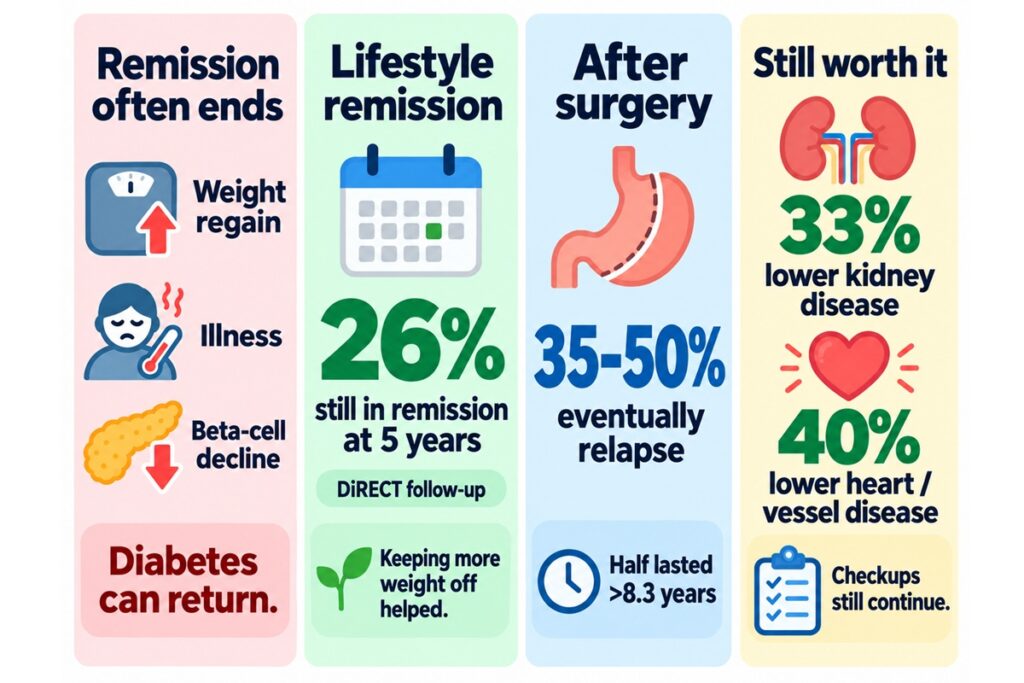
Remission can last for years, but it is not always permanent. The 2021 consensus notes that weight gain, another illness, or a continuing decline in the insulin-making cells can each bring diabetes back. In the five-year follow-up of DiRECT, 26% of people in remission at two years were still in remission at five years. People who kept more weight off were more likely to stay in remission.
Remission after surgery also ends for many people. The Rome trial was a small Italian study of 60 people, and its operations differ from the ones most common today, so its figures are not a general long-term remission rate. Of the people in remission at two years, 58.8% had raised blood glucose again within 10 years. Those who relapsed still had an average HbA1c near 6.7%, so their blood sugar stayed fairly well controlled. Across all surgery patients, diabetes complications were far fewer than with medical care alone.
Among 4,434 US adults who had gastric bypass, 68.2% reached remission within five years of the operation. Diabetes returned within five years in 35.1% of those people, and half of their remissions lasted longer than 8.3 years. The 2026 US guideline estimates that diabetes eventually returns in 35%–50% of people who reach remission after surgery.
In Look AHEAD, people who reached any remission later had a 33% lower rate of kidney disease and a 40% lower rate of heart and blood vessel disease. The authors note that better weight, fitness, blood sugar, and cholesterol may explain part of this, so it shows a link, not proof of cause.
The 2021 consensus adds that eye, kidney, and nerve damage can still occur after remission, and that its long-term effects on survival are unknown. It also finds no long-term evidence that the usual checks for complications can safely stop. High blood sugar in earlier years may already have affected the eyes, kidneys, nerves, or blood vessels, so people in remission still need regular follow-up: eye exams, kidney function tests, foot exams, and blood pressure and cholesterol checks. An HbA1c test at least once a year shows whether diabetes has returned.
This page summarizes research on remission across groups of people. It is not advice about diet, surgery, or any medicine for an individual.
Sources
- Definition and guideline: Remission consensus, 2021; US Standards of Care, obesity section, 2026.
- Global figures: International Diabetes Federation, Diabetes Atlas factsheet, 2025; Global Burden of Disease diabetes study, 2023; NCD Risk Factor Collaboration, 2024.
- Routine care: Scotland, 2021; Kaiser Permanente, 2014; Italian clinics, 2025.
- Diet and lifestyle trials: DiRECT 12 months, 2018, 24 months, 2019, and 5 years, 2024; DIADEM-I, 2020; Look AHEAD remission, 2012, and later outcomes, 2024; NHS England programme, 2024; Low-carbohydrate review, 2021.
- Surgery: Rome trial, 2021; Swedish Obese Subjects, 2014; US gastric bypass relapse, 2013.
- How weight loss works: Newcastle 600 kcal study, 2011; DiRECT mechanism study, 2018; personal fat limit hypothesis, 2015, and test at lower BMI, 2023.
- Weight medicines: STEP 2, 2021; SURMOUNT-2, 2023; Stopping analysis, 2025; Medicine-held remission proposal, 2026.
- Tirzepatide: Mounjaro label, 2026; Zepbound label, 2026; SURPASS-1, 2021; SURPASS-5, 2022; Normoglycemia analysis, 2023; Weight-loss mediation analysis, 2025; SURPASS-3 liver fat substudy, 2022; SURMOUNT-4, 2024.
- Records and counts: ICD-10-CM guidelines, 2025; NHS England QOF update, 2022; CDC survey methods, 2024.