Key takeaways
- Yes. People with type 2 diabetes can get a tattoo, but risk depends on blood glucose, tattoo location, studio and ink hygiene, and healing.
- A 2012 medical review advised against tattoos on the feet or lower legs because diabetes-related nerve and blood-vessel disease may slow healing or invite infection.
- No diabetes guideline sets an A1C level for tattoos. Below 7% and below 8% goals apply to general care and elective surgery, not tattoos.
- Choose a registered studio; see a doctor for spreading redness, fever, pus, or open sores.
People with type 2 diabetes can get a tattoo, and no existing law or diabetes guideline forbids it. The risk of a tattoo with type 2 diabetes depends on blood glucose, body site, studio and ink hygiene, and healing.
The National Diabetes Statistics Report from the Centers for Disease Control and Prevention (CDC) counted 40.1 million people with diabetes in 2023, diagnosed or not. That was 12.0% of the United States population. The CDC’s type 2 diabetes page says type 2 accounts for about 90% to 95% of diabetes, with no reference year given for the share.
A Pew Research Center tattoo survey of 8,480 adults in July 2023 found 32% had a tattoo and 22% had more than one. Among adults aged 30 to 49, the share with a tattoo was 46%. No published figure was found for the share of people with diabetes who have tattoos.
Why diabetes raises the risk of a new tattoo
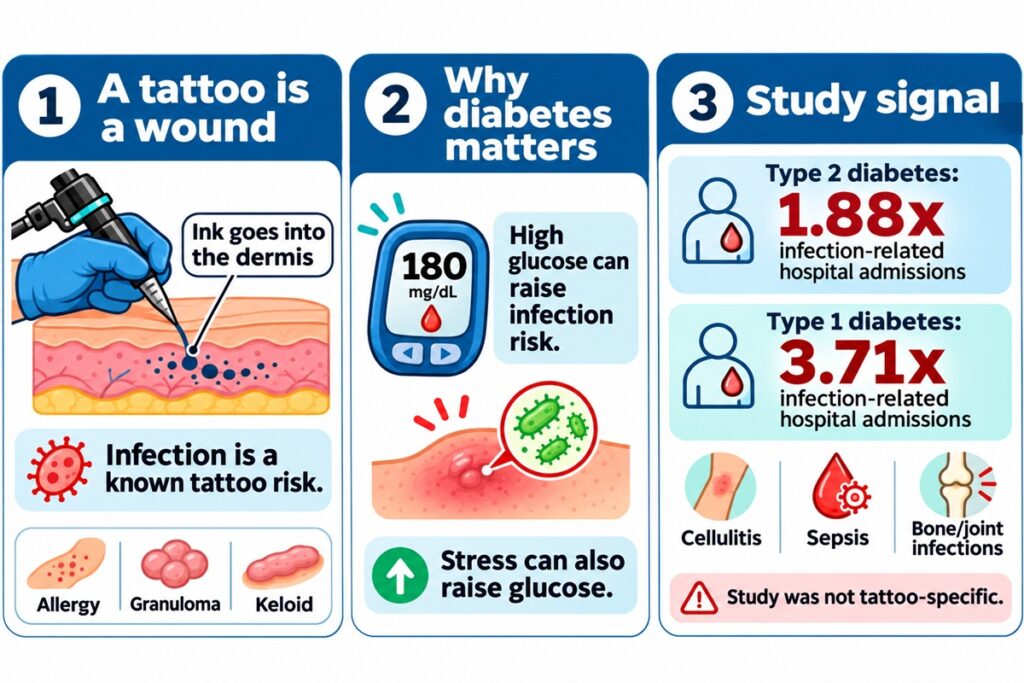
A tattoo is a wound because the needle places ink in the dermis, the skin layer under the surface. The Food and Drug Administration (FDA) tattoo fact sheet lists infections among tattoo risks, alongside allergic reactions, granulomas, and keloids.
High glucose raises infection risk in people with diabetes. A 2018 matched cohort study in England compared 96,630 adults aged 40 to 89 with type 2 diabetes with 203,518 matched adults without diabetes from 2008 to 2015.
Infection-related hospital admission occurred at 1.88 times the rate in type 2 diabetes, while type 1 diabetes carried 3.71 times the rate. Bone and joint infections, sepsis, and cellulitis, a skin infection, had the highest rate ratios. The study did not examine tattoos.
The American Diabetes Association (ADA) guidance on care around surgery states that high glucose around surgery raises the risk of infection afterward. It adds that the stress of surgery and the stress hormones it releases push glucose up. Tattooing is not surgery, so these surgery findings do not measure the infection risk of a tattoo.
GLP-1 medicines and tattoos
People with type 2 diabetes who use an injected glucagon-like peptide-1 (GLP-1) medicine inject under the skin of the abdomen, thigh, or upper arm and change the spot each time. Plan tattoo placement around usual injection sites. Avoid injecting through a fresh, inflamed, infected, or incompletely healed tattoo, and preserve suitable sites for rotation.
Ozempic injection, Trulicity, and Victoza name those three areas and call for rotation in the United States prescribing labels. Mounjaro, containing tirzepatide, acts on glucose-dependent insulinotropic polypeptide (GIP) and GLP-1 receptors and uses the same areas, with upper-arm injections given by another person. The tirzepatide vial instructions rule out injecting into scars or damaged skin, while no label mentions tattoos, so reading a healing tattoo as damaged skin is an inference.
Is there an A1C level needed for a tattoo?
No diabetes guideline checked sets an A1C (glycated hemoglobin) level needed for a tattoo. The sections of the ADA’s 2026 Standards of Care that were checked do not mention tattoos, and the one peer-reviewed review on tattooing that was found gives no number.
The figures quoted by the pages that rank highest in search for this question come from other ADA goals. Below 7% matches the general glucose goal, while below 8% matches the goal before elective surgery. Neither was written as a tattoo rule.
| A1C figure quoted in top search results | Where the number really comes from | Average glucose it reflects |
|---|---|---|
| 7% | ADA 2026 general goal for many nonpregnant adults | About 154 mg/dL |
| 8% | ADA 2026 goal before elective surgery, measured within three months | About 183 mg/dL |
| No number | 2012 medical review: diabetes “optimally controlled” at the time of tattooing | Not stated |
A1C reflects average glucose over about two to three months.
The ADA’s glycemic goals set below 7% as appropriate for many nonpregnant adults without severe hypoglycemia or hypoglycemia affecting health or quality of life. The same section allows lower goals for some people and less strict goals for others.
The 2012 medical review asked for diabetes “optimally controlled,” judged by A1C and glucose profile at the time of tattooing, to promote healing and prevent wound infection. The ADA’s surgery guidance recommends below 8% within three months before elective surgery, with individual risk assessment, and advises against postponing surgery on A1C alone. None of the three figures in the table is a requirement set for tattoos.
Tattoo placement on the feet, legs, and injection sites
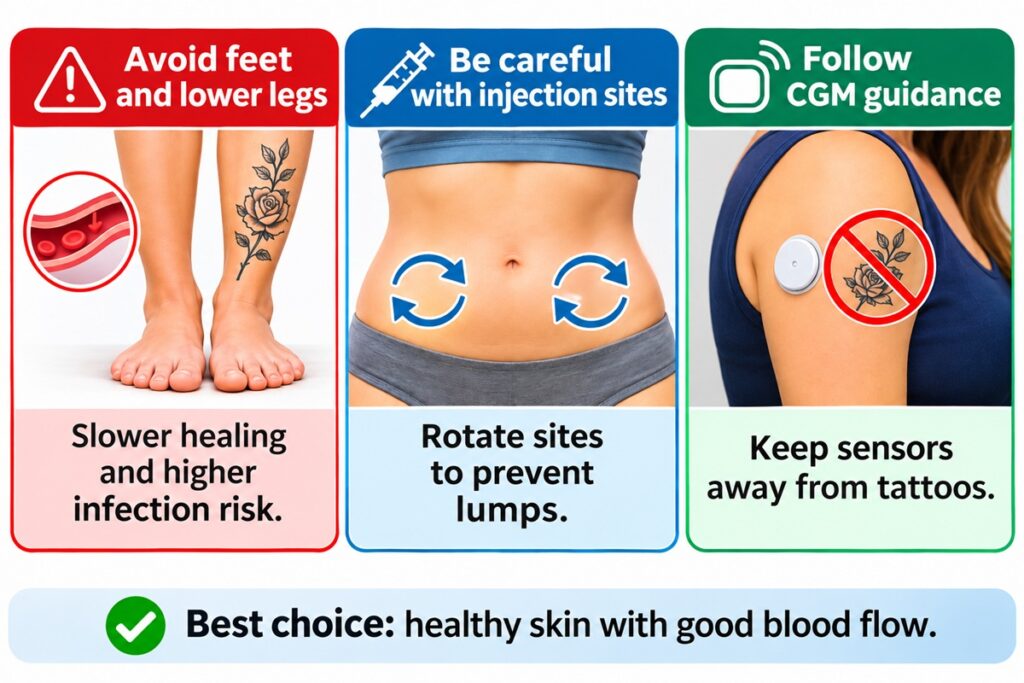
Published sources single out the feet and lower legs, alongside skin used for injections and sensors. The 2012 medical review advised against tattooing the feet or lower legs because diabetes-related nerve and blood-vessel disease may slow healing or invite infection.
The ADA’s guidance on neuropathy and foot care reports up to 50% of diabetic peripheral neuropathy may cause no symptoms, while lost protective sensation lets minor injuries go unnoticed. A federal page on diabetes and foot problems, last reviewed in 2017, says diabetes can lower blood flow in the feet. Low blood flow can slow the healing of a sore or an infection.
The ADA’s guidance on glucose-lowering medicines says insulin rotation is necessary to avoid lipohypertrophy, lumpy fat under the skin that can make absorption erratic. The Victoza label gives a different reason for rotating, to lower the chance of cutaneous amyloidosis, in which protein builds up into lumps under the skin. The Mounjaro label lets insulin share a body area with Mounjaro, as long as the two injections are not placed side by side.
Sensor makers give different tattoo advice for continuous glucose monitor (CGM) use. The Dexcom G7 instructions name the back of the upper arm, at least 3 inches from an infusion set or injection site, and away from tattoos, with no reason given. Abbott’s FreeStyle Libre support page tells users to avoid scars, moles, stretch marks, and lumps, but expects no interaction between tattoo ink and the sensor.
Who regulates tattoo studios and inks in the US
State and local authorities oversee tattoo studios in the United States, while the FDA oversees inks as cosmetics. The FDA states that “even unopened and sealed tattoo inks can harbor bacteria,” so a sealed container or sterile claim is no guarantee. Infections have resulted from contaminated inks even when artists followed hygienic procedures.
A 2025 review of reports on tattoo-associated infections since 1820 found that they have increased since 2000. It named poor hygiene as the main cause and linked contaminated inks to 11 outbreaks and recalls.
Laboratory testing supports the warning about contaminated ink. A 2024 FDA ink contamination study tested 75 commercial tattoo and permanent-makeup inks and found 26 contaminated. The work recovered 34 bacterial isolates, with 19 possibly pathogenic, and found no link between a sterile claim and absence of contamination.
A 2012 CDC outbreak report described 22 cases of tattoo-associated nontuberculous mycobacterial skin infection in four states during 2011 to 2012. In New York, 14 people tattooed from September to December 2011 were linked to one prediluted gray ink. The report’s advice to consumers was to choose studios registered with local authorities and to accept only inks made for tattoos.
An FDA consumer update asks anyone with a reaction to a tattoo to tell a health professional and the FDA. Dermatology reviews from 2015 and 2018 list diabetes among the conditions that change tattoo risk. They add that tattoo artists lack the training to advise clients on medical conditions.
Blood sugar during a long tattoo session
No published study has been found that measured glucose in people with diabetes while they were being tattooed. A 2016 study of 29 adults measured saliva cortisol, a stress hormone, and an immune protein before and after tattoo sessions, but not glucose.
The ADA’s glycemic guidance says stressful events raise the risk of both high and low glucose. Its examples are illness, trauma, and surgery, not tattooing.
The top-ranking pages on this question disagree about direction, with some warning of lows during long sessions and others warning of rises from pain and stress. The absence of direct measurement means neither account has study support. Breaks, snacks, and glucose checks appear on those pages as common recommendations without primary evidence.
Healing and signs of a tattoo infection
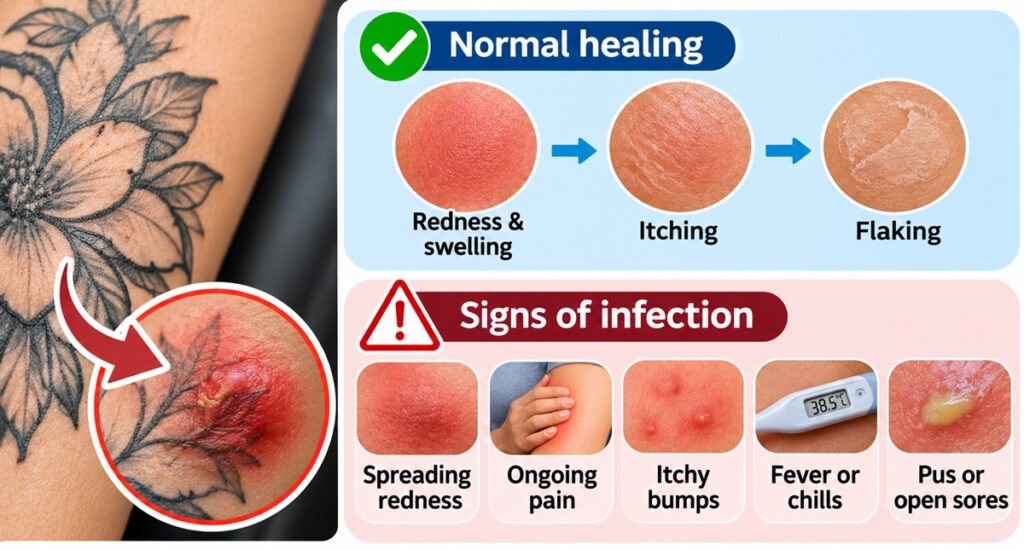
Infection can start immediately or days to months after tattooing, and the American Academy of Dermatology lists its signs on a page about tattoo skin reactions. They include redness that darkens or spreads, pain that continues or worsens, itchy red painful bumps, fever, chills, pus, and open sores. During normal healing, some redness and swelling come first, followed by itching and flaking.
The academy advises seeing a doctor or board-certified dermatologist right away for signs or symptoms of infection. An infection can also raise glucose because illness raises the risk of high glucose. The 2018 England study estimated that about 6% of infection-related hospital admissions were attributable to diabetes.
The academy’s page on caring for tattooed skin says petroleum-based products such as petroleum jelly can fade ink. The academy advises dermatology review for any reaction or change in tattooed skin.
One 2025 case report described a woman with diabetes who developed a bloodstream bacterial infection traced to a tattoo, with no visible signs at the tattoo site, and she recovered. A single case cannot show frequency. No published healing time for people with diabetes was found.
Medical-alert tattoos for diabetes
Medical-alert tattoos are increasingly common in people with diabetes, according to the 2012 medical review. Patients at the authors’ clinic cited the cost of replacing lost or broken jewelry. The authors asked diabetes organizations to evaluate the practice and provide education.
A 2013 case report described a 15-year-old with type 1 diabetes, prone to low blood sugar, who had a medical-alert tattoo. A 2013 letter argued that medical-alert tattoos should not be promoted for minors.
Readers should not rely on a tattoo as their sole emergency identification.
Note: Content on this page is for educational purposes only and is not medical advice.
Sources
- Centers for Disease Control and Prevention: National Diabetes Statistics Report, 2026; About Type 2 Diabetes, 2024; tattoo-associated mycobacterial infections, 2012
- Pew Research Center, 32% of Americans have a tattoo, 2023
- American Diabetes Association, Standards of Care in Diabetes: glycemic goals, glucose-lowering medicines, neuropathy and foot care, care in the hospital and around surgery, 2026
- Studies and reviews: Glassy et al., 2012; Chadwick and Shah and a letter on medical-alert tattoos in minors, 2013; Kluger, 2015; Lynn et al., 2016; Carey et al., 2018; Kluger and De Cuyper, 2018; Yoon et al., ink study, 2024; Yoon et al., infection review, Ojo et al., 2025
- US Food and Drug Administration: Tattoos and permanent makeup fact sheet, Think before you ink, 2024
- Prescribing labels on DailyMed: Victoza, 2025; Ozempic injection, Trulicity, Mounjaro, 2026
- Sensor makers: Dexcom G7 sensor sites, FreeStyle Libre and tattooed skin, 2026
- Skin and foot care: American Academy of Dermatology, tattoo skin reactions and caring for tattooed skin, 2026; National Institute of Diabetes and Digestive and Kidney Diseases, Diabetes and foot problems, 2017