Key takeaways
- No. You cannot catch diabetes from kissing, sex, saliva, shared food or utensils, blood, or living with someone who has it.
- About 11.0 million US adults had diabetes in 2023 without knowing it, 27.6% of all adults with diabetes.
- Couples share risk through habits, not germs. In a 22-year US study, having a spouse with diabetes was linked to about 20% higher risk.
- Shared glucose meters and insulin pens can spread hepatitis B, hepatitis C, and HIV, so use them for one person only.
Diabetes is not contagious, and no one can catch it from another person through saliva, kissing, shared food or utensils, sex or blood. Living or working closely with someone who has diabetes carries no risk of passing it on.
Diabetes is a chronic metabolic condition: the body struggles to make or use insulin. Treatment is usually long term. Type 1 diabetes currently has no cure, while some people with type 2 diabetes can achieve remission.
In type 1 diabetes the body’s own immune defenses destroy the insulin-producing cells. In type 2 diabetes the body responds poorly to insulin and gradually makes less of it.
Is diabetes a communicable or non-communicable disease?

Diabetes is a non-communicable disease. A communicable disease is caused by a germ, such as a virus or bacterium, that travels to a new host through contact, air, food, water or insects. Diabetes has no germ to pass on.
The World Health Organization names diabetes as one of the main non-communicable diseases, which it describes as conditions of “long duration” arising from genetic, physiological, environmental and behavioral factors. The difference between communicable and non-communicable diseases depends on whether a germ causes the illness.
A 2019 opinion review did call diabetes “communicable”, but it used the word loosely for habits and surroundings shared in families and offered no new data on infection.
How many people in the US have diabetes
The National Diabetes Statistics Report from the US Centers for Disease Control and Prevention (CDC) puts the total at about 40.1 million people of all ages in 2023. That was 12.0% of the US population. About 11.0 million adults had diabetes without knowing it, which was 27.6% of all adults with diabetes.
Diagnosed type 1 diabetes accounted for about 2.1 million people, of whom about 1.8 million were adults aged 20 or older. The estimates are based on self-reported diagnoses and on fasting glucose or A1C (a blood test of average glucose over about three months) measured in a national survey.
Diabetes is also tied to two other long-term conditions. About one in three adults with diabetes has chronic kidney disease, according to the CDC. People with diabetes have twice the risk for heart disease, according to the CDC. High blood sugar over time damages blood vessels, but high blood pressure, high cholesterol, smoking, kidney disease and obesity also add to the risk.
Kidney disease and heart disease follow the same rule as diabetes: neither one spreads from person to person.
Mounjaro for type 2 diabetes: a long-term weekly treatment

Mounjaro is approved as an adjunct to diet and exercise to improve glycemic control in adults and children 10 years and older with type 2 diabetes. It also reduces major cardiovascular event risk in high-risk adults. The starting dose is 2.5 mg by injection once weekly, and it may increase by 2.5 mg after at least four weeks. The maximum is 15 mg for adults or 10 mg for children. Prices differ a lot between providers; see where tirzepatide costs less.
In a 40-week trial, tirzepatide was superior to semaglutide in lowering A1C. Reductions in body weight were also greater with tirzepatide than with semaglutide. The most common adverse events were nausea, diarrhea, and vomiting, and these were mainly mild to moderate. Do not use Mounjaro if you have a personal or family history of MTC or MEN 2, or a previous serious allergic reaction to tirzepatide or its ingredients.
Is type 1 diabetes contagious?
Close contact with someone who has type 1 diabetes cannot give it to anyone else, since it isn’t contagious. The immune system attacks the beta cells of the pancreas (the cells that release insulin), and neither the cause of that attack nor a way to prevent it is known.
Researchers have looked at viruses as a possible trigger, since the cause is still unknown. A 2023 meta-analysis of 60 studies, with 5,981 cases and 6,096 controls, found enteroviruses (common gut viruses) more often in people with type 1 diabetes or its early immune changes. The results varied widely between studies, and the timing of infection was often unclear.
A 2019 study that followed young children at increased genetic risk found a narrower result. Long-lasting enterovirus B infection may play a part in the early immune stage in some children, but the study did not link it to type 1 diabetes itself. The virus can pass between people, while the immune attack that may follow cannot.
Type 1 is often thought of as a childhood condition, but most people living with it in the United States are adults. In 2023, 1.8 million of the 2.1 million people diagnosed with type 1 were aged 20 or older. An adult who develops type 1 diabetes at 38 has not caught it from a colleague or partner. Type 1 diabetes is an autoimmune disease and is not transmitted between people. The differences between type 1 and type 2 lie in cause, onset and treatment rather than in any risk of spread.
Type 1 can run in families because children can inherit genes that raise the risk, with no germ involved. In a Finnish national study of 5,291 children whose parent had type 1 diabetes, 6.7% had developed it by age 20. The share was 7.8% when the father had type 1 and 5.3% when the mother had it, so most of these children did not develop it by 20.
Is type 2 diabetes contagious between spouses?
A partner cannot catch type 2 diabetes through kissing, sex, shared meals or daily contact, even though spouses often end up sharing the same risk.
Couples do share a higher chance of developing it, and researchers point to three reasons:
- couples eat the same meals and often have similar activity levels and weight
- people tend to choose partners with similar habits
- one partner’s diagnosis often leads the other to have a glucose test
No study has measured how much each reason contributes.
A US study of 8,077 married adults without diabetes followed them for a median of 22 years. Having a spouse with diabetes was linked to about 20% higher risk, after accounting for weight and other risk factors.
A 2025 review of couples studies from several countries put the odds at about 1.5 to 1.7 times as high, depending on which studies it included. An earlier combined estimate of 26% higher risk had not accounted for body weight, and it became smaller and less certain once weight was included.
One Northern California study found odds 8.7 times as high within a year of the partner’s diagnosis. Reviewers treat that figure as an outlier, and extra testing of partners soon after a diagnosis may have raised it.
In the same health system, partners of newly diagnosed people had more glucose screening, weight-management classes and weight loss than partners of people without diabetes. A couple in their 40s who cook and eat together may both develop type 2 over the years because they share the same habits.
Parents’ diabetes carries more risk than a spouse’s, and the reasons are genes and upbringing. The Framingham Offspring Study looked at 2,527 adult children with a mean age of 54.
Diabetes in the mother was linked to about 3.4 times the odds of type 2 diabetes in these children. Diabetes in the father was linked to 3.5 times the odds, and diabetes in both parents to 6.1 times.
Prediabetes, the stage before type 2 diabetes
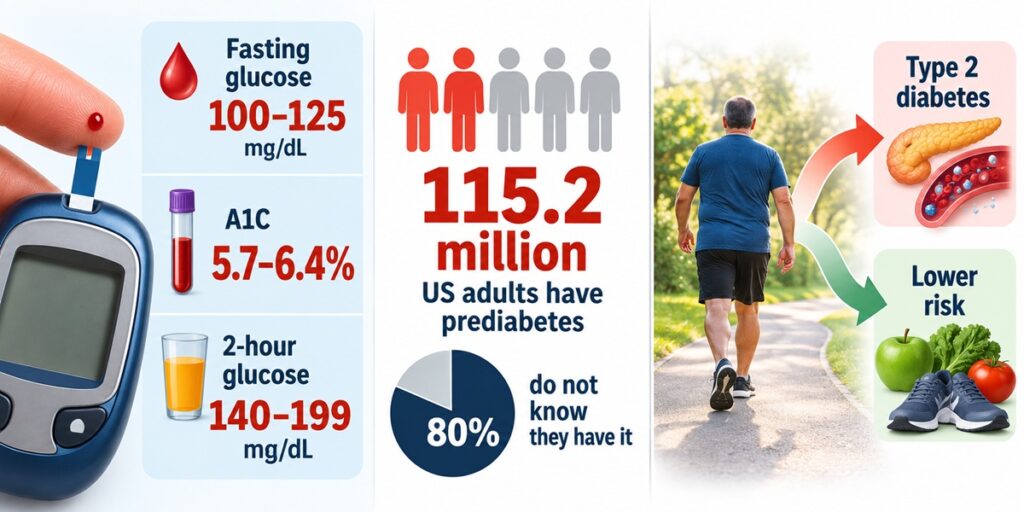
The same holds for prediabetes: no amount of contact, shared food, saliva or blood transmits it. In prediabetes, blood glucose is above normal but below the level used to diagnose type 2 diabetes.
In 2023, about 115.2 million US adults had prediabetes, more than two in five.
According to the CDC, about eight in ten people with prediabetes do not know they have it.
Any one of three results places a person in the prediabetes range:
- fasting glucose of 100 to 125 mg/dL
- A1C of 5.7% to 6.4%
- glucose of 140 to 199 mg/dL two hours into an oral glucose tolerance test
So a 34-year-old whose routine blood test shows a fasting glucose of 112 mg/dL has prediabetes, not type 2 diabetes. Diabetes starts at a fasting glucose of 126 mg/dL or higher, an A1C of 6.5% or higher, or 200 mg/dL or higher two hours into an oral glucose tolerance test. Without clear signs of high blood sugar, a doctor usually repeats an abnormal result to confirm it.
Whether type 2 diabetes can be delayed in people at this stage was tested in the Diabetes Prevention Program, a US trial published in 2002. It enrolled 3,234 adults with raised blood glucose and compared lifestyle change, the medicine metformin and a placebo over an average of 2.8 years.
The difference shrank after the trial ended and every group was offered lifestyle support. The lifestyle group still had 34% fewer new cases over 10 years and 27% fewer over 15 years.
Infections and laboratory studies linked to diabetes
Some infections are linked to a higher chance of diabetes in the person who has the infection. None of them shows diabetes passing from one person to another.
Hepatitis C spreads through blood and damages the liver. A 2008 review of 34 studies. People with hepatitis C had about 1.7 times the risk of diabetes compared with people without it, in both retrospective and prospective studies.
The same distinction applies to the liver itself: hepatitis viruses spread between people, but fatty liver disease linked to weight and blood sugar does not.
Several observational studies have reported an increased incidence of newly diagnosed diabetes after COVID-19, although this remains under study.
Among 181,280 US veterans still alive 30 days after COVID-19, the risk of new diabetes over the next 12 months was about 40% higher. The comparison was with over four million veterans without COVID-19, and the gap meant about 13 extra diagnoses per 1,000 people.
Headlines about ‘transmissible’ diabetes trace to a 2017 mouse study of islet amyloid polypeptide. This hormone is released along with insulin and can clump together in the pancreas. Researchers bred mice to make the human form of the protein, then injected pancreas material containing its clumps into their abdomens. The mice developed high blood glucose, poor glucose tolerance and loss of beta cells.
Scientists not involved in the work, speaking to Science magazine, were cautious. One said the spread between people remained to be determined. Another called the transmission idea “overstated”, since the disease was passed on by injecting pancreas material, which has no counterpart in everyday life.
Person-to-person spread was never part of what the study tested.
Infections that can spread through shared glucose meters and insulin pens
Shared diabetes equipment can spread bloodborne viruses, a real risk that has nothing to do with diabetes itself spreading. Hepatitis B has caused repeated outbreaks traced to shared fingerstick devices and glucose meters, most of them in long-term care homes where staff check residents’ glucose.
Between 1996 and 2011, CDC received reports of 29 hepatitis B outbreaks in US long-term care. Of these, 25 involved adults with diabetes whose glucose checks were done by staff. A 2005 report described three of these outbreaks and noted that single-person use of fingerstick devices had been advised since 1990.
Between 2008 and 2019, 15 outbreaks in long-term care were linked to staff-assisted glucose checks. In a 2024 North Carolina case, a nursing home resident caught hepatitis B from another resident after both had glucose checks with shared meters less than a minute apart.
CDC’s infection control guidance for care settings sets three rules:
- a fingerstick device is never used for more than one person
- glucose meters are not shared, and where sharing cannot be avoided in a care setting, the meter must be one designed for professional use
- insulin pens, cartridges and syringes are used for one person only
Unsafe sharing of these devices can spread hepatitis B, hepatitis C and human immunodeficiency virus (HIV), which are communicable diseases carried in blood.
CDC’s page on diabetes and the immune system says people with diabetes can have more frequent respiratory infections, flu, pneumonia, urinary tract infections and skin infections. It adds that they may take longer to heal. This changes how well a person with diabetes fights off germs, but it says nothing about diabetes itself moving from one person to another.
Note: The information on this page is for educational purposes only and is not medical advice.
Sources
- Centers for Disease Control and Prevention: National Diabetes Statistics Report, Diabetes Basics, 2026; Diabetes and Your Heart, Your Immune System and Diabetes, Injection safety and infection control, 2024
- Morbidity and Mortality Weekly Report: hepatitis B outbreaks and glucose monitoring, 2005; hepatitis B and adults with diabetes, 2011; diabetes after COVID-19 in under-18s, 2022; hepatitis B case in North Carolina, 2025
- World Health Organization, Noncommunicable diseases fact sheet, 2025
- National Institute of Diabetes and Digestive and Kidney Diseases: Definition & Facts of NAFLD & NASH, 2021
- GLP-1 medicines: Ozempic label, Trulicity label, ADA Standards of Care, 2026; Tzang et al., 2025
- Diabetes Prevention Program: Knowler et al., 2002; 10-year follow-up, 2009; 15-year follow-up, 2015
- Type 1 diabetes: Isaacs et al., 2023; Vehik et al., 2019; Harjutsalo et al., 2006
- Couples and families: Kowall and Rathmann, 2025; Appiah et al., 2019; Schmittdiel et al., 2018; Cunningham et al., 2017; Leong et al., 2014; Meigs et al., 2000
- Infections and laboratory studies: Xie and Al-Aly, 2022; Zhang et al., 2022; Kalra and Kumar, 2019; Mukherjee et al., 2017; Science news report, 2017; White et al., 2008