Tirzepatide may cause stomach and other side effects. Rates below come mainly from adult Zepbound weight trials. Your experience may differ. Talk with your prescriber about symptoms that concern you.
What are you feeling?
Call a doctor right away if you have:
- severe stomach pain that will not go away, sometimes felt in the back
- swelling of the face, lips, tongue, or throat, trouble breathing, or a severe rash
- nausea, vomiting, or diarrhea that will not stop, or being unable to keep fluids down
- upper stomach pain with fever or yellow skin or eyes
- a lump in the neck, trouble swallowing, or hoarseness that lasts
- thoughts of harming yourself (call or text 988)
Common side effects of tirzepatide
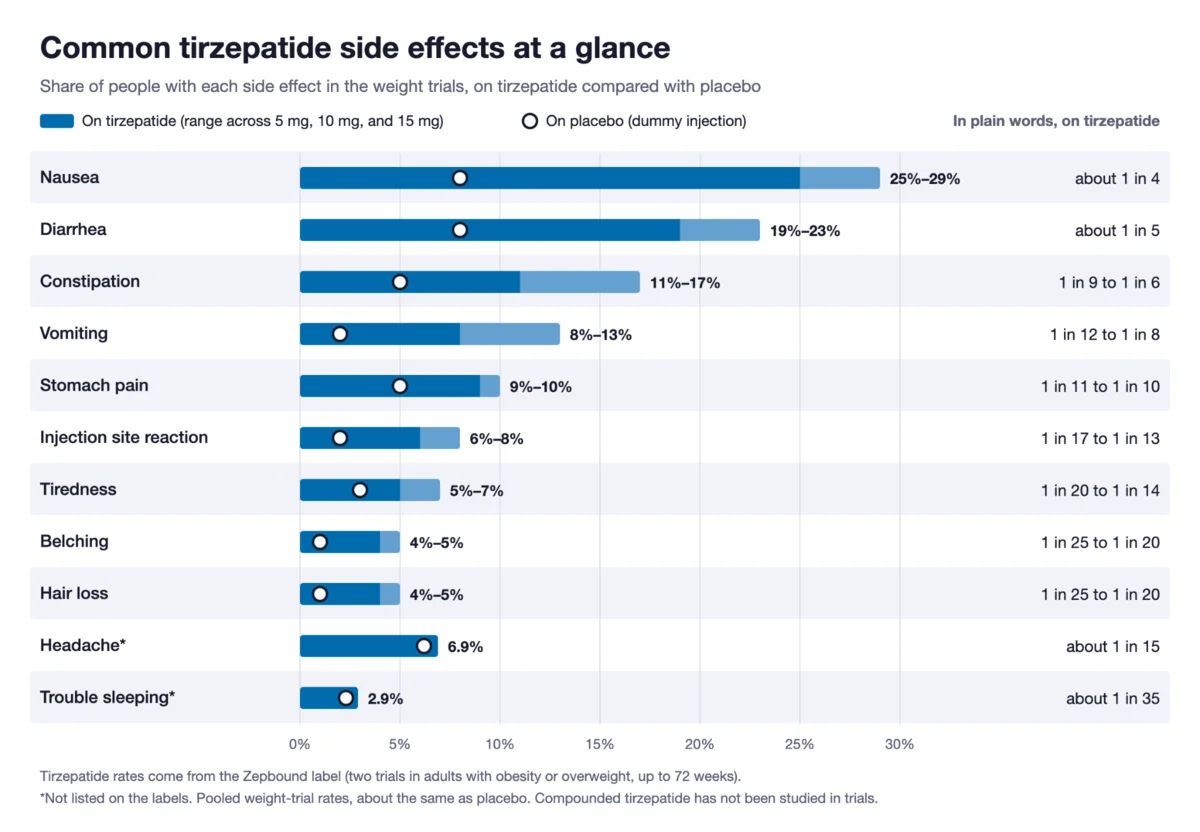
Nausea, diarrhea, and constipation are common with tirzepatide. The symptom rates in this article come from adult Zepbound weight-loss trials using 5 to 15 mg for up to 72 weeks. These rates may not apply to every person who takes tirzepatide.
Nausea
Nausea is the most common reported side effect and is usually mild to moderate.
How common is it?
About 25% to 29% of people in the weight trials reported nausea.
When does it happen?
Nausea often occurs when treatment starts or the dose increases. It often becomes less common over time. The length of an episode varies.
What helps?
Ask your prescriber before the next dose increase if you still feel sick.
- Eat small meals and stop when you feel full.
- Try bland foods and avoid greasy foods.
- Take small sips of water and keep a bottle nearby.
- Ask your provider whether nausea medicine may help.
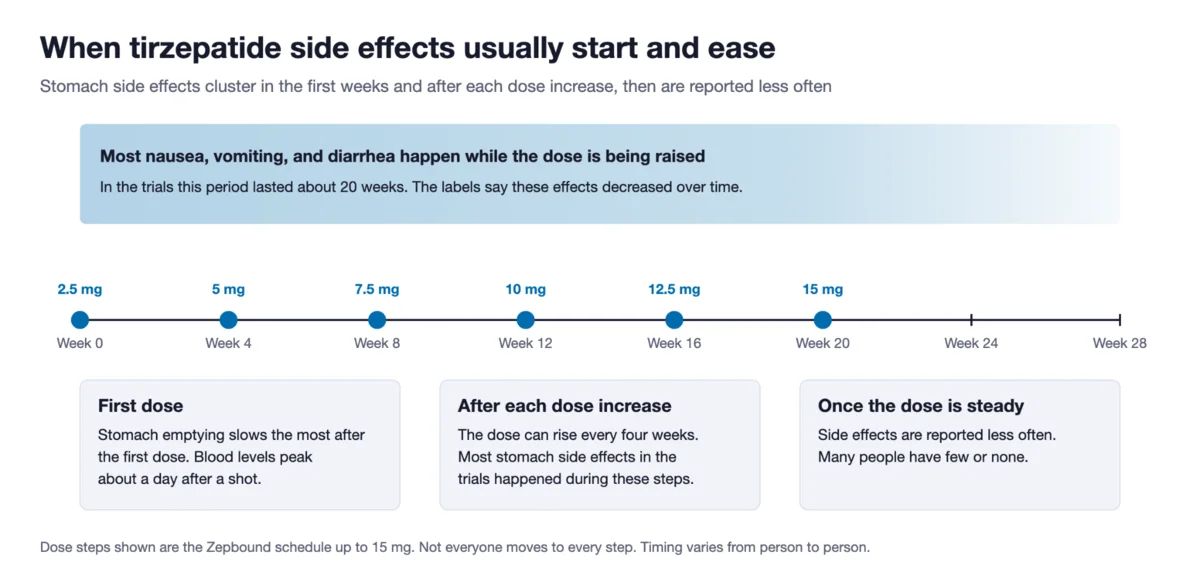
The usual schedule describes an increase from 2.5 mg weekly to 5 mg after four weeks. Later increases are guided by the prescriber and are at least four weeks apart. The 2.5 mg dose is not an approved long-term dose. Ask your prescriber before increasing the dose if you are still nauseated. A provider may consider slower increases or a lower dose when appropriate. Do not change or skip doses yourself.
When to get medical help
Get urgent medical advice if nausea will not stop or you cannot keep fluids down.
“It took me a year to get rid of the nausea I’d have on day 2-3. But it’s so much improved I’m so glad I hung in there.”
— a tirzepatide user
Diarrhea
Diarrhea is common with tirzepatide.
How common is it?
About 19% to 23% reported diarrhea.
When does it happen?
It often occurs when treatment starts or the dose increases and often becomes less common over time. Episode length varies.
What helps?
Focus on fluids. Take small sips often. Avoid large or high-fat meals. Fluids help lower the risk of dehydration, which can injure the kidneys.
When to get medical help
Contact a provider urgently if diarrhea persists or fluids will not stay down.
Constipation
Constipation is common with tirzepatide.
How common is it?
About 11% to 17% reported constipation.
When does it happen?
The labels do not state when it starts.
What helps?
Increase fluids and fiber slowly. Add fiber-rich foods a little at a time. Gentle movement may also help.
When to get medical help
Severe pain, vomiting, or being unable to pass gas needs urgent medical care. After approval, product labels also reported fecal impaction, which means hard stool stuck in the bowel, and bowel obstruction, which means a blockage in the bowel.
Vomiting
Vomiting can occur with tirzepatide.
How common is it?
About 8% to 13% reported vomiting.
When does it happen?
It often occurs when treatment starts or the dose increases and often becomes less common over time. Episode length varies.
What helps?
Protect against dehydration. Take small sips of fluid if you can. Ask your provider what to do if vomiting returns.
When to get medical help
Get urgent medical advice if vomiting persists or fluids will not stay down.
Stomach pain
Stomach pain was reported in the weight trials.
How common is it?
About 9% to 10% reported stomach pain.
When does it happen?
The labels do not give a clear timing pattern.
What helps?
Use small meals only for mild discomfort. Do not try to hide or treat severe pain as a routine side effect.
When to get medical help
Persistent or severe pain, or pain that reaches the back, needs prompt evaluation.
Headache
Headache is not listed in either label’s table of common side effects. Both medication guides list it as a possible sign of low blood sugar.
How common is it?
In the weight trials, headache occurred in 6.9% on tirzepatide and 6.2% on placebo. The close rates do not prove tirzepatide caused the headaches.
When does it happen?
The labels and trial reports do not give a timing for this effect.
What helps?
Ask your provider to check the cause if headaches continue. No label, trial report, or guidance names a specific treatment.
When to get medical help
Headache with other signs of low blood sugar needs medical advice, especially when using insulin or a sulfonylurea, which is a type of diabetes pill.
Tiredness
Fatigue was reported in Zepbound weight-management trials.
How common is it?
About 5% to 7% reported tiredness.
When does it happen?
The labels do not state when it starts.
What helps?
Make sure you are eating and drinking enough. Small, frequent meals and reminders to eat may help when appetite is low. See Side effect or low nutrients?
When to get medical help
Ask a provider about extreme or persistent tiredness, dehydration, low blood sugar, or possible nutrient problems.
Sulfur burps
The labels list belching, but they do not mention a sulfur smell.
How common is it?
About 4% to 5% reported belching.
When does it happen?
The labels do not state when it starts.
What helps?
Try smaller meals eaten slowly. Stay upright after meals and avoid fizzy drinks and alcohol. Evidence for sulfur-smelling burps is limited.
When to get medical help
Ask a provider about lasting burping or burping with severe stomach pain.
Trouble sleeping
Insomnia is not listed as a side effect on either label.
How common is it?
It occurred in 2.9% on tirzepatide and 2.3% on placebo. The close rates do not prove tirzepatide caused it.
When does it happen?
No trial report says when it starts.
What helps?
Ask your provider if sleep problems continue. No label or trial report names a specific remedy.
When to get medical help
A prescriber can consider referral to a sleep specialist for lasting trouble sleeping.
“Also I had some weird insomnia on injection days but that went away a lot faster.”
— a tirzepatide user
Hair loss
Hair loss may be linked to weight reduction, especially rapid weight loss. A direct medicine effect has not been ruled out.
How common is it?
About 4% to 5% reported hair loss. The rate was 7.1% in women and 0.5% in men.
When does it happen?
Temporary shedding may begin several months after major or rapid weight loss. Recovery varies.
What helps?
Keep eating enough food and protein. Ask about nutrition if shedding is heavy. Other causes, including nutrient deficiencies and thyroid problems, may need evaluation.
When to get medical help
Ask your prescriber about persistent or substantial hair loss.
Injection site reactions
Reactions may include bruising, redness, itching, pain, or rash.
How common is it?
About 6% to 8% reported an injection site reaction.
When does it happen?
The available trial information does not establish when reactions occur.
What helps?
Change the injection spot each week. Do not inject into bruised, sore, or hard skin. Follow your individual device instructions.
When to get medical help
Get emergency help for widespread swelling or trouble breathing. Contact a provider for spreading redness, warmth, or fever.
Rates in the studies
These rates are from Zepbound adult weight trials using 5 to 15 mg for up to 72 weeks. A placebo is an injection with no active drug. Rates vary across trials and brands.
| Side effect | On tirzepatide (5 mg to 15 mg) | On placebo |
|---|---|---|
| Nausea | 25% to 29% | 8% |
| Diarrhea | 19% to 23% | 8% |
| Constipation | 11% to 17% | 5% |
| Vomiting | 8% to 13% | 2% |
| Stomach pain | 9% to 10% | 5% |
| Injection site reaction | 6% to 8% | 2% |
| Tiredness | 5% to 7% | 3% |
| Belching | 4% to 5% | 1% |
| Hair loss | 4% to 5% | 1% |
| Headache | 6.9% (not on the labels) | 6.2% |
| Trouble sleeping | 2.9% (not on the labels) | 2.3% |
When side effects start and how long they last
Many stomach side effects start in the first months or during dose increases. Nausea, vomiting, and diarrhea often become less common over time. The length of one episode varies.
After the first dose
Tirzepatide slows stomach emptying most after the first dose, and this effect lessens with later doses. Blood levels peak about 24 hours after injection. The labels do not say when side effects begin.
After a dose increase
Prescriber-directed increases are at least four weeks apart. In trials, nausea, vomiting, and diarrhea occurred most often while doses were rising.
How long side effects last
No label or main trial analysis reports how long one episode lasts.
What people say
Four tirzepatide users, two of them taking compounded tirzepatide, describe their side effects in their own words.
“Four shots in… I feel amazing… my eating cleaned up drastically, my mood is better, my energy is better.”
— a tirzepatide user
“Interestingly, I’ve had fewer side effects on 7.5 mg than I did the whole three months on 5 mg.”
— a tirzepatide user
“I take #4 tomorrow but it has been uneventful for me in terms of side effects. I feel fantastic…”
— a compounded tirzepatide user
“I didn’t and still don’t have any serious side effects. At week 7, I am now starting to struggle a bit with constipation…”
— a compounded tirzepatide user
Personal experiences. Results and side effects vary.
Side effect or low nutrients?
Unusual tiredness and heavy hair loss may be side effects or signs that you are eating much less. Make adequate food and protein a priority. A provider can assess your diet and consider checking nutrient levels when symptoms persist.
Vitamin D, calcium, and vitamin B12 may be low when food intake is limited.
Rates for compounded versions are unknown. Added B12 has not been proven to prevent tirzepatide side effects. Strength can vary, so confirm the dose with your pharmacist or provider. See the sources for more information.
Serious risks and long-term side effects
Tirzepatide has a boxed warning, the strongest warning on a drug label, about thyroid C-cell tumors. Tirzepatide caused these tumors in rats. It is not known whether it causes them in people.
People with a personal or family history of medullary thyroid carcinoma (MTC), a type of thyroid cancer, or multiple endocrine neoplasia syndrome type 2 (MEN 2), an inherited condition that can cause certain tumors, should not take tirzepatide.
One analysis of 48 placebo-controlled trials found no clear increase in thyroid cancer. However, the trials were short and were not designed to study cancer, so they cannot settle the long-term risk.
Other label warnings include:
- pancreatitis, an inflammation of the pancreas
- gallstones and gallbladder inflammation
- sudden kidney injury, often after dehydration
- allergic reactions, including severe reactions reported after approval
- low blood sugar, mainly with insulin or a sulfonylurea, which is a type of diabetes pill
Tirzepatide delays stomach emptying and can cause severe stomach and bowel reactions. It is not recommended for people with severe gastroparesis, which means the stomach empties very slowly.
Rare reports describe food or liquid entering the lungs during anesthesia or deep sedation. Tell your care team before a procedure.
Birth control pills may work less well. Both labels advise using birth control that is not taken by mouth or adding a barrier method, such as condoms, for four weeks after starting and after each dose increase. Zepbound should be stopped if pregnancy is confirmed, and patients should contact their provider.
In people with type 2 diabetes, diabetic retinopathy, damage to the blood vessels in the eye, may worsen for a time when blood sugar improves quickly.
A three-year trial found no new safety concerns. A four-year trial in about 13,300 adults with type 2 diabetes found more stomach and bowel effects with tirzepatide than with another diabetes medicine.
In a body-scan study, lean mass, which includes muscle and other nonfat body tissue, made up about one-quarter of the weight lost. This was the same share as with placebo. People who switched to placebo after 36 weeks on tirzepatide regained an average of 14% of their body weight over the next year. Effects beyond about four years are not known.
Using Zepbound or Mounjaro?
Zepbound and Mounjaro both contain tirzepatide. Most rates above come from Zepbound weight trials. Mounjaro trials involved adults with type 2 diabetes and should not be compared directly. Lilly’s Zepbound side effects page lists common effects in plain words.
Frequently asked questions
How long do tirzepatide side effects last?
Nausea, vomiting, and diarrhea happen most often during dose increases and often become less frequent over time. The duration varies: symptoms may end earlier or continue after the dose is increased.
Do side effects get worse when the dose goes up?
Side effects can worsen when the dose goes up. In the trials, a dose could be skipped or lowered one step when side effects were hard to tolerate. Only a prescriber should make dose changes.
Can tirzepatide cause anxiety or mood changes?
Tirzepatide has not been shown to cause anxiety or mood changes. Neither current label lists depression or suicidal thoughts as side effects. Zepbound’s warning about suicidal thoughts was removed in February 2026 at the FDA’s request.
In weight trials of adults without major psychiatric illness, depression scores were no worse than on placebo, and anxiety symptoms affected 1.5% compared with 3.5%. Anyone with thoughts of self-harm can call or text 988.
This page summarizes group-level label and trial data. It does not tell any individual what dose, diet, or medicine to use.
Sources
- Labels and label changes: Zepbound label, 2026; Mounjaro label, 2026; FDA Zepbound approval letter, NDA 217806/S-042, 2026
- Reddit side effect analysis: Sehgal et al., Nat Health, 2026; Penn Engineering news release, 2026
- Managing side effects and nutrition: Mozaffarian et al., Obes Pillars, 2025; Gorgojo-Martínez et al., J Clin Med, 2022
- Crisis support: 988 Suicide and Crisis Lifeline
- Trial side effects and timing: Rubino et al., Diabetes Obes Metab (SURMOUNT-1 to -4), 2025; Wadden et al., Obesity (SURMOUNT), 2026
- Personal experiences: r/Mounjaro, Reddit, 2026; r/compoundedtirzepatide, Reddit, 2026
- Hair shedding: AAD Hair shedding
- Compounded tirzepatide and added ingredients: FDA Concerns with Unapproved GLP-1 Drugs Used for Weight Loss, 2026; McCall et al., Expert Opin Drug Saf, 2026; FDA Dosing Errors Associated with Compounded Products, 2024; Belcourt et al., Ann Pharmacother, 2026; Cyanocobalamin Injection label, 2026; Mayo Clinic Vitamin B-6
- Thyroid cancer and long-term safety: Ko et al., Ann Intern Med, 2026; Jastreboff et al., NEJM (SURMOUNT-1), 2025; Nicholls et al., NEJM (SURPASS-CVOT), 2025; Look et al., Diabetes Obes Metab, 2025
- Brand information: Lilly Zepbound side effects, 2026