Yes, tirzepatide (Mounjaro, Zepbound) is the active ingredient in both Zepbound and Mounjaro, two brand-name injections from Eli Lilly. Records from the Food and Drug Administration (FDA) list two Eli Lilly applications, one for each brand, and no approved generic as of October 2026. Unbranded tirzepatide sold without either brand name is usually a compounded product, and compounded products are not FDA approved.
Mounjaro is approved for type 2 diabetes care, while Zepbound is approved for weight management and for breathing interruptions during sleep in adults with obesity. The two brands differ in approved uses and label terms, not in the active ingredient.
How tirzepatide, Zepbound, and Mounjaro are related
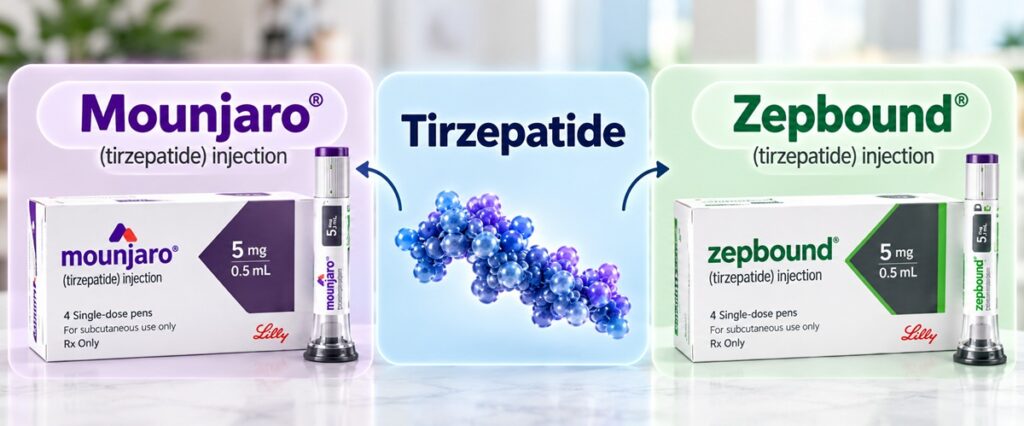
Eli Lilly holds two FDA applications for the same active ingredient, one sold as Mounjaro and one sold as Zepbound. Both labels show tirzepatide as the established name with the brand name beside it. Both list the same maker, the same six strengths, and the same four presentations.
Single-dose pens and single-dose vials deliver 2.5 to 15 mg in 0.5 mL, while multi-dose vials and single-patient-use KwikPens deliver four 0.6 mL doses. Both labels list the same inactive ingredients.
What is the generic name for Zepbound?
The generic name for Zepbound is tirzepatide, which is the official non-brand name printed on the label, not a generic product anyone can buy. FDA records as of October 2026 list only Eli Lilly’s injections, with no application for a generic and no approved oral form. The FDA’s statement on unapproved weight-loss products adds that compounded drugs are not FDA approved, so a compounded product is not a generic either.
A generic medicine needs its own FDA approval, which can come once applicable patents and exclusivities expire. The Orange Book entry for Mounjaro and the Orange Book entry for Zepbound both list patent 9474780 on the active ingredient itself, expiring May 13, 2036.
Both entries also list five-year exclusivity for a new active ingredient, ending May 13, 2027. The Orange Book cautions that a patent listing does not define the full scope of claims that may be asserted, so listings alone do not set a generic launch date.
Is tirzepatide the same as Wegovy or Ozempic?
No, tirzepatide is not the same as Wegovy or Ozempic because those two brands contain semaglutide as the active ingredient. Tirzepatide acts on glucose-dependent insulinotropic polypeptide (GIP) and glucagon-like peptide-1 (GLP-1) receptors, while semaglutide acts on GLP-1 receptors alone.
Ozempic injection appears with Mounjaro among the type 2 diabetes medicines that act on GLP-1 receptors, while Wegovy is the weight-management brand of semaglutide.
Is tirzepatide the same as Mounjaro?
Yes, tirzepatide is the same active ingredient as Mounjaro, which is the brand name Eli Lilly uses for tirzepatide in type 2 diabetes care.
The sharpest split between the two labels is in approved population and use. Mounjaro covers children 10 years of age and older with type 2 diabetes, while Zepbound covers adults only, for weight and for sleep apnea.
| Label point | Mounjaro | Zepbound |
|---|---|---|
| Approved uses | Blood sugar control in type 2 diabetes; lower risk of heart attack, stroke, or heart-related death in adults with type 2 diabetes at high risk | Weight reduction and keeping it off in adults with obesity, or overweight with a weight-related condition; moderate to severe OSA in adults with obesity |
| Ages | Adults and children 10 years of age and older with type 2 diabetes | Adults only |
| 2.5 mg dose | May continue for blood sugar control | Starting dose only, not a maintenance dose |
| Use with other tirzepatide or GLP-1 medicines | No statement on the label | Not recommended |
| Pregnancy | Use only if the benefit justifies the risk to the fetus | Stop when pregnancy is recognized |
| Retinopathy warning covers | People with a history of diabetic retinopathy | People with type 2 diabetes |
| Suicidal behavior warning | Not on the label | Removed in February 2026 |
| Trials in the label | SURPASS program | SURMOUNT program and SURMOUNT-OSA |
Rows compare label wording only; both brands contain the same active ingredient in the same strengths.
Mounjaro’s approved uses center on type 2 diabetes, from blood sugar control in adults and children 10 years of age and older to heart risk reduction in high-risk adults.
Zepbound’s approved uses center on weight reduction with diet and activity and on moderate to severe obstructive sleep apnea (OSA) in adults with obesity. Mounjaro has no weight-management approval on its label, although the label does not address off-label prescribing.
What the Mounjaro and Zepbound trials tested
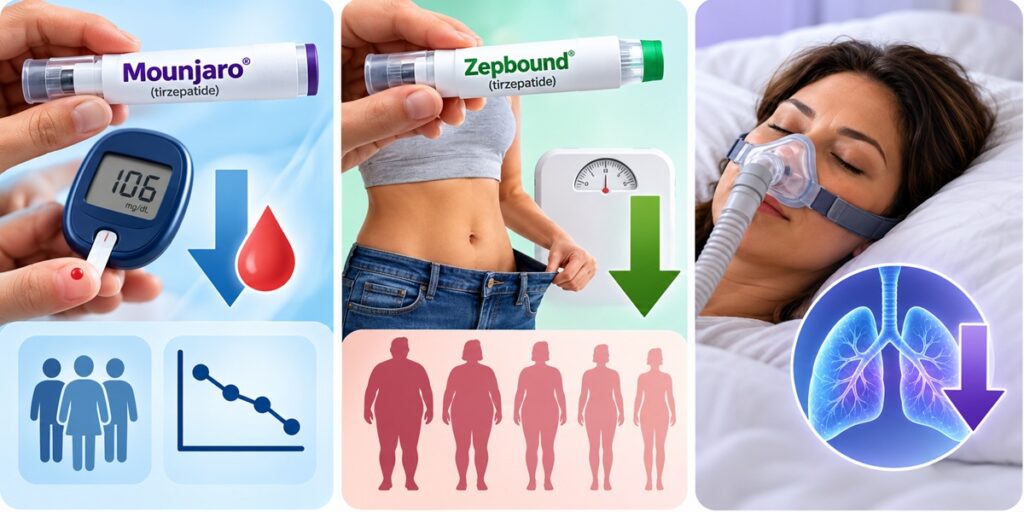
All tirzepatide efficacy trials were funded by Eli Lilly, and each brand label reports the program that enrolled its approved population. The Mounjaro program was SURPASS in adults with type 2 diabetes, while the Zepbound program was SURMOUNT in weight management and SURMOUNT-OSA in sleep apnea. No trial compared one brand with the other brand because both contain the same active ingredient in the same formulation.
SURPASS 1 through SURPASS 5 tested tirzepatide over 40 to 52 weeks in adults with type 2 diabetes, with hemoglobin A1C change as a central measure. Reductions ranged from 1.7 to 2.4 points across doses and comparators over those periods, with placebo, semaglutide 1 mg, insulin degludec, and insulin glargine as comparators. Weight change in those diabetes trials was lower than in the weight-management program.
The SURPASS-CVOT trial compared tirzepatide with dulaglutide 1.5 mg over a median of about four years in 13,299 adults who had type 2 diabetes along with artery disease. Heart attack, stroke, or heart-related death occurred in 12.2% with tirzepatide and 13.1% with dulaglutide. The result showed tirzepatide was no worse than dulaglutide but did not show it was better.
The SURMOUNT-1 trial enrolled 2,539 adults with obesity or overweight plus a weight-related condition without diabetes and followed weight change over 72 weeks. Average change was minus 15.0%, minus 19.5%, and minus 20.9% with 5, 10, and 15 mg, compared with minus 3.1% with placebo.
The SURMOUNT-2 trial enrolled 938 adults with overweight or obesity and type 2 diabetes over 72 weeks. Average change was minus 12.8% with 10 mg and minus 14.7% with 15 mg, compared with minus 3.2% with placebo.
On the same 15 mg dose, average weight change was minus 20.9% in people without diabetes and minus 14.7% in people with type 2 diabetes. Those two figures come from separate trials with different populations, not from a direct comparison within one trial.
The SURMOUNT-OSA trial enrolled 469 adults with moderate to severe obstructive sleep apnea and obesity without diabetes over 52 weeks. Breathing interruptions fell by about 25 to 29 events per hour with tirzepatide, compared with about five with placebo.
Zepbound and compounded tirzepatide
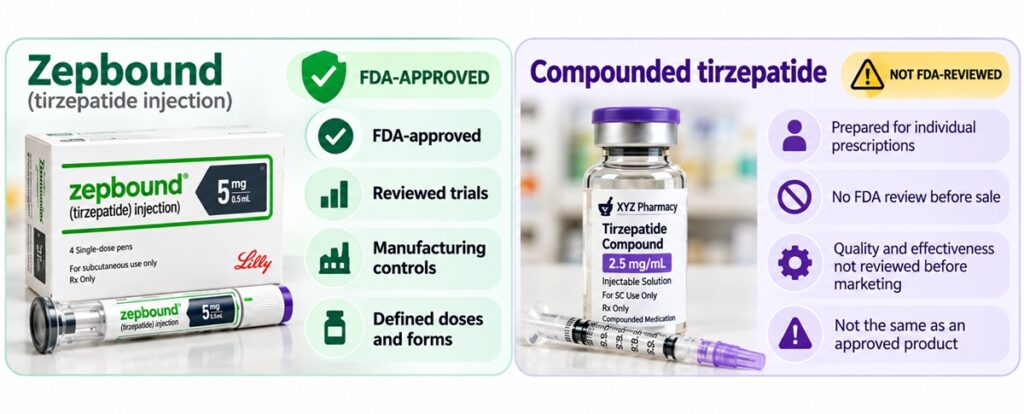
Compounded tirzepatide and Zepbound differ in FDA review even when both claim tirzepatide as the active ingredient. Zepbound has an approved label based on reviewed trials, manufacturing controls, and defined doses and forms. Compounded products are prepared for individual prescriptions without FDA review of safety, effectiveness, or quality before sale.
Compounding grew while tirzepatide was on the FDA shortage list, which the FDA first listed in December 2022. The FDA then determined the shortage resolved in October 2024 and restated that finding in December 2024. FDA policy on compounding as GLP-1 supply stabilized then ended its temporary allowances in February 2025 for pharmacies and in March 2025 for outsourcing facilities (large-scale compounders).
Pharmacies that compound for individual prescriptions may still compound when a prescription exists for an identified patient. The product must not be regularly produced as a copy that is essentially the same as the approved product. A prescriber determination of a significant difference for that patient, documented for that patient, is part of that test.
Outsourcing facilities face a separate rule. They may compound from bulk ingredient powder only when the drug is on the FDA’s clinical-need list for bulk ingredients or in active shortage, and tirzepatide meets neither condition. In April 2026 FDA proposed, in a Federal Register notice, to exclude tirzepatide, semaglutide, and liraglutide from that list.
The FDA said it found no clinical need for outsourcing facilities to compound those three drugs from bulk. Comments closed in June 2026, and no final determination had been published by October 2026.
Reports to the FDA as of May 31, 2026, numbered more than 730 adverse events with compounded tirzepatide and 990 with compounded semaglutide. Underreporting is likely because pharmacies compounding under individual prescriptions need not report.
Claims that compounded tirzepatide matches Zepbound
Claims that compounded tirzepatide matches Zepbound rest on marketing language rather than FDA review. In September 2025, FDA warning letters to online sellers called claims of the same active ingredient as Mounjaro and Zepbound false or misleading. The FDA said compounded products are not approved, so those claims implied a sameness that had not been established.
The FDA also lists claims that a compounded drug is the same as an approved drug among its warning signs for unapproved GLP-1 products. Its other signs include fraudulent pharmacy labels and products sold for research use with dosing instructions. No trial has tested a compounded tirzepatide product, so no published evidence compares results on Zepbound with results on compounded tirzepatide.
Research-use and counterfeit tirzepatide
Research-use and counterfeit tirzepatide are separate from pharmacy compounding for a named patient. The FDA has warned sellers that products labeled for research purposes or not for human consumption are unapproved drugs when sold directly to consumers with dosing instructions for human use. Some products named a licensed pharmacy that did not make the product, and some named pharmacies did not exist.
The FDA also reported fraudulent compounded semaglutide and tirzepatide in the United States. The FDA’s concerns page reports doses above label limits for both medicines, while its dosing-error warning names semaglutide only.
What compounded products contain
About half of advertised compounded products in a 2026 review combined the drug with vitamins or other additives rather than matching the approved formulation. The review covered 33 compounded semaglutide or tirzepatide products advertised online from February to March 2025. The added ingredients were vitamin B12 (cyanocobalamin), glycine, niacinamide, docusate, or the anti-nausea medicine ondansetron.
Single-ingredient products in that sample were tablets placed under the tongue or tablets that dissolve in the mouth, neither an approved tirzepatide form. A 2026 secret-shopper study visited 75 weight-loss clinics and medical spas in two states from August to October 2025. Among those clinics, 56.0% offered products combined with B vitamins and 9.3% offered oral forms.
Of 21 named compounding suppliers in the clinic study, 19.0% lacked a license for sterile compounding. Both studies pooled semaglutide and tirzepatide, so results do not describe tirzepatide alone. To check a pharmacy’s license and FDA record before an order, see our compounding pharmacy checklist.
Is tirzepatide cheaper than Zepbound?
Compounded tirzepatide is cheaper than brand tirzepatide (Zepbound), with the biggest gap at higher doses. Each clinic sets its own price for compounded tirzepatide. The price of tirzepatide can range from $280 to $400 for one month without a long commitment. For current plan prices by dose, see cheapest tirzepatide online.
Prepaid plans and first-month offers can start at under $150. Lilly’s self-pay prices are $299 to $699 per 28 days for Zepbound KwikPen or four single-dose vials, depending on dose and refill timing. Mounjaro single-dose pens cost $499 a month at every strength.
Switching from compounded tirzepatide to Zepbound
Whether people can switch from tirzepatide to Zepbound is a question labels answer with starting rules rather than with a conversion table. Both Mounjaro and Zepbound labels start every indication at 2.5 mg once weekly for four weeks and give no dose conversion from another tirzepatide product. Zepbound also states that use with other tirzepatide products or any GLP-1 receptor agonist is not recommended, while Mounjaro carries no equivalent statement.
A change in presentation needs training on the new Instructions for Use under both labels, including moves between pens, single-dose vials, multi-dose vials, and KwikPens. Compounded tirzepatide doses may be written in units or mL that change meaning with vial strength, while Lilly products state mg in fixed volumes.
Note: This page gives general information, not medical advice.
Sources
- US prescribing labels on DailyMed: Mounjaro and Zepbound, 2026
- FDA Orange Book: Mounjaro and Zepbound patent and exclusivity listings, 2026
- FDA on compounding: policy as GLP-1 supply stabilized and concerns with unapproved GLP-1 drugs, 2026; Federal Register notice on the 503B bulks list, 2026
- Weight and sleep apnea trials: SURMOUNT-1, 2022; SURMOUNT-2, 2023; SURMOUNT-OSA, 2024
- Type 2 diabetes trials: SURPASS 1 to 5 as reported in the Mounjaro label, 2026; SURPASS-CVOT, 2025
- Compounded products on the market: Belcourt et al., 2026; DiStefano et al., 2026