Figures published c. 2005 by the World Bank. The Millennium Development Goals program concluded in 2015; this site is preserved as a historical record.
Maps Maps listed here provide geographical representations of the country status measured in terms of MDG and related indicators. Each map can be saved and printed by right clicking the map.
Official development assistance and net official aid
record the actual international transfer by the donor of financial resources or of goods or services valued at the cost to the donor, less any repayments of loan principal during the same period. Grants by official agencies of the members of the Development Assistance Committee are included, as are loans with a grant element of at least 25 percent, and technical cooperation and assistance. Aid per capita includes both ODA and official aid, and is calculated by dividing total aid by the midyear population estimate.
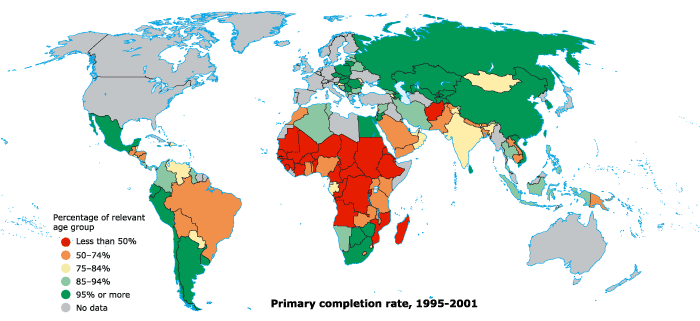
Primary School Completion is the number of students successfully completing the last year of (or graduating from) primary school in a given year, divided by the number of children of official graduation age in the population.
Child Mortality (Under-5 mortality rate) is the probability that a newborn baby will die before reaching age five, if subject to current age-specific mortality rates. The probability is expressed as a rate per 1,000.
Total fertility rate represents the number of children that would be born to a woman if she were to live to the end of her childbearing years and bear children in accordance with prevailing age-specific fertility rates.
Ratio of girls to boys in primary and secondary education is the percentage of girls to boys enrolled at primary and secondary levels in public and private schools
Prevalence of HIV refers to the percentage of people aged 15-49 who are infected with HIV.
Carbon dioxide emissions are those stemming from the burning of fossil fuels and the manufacture of cement. They include contributions to the carbon dioxide produced during consumption of solid, liquid, and gas fuels and gas flaring.
Freshwater resources refer to total renewable resources, which include internal flows of rivers and groundwater from rainfall in the country, and river flows from other countries. Freshwater resources per capita are calculated using the World Bank’s population estimates.
Population below $1 a day is the percentage of the population living on less than $1.08 a day at 1993 international prices.
Population below $2 a day is the percentage of the population living on less than $2 a day at 1993 international prices.